
Drastic reduction in energy inequality needed to meet climate targets and ensure sustainable access to energy for all
Add us as your preferred source on Google to see more of our content in Search.
 Add to Preferred Sources
Energy inequality needs to be reduced eight-fold by 2050 to narrow the gap in energy consumption between the highest and lowest energy consumers worldwide. Moreover, to meet this goal, income inequality should be scaled down to the levels recorded 150 years ago. The authors of research published in Lancet Planetary Health admit that this task will be difficult but imperative in order to provide some 4 billion people with access to “decent living energy in a climate-safe future” while also allowing underprivileged communities to access more energy to improve their quality of life.
Energy consumption plays a crucial role in human well-being, yet energy use worldwide is plagued by massive inequality. Shockingly, the top 10% of global energy consumers use approximately 30 times more energy than the bottom 10%. To reduce this inequality while at the same time decreasing energy consumption so as to restrict air temperature rise to 1.5 degrees Celsius compared to pre-industrial levels, drastic measures need to be taken. Scientists have previously charted a course of action to reduce worldwide energy requirements by 40% by the year 2050, as a result of which the temperature increase would be restricted to 1.5 degrees Celsius. At the same time, they proposed that the average living standards be preserved in the Global North and improved in the Global South.
Following on from this, the authors of the research published in Lancet Planetary Health, Dr. Joel Millward-Hopkins and Dr. Yannick Oswald, explain that if global energy use is reduced to climate-safe levels by 2050 but the current energy consumption inequalities remain, then over 4 billion people in the Global South alone could lack access to decent living energy, with at least 100 million in the Global North suffering the same fate. Conversely, the research discovered that in order to narrow the disparity in energy consumption between the most and least energy-consuming countries around the world, energy inequality should be reduced by a factor of eight by the year 2050.
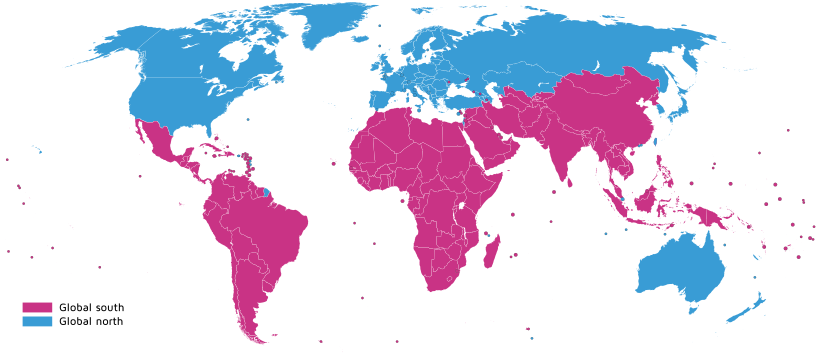
Fig.1.The blue section of the map represents the Global North, which mainly consists of countries located in the northern hemisphere, along with a few situated in the southern hemisphere. In contrast, the red parts denote the Global South, encompassing numerous nations in the southern hemisphere and some in the northern hemisphere.
Source: The Conversation
According to the study’s authors, shrinking the worldwide energy inequality gap represents a more complex obstacle as this involves the interdependence between energy inequality and income inequality. They suggest that in order to accomplish the essential extent of reduction in global energy inequality, it is imperative to reduce income inequality to the levels observed in European nations with strong welfare systems such as Norway. In other words, to ensure secure climatic conditions while upholding adequate living standards, the rate at which income inequality must decrease would surpass the rates witnessed during the “golden age of capitalism” following World War II. During this era (1950-1975), the proportion of income received by the highest-earning 1% in the US declined from 17% to 10% whereas, at present, the top 1% of households control a third of the nation’s wealth.
Dr. Millward-Hopkins, commenting on the outcomes of the report, said:
“I hope it will highlight how difficult it would be to reconcile the current economic system with providing decent living standards universally and avoiding ecological breakdown. Almost everyone agrees that poverty is unacceptable and that we should keep the planet habitable. Our argument is that this may require global inequality to reduce to levels that haven’t been seen for at least 150 years. The challenge for reducing inequality is of a similar magnitude to that of reducing carbon emissions.”
The authors of the research combined the current global and regional energy consumption inequalities with scenarios for low energy demand by 2050. By employing a threshold analysis, the researchers calculated the number of individuals who would be deprived of the essential energy needed to sustain their well-being in the event of a low energy demand pathway. This calculation was based on the assumption that the disparities in energy consumption would persist at their present level.