

Add us as your preferred source on Google to see more of our content in Search.
 Add to Preferred Sources
A growing population can place stress on the environment, transportation, and the provision of natural resources like water, food, and energy in situations when governments fail to think strategically or are late to implement adequate adaptive reforms.
The ineffective management of natural resources can result in their scarcity and environmental damage, both of which are detrimental to initiatives aimed at encouraging sustainable development.
At the same time, if appropriate policies are adopted, an increasing population can also spur economic expansion and result in a larger labor force which is advantageous for sustainable development. And yet it is crucial to ensure that environmental conservation and the safeguarding of natural resources go hand in hand with economic progress.
Population growth forecasts
On November 15, 2022, the global population reached a milestone of 8 billion people. However, according to experts, this number is expected to increase even further.
Based on data from the United Nations, the global population will continue to grow over the next five to six decades, reaching its peak of around 10.3 billion somewhere around the mid-2080s.
After that, the number of people in the world will start to decline. By 2100, forecasts show that there will be around 10.2 billion people on Earth.
Today, according to experts, one in four people resides in a country where the population has already reached its peak.
Why is the global population growing?
The global population has tripled in less than 80 years from about 2.5 billion in 1950 to over 8 billion today. Several key reasons could explain such considerable growth:
1. Declining mortality rates
The most powerful driver of population growth is, in fact, the low death rate. People live much longer nowadays and fewer are dying young.
If we analyze the data on mortality rates for people under the age of 5 (per 1,000 live births) from the World Bank, we can notice that the rate fell from 94 deaths per 1,000 births in 1960 to 37 in 2024.
Furthermore, thanks to vaccinations and improved sanitation, the incidence of infectious illnesses like smallpox, cholera, and typhoid that used to wipe out entire communities has significantly decreased.
Mortality rate, under-5 (per 1,000 live births)
Source: World Bank
2. High fertility in developing nations
Sub-Saharan Africa is the region that boasts the world’s fastest-growing population, with a total fertility rate (TFR) averaging around 4.3 children per woman as of 2024, compared to a global average of around 2.2, according to data from the World Bank. By 2050, this region alone is predicted to make up 22% of the world’s population, up from the current 14%.
Several reasons could explain this fact:
On the positive side, there has been a considerable decline in child mortality in the sub-Saharan Africa region, which is attributed to vaccination campaigns, an increasing number of insecticide-treated mosquito nets that people receive, and various nutritional programs. Ultimately, this has led to an increase in life expectancy at birth.
On the negative side, the region struggles with a high poverty rate, low education levels, various cultural norms, and limited freedom for women.
Total population in Sub-Saharan Africa from 1960 to 2024
Source: World Bank
3. Improved healthcare and food security
The Green Revolution in the 1960s and 1970s (which was based on fertilizer use, pesticides, and irrigation) led to a drastic increase in food production, and thus considerably reduced famine deaths.
In addition, more people gained access to antibiotics, vaccines, and maternal healthcare, which has contributed to an increase in global life expectancy from 50 years in 1960 to about 73 years today.
Since an increasing number of people today are surviving childhood and adulthood, the global population size grows as well.
4. Increased longevity
Despite the decreasing fertility rates in numerous developed countries, including Germany, Japan, Italy, and South Korea, their population does not show a drastic decline because people live there much longer. An aging but long-lived population keeps the total headcount high even when birth rates fall.
Fertility rates and life expectancy
Fertility rates around the world are going down – in 2024, there were 2.2 births per woman registered, according to the United Nations’ World Fertility report. By comparison, in 1990 this figure was 3.3, and back in the 1960s it was 5.
Still, even though such a dramatic decline in fertility has been witnessed around the globe, its timing is different for each nation and region.
Experts believe that the global fertility rate will continue declining, reaching 2.1 births per woman in 2050 and 1.8 births per woman in 2100.
As for life expectancy, this will continue to increase.
Furthermore, by 2080, there will be more people aged 65 or older than the number of children aged below 18, according to data from the United Nations.
Low- and lower-middle-income nations will be the primary driver of population growth.
With some of the highest birth rates worldwide and declining mortality, Africa has seen an almost tenfold growth in its population.
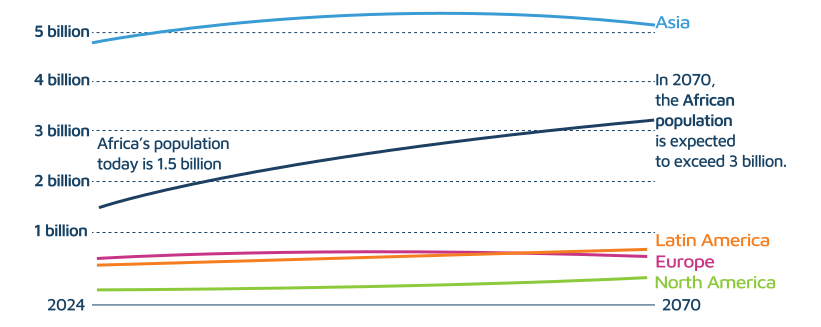
Population growth forecast across continents (2024-2070)
Source: Our World in Data
The number of people in sub-Saharan African countries is predicted to climb by 79%, reaching 2.2 billion by 2054.
Africa’s current population is around 1.5 billion, and by 2100, it is predicted this will rise to 3.3 billion people.
Currently, Nigeria is the continent’s most populous nation with 237,5 million residents and a fertility rate of 4.3 births per woman in 2025.
By the end of the century, it could surpass the USA, which currently has a population of over 340 million, based on World Bank data. By 2050, experts at UNFPA predict that Nigeria will be the world’s 3rd most populous country, reaching 400 million people.
The positive and negative effects of population growth on sustainable development
In a nutshell, global population growth can have both positive and negative effects. For instance, an expanding population can result in higher costs and potential obstacles to sustainable development but, at the same time, it can increase demand for goods and services which can boost economic growth.
Negative effects of population growth
A growing number of people means more emissions, but at the same time, it also means economic growth and more innovation potential.
Let’s check out some of the worst impacts that a growing population can bring, and then analyze the benefits of this trend.
1. Climate change
Increasing consumption (especially in high-income nations) and the results of this contribute to an increasing level of greenhouse gas emissions, which trigger the warming of the atmosphere and, in consequence, a changing climate.
2. Environmental degradation
More people require more food, which means an increase in agricultural output. With outdated technology in agriculture this means deforestation to ensure more agricultural land is available. Logging and infrastructure development impact biodiversity and lead to more CO2 emissions.
Loss of habitat threatens ecosystem services by increasing the pace of species extinction.
In addition, overfishing damages ecosystems and reduces the number of marine fauna and flora species.
Case study: India
In terms of high CO2 emissions, a good example is India, the world’s most populous country, hosting over 1.4 billion people.
Despite major investments in renewable energy, particularly solar power, the country relies heavily on coal to meet its growing electricity demand (pressured by its fast-growing population). In fact, coal accounts for more than 70% of India’s electricity generation, according to India’s Ministry of Coal, making it one of the largest sources of the country’s CO2 emissions.
3. Resource shortage
Water scarcity worsens as demand exceeds supply, which is particularly visible in areas that are vulnerable to drought and poor regions that have outdated or absent infrastructure.
Food shortages intensify amid increased demand, the effects of climate change, and unsustainable farming practices.
Case study: Cape Town, South Africa
When talking about water scarcity, it’s worth recalling the drinking water crisis in Cape Town, where a growing population, along with issues linked to climate change, led to a dramatic drought-induced municipal water failure.
Authorities were forced to carry out strict measures like shutting down public taps, setting up water management systems for high-volume customers, and lowering the water supply to homes.
4. Economic inequality and youth unemployment
Since a lot of low-income nations, especially in sub-Saharan Africa, register fast population growth, we are witnessing a disproportionately high share of young working-age people. For young people in sub-Saharan Africa, the biggest labor market obstacle continues to be the absence of decent and productive jobs, says the International Labor Organization (ILO).
More than one in five young people in the region is not in employment, education, or training. Moreover, a lot of them are working in low-productivity, informal, or unsafe jobs.
The Middle East and North Africa (MENA) is another region where youth unemployment rates are among the highest in the world, around 24%, outlines ILO.
Experts predict that in the case of strong population growth, there will be pressure on job creation in the above-mentioned regions. To solve the issue, economic productivity, skills development, and investment need to accelerate.
5. Increase in municipal solid waste
The amount of municipal solid waste is expected to register an increase of nearly 100% from 2.1 billion tons per year in 2025 to 3.8 billion tons by 2050.
6. Higher pressure on urban infrastructure
More people within an urban region that has poorly planned infrastructure will result in traffic jams, degraded land, as well as issues with water, sanitation, and housing systems.
7. Pressure on social services and healthcare
Population growth exceeds economic capacity in low-income nations, placing a burden on the social safety net, healthcare system, and educational system.
8. Increased conflict and political instability
The decreasing level of natural resources in various regions often leads to conflicts, in which parties are competing for freshwater, arable land, fisheries, and other resources. Take, for example, the Lake Chad basin.
Case study: Lake Chad basin and Mali
According to experts from North-West University, South Africa, changing climatic conditions and land use patterns led to considerable losses in water bodies and natural forage in this North-central Africa region. This, in turn, intensified rivalry over natural resources, leading to communal conflicts between pastoralists and farmers.
Central Mali also witnesses conflicts between farming and herding populations due to the decreasing arable land and unpredictable water supplies, says the United Nations.
The most fragile are nations and regions that house fast-growing populations. Governments face significant issues attempting to meet basic needs and keep social order.
9. Higher risk of pandemics
High population density combined with poor living conditions speeds up the spread of infectious diseases.
Since an increasing number of people move into previously undisturbed ecosystems (be it for agriculture, housing, or both), the chances of new pathogens entering human populations considerably increase.
A growing population, thus, raises the incidence of zoonotic spillover incidents (when animals transmit infections to humans), says the U.S. Centers for Disease Control and Prevention (CDC).
COVID-19 and Ebola, for instance, emerged or spread in part as a result of the destruction of natural barriers separating wildlife from human-populated areas.
10. Biodiversity loss
According to the WWF’s Living Planet Index, vertebrate populations have registered a dramatic average decline of 73% since 1970. The main reasons are rapid human population growth and the increase in land conversion and resource extraction linked to it.
Because natural habitats that species rely on have been either lost or deteriorated by deforestation, wetland drainage, overfishing, and urban growth, the current rate of species extinction is 1,000-10,000 times faster than the natural extinction rate.
In addition to the ecological crisis, this reduction in biodiversity directly jeopardizes pollination, soil fertility, and water purification that human food systems depend on.
Positive effects of population growth
1. Larger workforce
More people could fill the void in industries that require a qualified workforce. If this is coupled with investments in education, health, and decent jobs, this can spur economic expansion, innovation, productivity, and entrepreneurship.
2. Innovation and economic growth
A larger market means more potential inventors and researchers, who can work on solutions for sustainability challenges (e.g., renewable energy, sustainable farming). This, in turn, will stimulate innovation and contribute to economic growth.
Case study: The success story of Bangladesh
In poor Bangladesh of 1975, a high fertility rate was a real burden for families and the country. Through several social policies, the authorities managed to reduce the total fertility rate from 6.9 in 1975 to 2.2 in 2024, according to the World Bank.
To achieve such a remarkable result, the Bangladesh government:
Made demographics one of its major priorities – From day one, the very first Five-Year Plan in 1971, the government realized that high fertility was an economic problem as well as a health issue for mothers and their children. Health, education, and religious affairs ministries all had to answer for it.
Evaluated everything before launching on a national scale – In 1977, in a controlled experiment in the Matlab community (a religiously conservative area), health workers provided married women in the villages a variety of family planning options during routine home visits. As a result, families in the program got healthier and wealthier, and the model went national.
Maintained the commitment throughout all administrations – Different parties had the same mission. For nearly 50 years, every administration kept population policy in the national plan.
Sent experienced women and religious leaders to talk to women – Married, salaried female workers went house to house and carried out real conversations with other women. Meanwhile, the government imams were instructed to clarify to women that family planning is not forbidden in Islam.
3. Diversity
An increasing population may bring together people from various racial, ethnic, and cultural origins, fostering greater diversity and a greater exchange of opinions.
4. Domestic market growth
Growing populations can potentially boost local economies and attract investment by increasing the domestic demand for products and services.
5. Better urban planning with increased sustainability
If properly controlled, rapid urbanization can lead to decreased per-capita emissions and better transport systems.
6. Potential for healthy aging economies
Healthy aging programs can keep older people in the workforce, generating social and economic benefits as they live longer lives.
The impact of upper-middle-income and high-income countries on sustainable development
Upper-middle-income and high-income nations tend to have lower rates of population growth and an extremely high amount of per capita resource use, including energy, water, and raw materials. This may put a strain on the world’s limited resources and harm other nations’ efforts to achieve sustainable development.
A growing population results in rising emissions and, combined with the industrial revolution and modern consumption patterns, these three issues are at the heart of the massive levels of CO2 and methane emissions that are causing climate change.
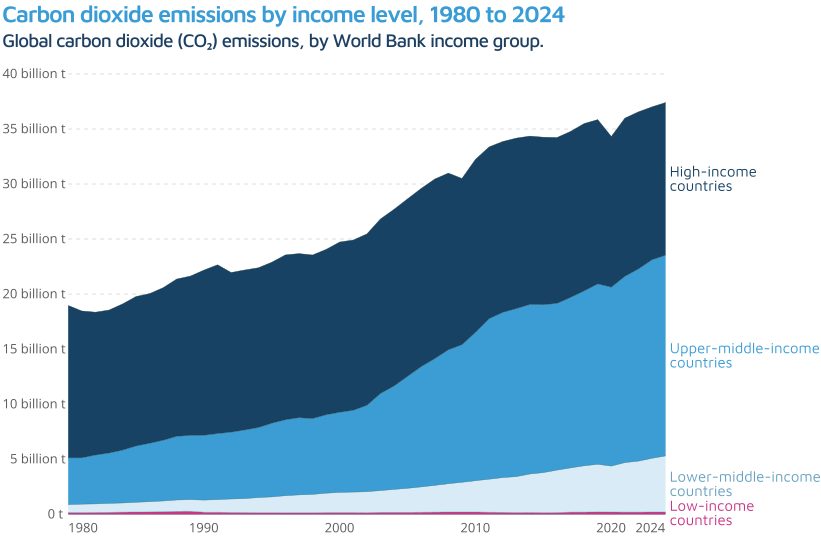
It is important to note, however, that the nations with most CO2 emissions at this point in time are not those with low average incomes and rapidly expanding populations, but rather those with high average incomes and populations that are currently growing gradually or not at all, or, to put this simply – wealthy nations.
CO2 emission by income level, 1980-2024 (in billion tons)
Source: Our World In Data
Since upper-middle-income and high-income nations rank among the major contributors to global warming, some low-income nations could face serious issues that are linked to sustainable development, and these countries are already at risk since most have limited adaptability and resilience to the effects of climate change.
Top 10 countries by CO2 emissions (2010 and 2024 comparison, million metric tons)
Source: Statista
Even though, as of 2024, China is currently the world’s biggest carbon dioxide polluter (having released 12.3 billion metric tons of CO2 in 2024), the United States (with 4.9 billion metric tons of CO2 in 2024) has historically emitted significantly more million metric tons of CO2 during its history (more than 400 GtCO₂ since 1750).
China’s emissions have primarily been generated over the last 20 years, which accounts for the large difference between the two nations. China and the United States together have emitted nearly 40% of all CO₂ emissions since the Industrial Revolution in the late 18th century.
That is the total amount of emissions, but what if these were estimated per capita?
Top 10 countries by carbon dioxide emissions per capita
Based on data from the World Bank, the number one nation in terms of CO2 emissions per capita is Palau. With a population of 17,695 (as of 2024), the country tops the list mostly due to its two diesel-fired power stations.
The high per capita numbers are also a result of the use of private vehicles, boats, and airplanes which enable Palau’s many small islands to be explored.
Top-10 nations by Carbon dioxide (CO2) emissions per capita (t CO2e/capita)
Source: World Bank
*The combustion of fossil fuels is the primary cause of carbon dioxide emissions. The data in this graph covers fossil CO2 emissions from transportation, power generation, and heating, but does not include CO2 emissions that are linked with changes in land use (i.e., deforestation, reforestation).
*The graph also does not take into account emissions from international aviation and shipping, since these are considered in the global total.
*This data focuses on territorial emissions, which are emissions generated inside a nation’s boundaries rather than emissions from imported commodities.
A growing population leads to increased demand for resources
One of the consequences of population expansion is the rise in food demand, which puts pressure on land, water, and energy. In addition, it leads to more chemical fertilizers and pesticides being used, which ultimately leads to soil deterioration.
In regions where people depend on subsistence farming (when farmers cultivate crops for their own consumption and that of their families), more land must be cleared for crops due to the lack or absence of irrigation, seed, and soil improvement. As a result, deforestation impacts biodiversity and soil health and affects the balance of carbon on the planet.
Population growth and its impact on agriculture can also lead to habitat loss and can have a negative effect on biodiversity. Sustainable agricultural techniques can help to preserve biodiversity by using less hazardous chemicals and fostering ecosystem-supporting methods.
As consumption patterns change, so do people’s diets. With a rise in average incomes, the change in the food that people eat has been shifting towards the consumption of more calories and a wider variety of resource-intensive foods (beef, dairy, poultry, pork, eggs).
Such changes have a detrimental effect on the environment, causing a rising level of greenhouse gas emissions, a loss of biodiversity, and contamination of the water and soil due to poor environmental mitigation.
If governments want to put an end to hunger and deal with the problem of food insecurity, they could consider devising a comprehensive strategy that prioritizes boosting agricultural output through a sustainable approach, rather than an intensive strategy, and reducing food loss and waste, as well as improving the infrastructure and supply chains of food systems.
A growing population puts pressure on healthcare
Without a doubt, an increasing population puts pressure on healthcare and social care services, and several reasons back this claim:
- Overcrowding in healthcare facilities can result in longer queues, delayed care, and a shortage of medical staff.
- Communicable diseases spread more easily in dense populations.
- Overpopulation puts pressure on infrastructure, including waste management, clean water, and food supply.
Thus, population growth and diversification demand:
- Strategic planning, innovative care models, more personnel, better infrastructure, and investment in technology (which may put financial strain on providers and governments).
- A greater need for specialized services (such as mental health, long-term care, and care for the elderly).
- Flexibility of healthcare systems to meet changing needs to guarantee fair access and high-quality treatment.
Growing population and reproductive health
Ensuring that women have the freedom to choose when and how many children to have can significantly boost well-being and help to break cycles of poverty among generations.
According to the UN, if more people have access to excellent reproductive health services, this could help to manage fertility rates and accelerate social and economic growth. This mainly concerns lower-income countries.
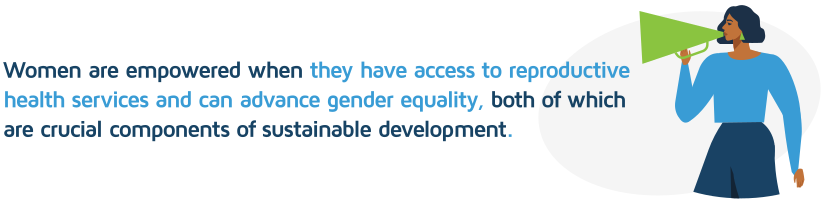
Reproductive health is also in line with a number of the Sustainable Development Goals (SDGs), notably SDG 3 on health and well-being, SDG 5 on gender equality, and SDG 17 on partnerships for the goals.
How can population growth be managed sustainably?
When we talk about managing population growth, we don’t mean giving people advice on how many children they should have. The goal is to remove barriers and help people, especially women, make their own choices freely.
It’s important that girls get proper education, rural communities benefit from proper healthcare, and women are free to participate equally in economic life. If these are accomplished, fertility rates tend to fall on their own.
The table below includes five approaches to sustainable population management and their links to SDGs.
All of these solutions are interconnected. Quality education helps people better understand family planning. When people have stable incomes and more opportunities, they are more likely to make long-term decisions about having children. When farming is sustainable, societies have more stability and time to adapt to gradual population changes.
Frequently Asked Questions
What are the main effects of population growth?
On the negative side: Population growth leads to higher demand for food, water, and energy. These, in turn, put more pressure on land, ecosystems, and infrastructure. It also leads to more greenhouse gas emissions due to expanded agriculture and urbanisation.
On the positive side: A growing population means a larger workforce, stimulates domestic markets, and leads to more experts able to solve sustainability challenges.
Ultimately, it all comes down to whether governments invest in education, healthcare, and climate-resilient infrastructure.
What are the causes of population growth?
The main cause is declining mortality rates, meaning that people live longer due to better healthcare, nutrition, and sanitation. At the same time, in some regions, birth rates remain high, especially in sub-Saharan Africa and parts of South Asia. In regions where birth rates are high, people, for the most part, don’t have access to family planning, quality education, and in some regions, girls have to marry early.
What are 10 ways to reduce overpopulation?
A combination of approaches may help reduce overpopulation, including: 1. Expanding girls’ access to education, 2. Opening access to family planning to all women, 3. Increasing women’s access to economic possibilities and allowing them to make their own decisions, 4. Investing in child healthcare, 5. Shifting to sustainable agricultural systems. 6. Invest in planned urbanisation and basic urban services (water, sanitation, energy, transport). 7. Assisting community-led development, 8. Tackling child marriage, 9. Offering comprehensive sexuality education, 10. Better social protection systems to ease the burden so families won’t have to rely on their children to provide them with financial stability as they age.
Final word
The continuously growing population could lead to the depletion of natural resources, environmental degradation, and overcrowding. It is evident that if everyone continues to consume at levels comparable to those of today’s developed nations, with the technologies available today, the world will be unable to sustainably maintain the existing population. At the same time, however, population growth can increase economic growth and technological innovation.
Considering the positive and negative outcomes, maintaining the balance between population growth and sustainable development calls for careful planning, investment in sustainable technology, and international cooperation.