

Add us as your preferred source on Google to see more of our content in Search.
 Add to Preferred Sources
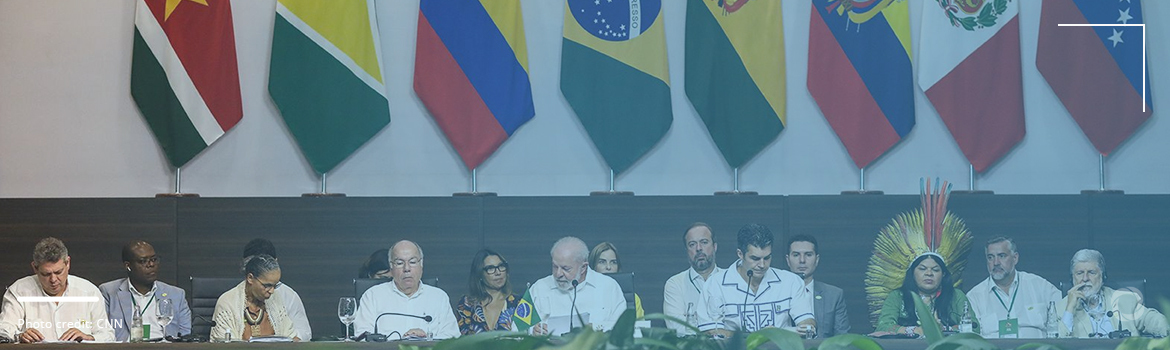
For the first time in decades, the eight countries that are home to the Amazon sat at the same table in the city of Belém this August to discuss the future of the forest known as the lungs of the planet. Convened by Brazilian President, Luiz Inácio Lula da Silva, the Amazon Summit had the mission of showing the world that Latin America is capable of leading the process of reducing deforestation and conserving the environment.
The event was seen as a rehearsal for the diplomacy of the Amazonian countries ahead of the 28th United Nations Climate Conference (COP-28) due at the end of this year.
“The basic idea is for us to get ready so that all countries that have forests have a common position at COP28 in the United Arab Emirates,” said Luiz Inacio Lula da Silva.
The main expectation was for the seven countries to agree on zero deforestation by 2030 which proved impossible given that each nation articulated different ideas and strategies. Most believe that it is unrealistic for the goal to be achieved in such a short time. Bolivia, under President Luiz Alberto Arce, was the most resistant to the proposal. Brazil itself, after promising at international events to contain illegal activity in its forests until the end of this decade, failed to make the same commitment at the summit.
Although the Belém final document mentions the term “deforestation” 13 times, it offers no resolutions. It simply highlights the need to create a joint environmental guard for the Amazon, in addition to having a Court of Justice to deal with environmental crimes.
The lack of a joint commitment has drawn criticism from the international community and environmental experts. The executive secretary of the non-governmental organization, Observatório do Clima, Márcio Astrini, blamed the lack of consensus on political and economic differences between the participating countries.
“We literally have the planet on fire, with record temperatures every day and approaching the point of collapse of the Amazon. An event like this cannot end without direct declarations about the end of deforestation. It would just be a promise, but they couldn’t even make this promise,” criticized Astrini.
Oil as the bone of contention
In the days leading up to the summit, Belém witnessed a range of rallies with protestors calling for an end to oil exploration in the Amazon and a global reduction in the use of fossil fuels.
This topic was also the main bone of contention at the Amazon Summit splitting the countries into two camps: those rich in oil reserves, such as Brazil, Venezuela, Guyana, Suriname and Ecuador, and Colombia, on the other side.
Among the Amazonian countries, Colombia stands out the most for forest preservation. In 2022, there was a 10% reduction in deforestation compared to the 1,589 square kilometers registered in 2019.
Colombian President Gustavo Petro reinforced his criticism of the use of fossil fuels and oil exploration in the Amazon area. The Colombian position came amid a row in Brazil over a project announced by the state-run oil company, Petrobras, to drill for oil at the mouth of the Amazon river.
On the other side, Lula da Silva’s vision is that the Amazon region needs to generate wealth and jobs for those who live in there.
“We need to reconcile environmental protection with social inclusion, fostering technological innovation and stimulating the local economy,” he pondered.
“Putting oil into the Amazon is a scandal. Stopping deforestation in the forest is a way to save it, but if we don’t stop oil exploration and gas emissions, the Amazon will be destroyed even without deforestation because global warming will destroy the forest and create a cycle of collapse,” predicts Marcio Astrini.
What does Brazil want to explore?
Petrobras has already drilled 95 oil wells but there has only been one commercial discovery of natural gas and a high rate of abandonment due to operational difficulties which the sector says are a reflection of outdated technology used at the time when the region hit its exploration peak in the 1970s.
Despite successive failures, the basin at the mouth of the Amazon came back on the radar after massive oil discoveries in Guyana and Suriname which made the Brazilian Equatorial Margin more promising.
A 2021 study estimates that one of the basins on the Equatorial Margin has reserves of 20 billion to 30 billion barrels. The government predicts that this entire margin can produce 10 billion barrels. Confirmation of these numbers, however, depends on the drilling of wells.
While Ibama, the organization responsible for authorizing the use and exploration of natural resources, has denied Petrobas a license, the Brazilian government does not have a united stance on the matter. The Ministry of Mines and Energy has defended the proposal whereas the Ministry of the Environment is opposing it.
Minister of the Environment Marina Silva argues that there is no point in putting an end to deforestation if the world does not reduce fossil fuel emissions.
“Even if we manage to reduce deforestation by 100%, if the world does not stop emissions from fossil fuels, we will equally harm the Amazon. Presidents are clear about this,” she said.
The Minister of Mines and Energy of Brazil, Alexandre Silveira, takes the opposite view and argues that Petrobras can investigate whether there is oil on the Equatorial Margin which runs from Rio Grande do Norte to Amapá, about 500 kilometers from the mouth of the Amazon River. According to Silveira, the Brazilian population has a “right” to know what resources are available in the country.
In March, the minister announced plans to scale up national production and make Brazil the fourth largest oil producer in the world whereas today it is currently the eighth, according to the US Energy Information Administration.
Brazilian President Lula has not taken sides yet which runs counter to his staunch anti-deforestation pre-electoral and post-electoral promises.
“I’m going to tell you that you can keep dreaming and I also want to keep dreaming. We had Petrobras with a platform prepared to carry out research in this region. There was a study by Ibama that said it was not possible, but this study is not complete, because they point out technical flaws that Petrobras has the right to correct. We are discussing this,” stated Lula.
According to the International Energy Agency, for the world to achieve zero net carbon emissions by 2050, it is essential that no new fossil fuel extraction projects are authorized. Achieving this goal in the next three decades is one of the most important steps towards fulfilling the Paris Agreement, limiting global warming to 1.5°C and avoiding the most catastrophic effects of the climate crisis, according to the Intergovernmental Panel on Climate Change.