

Add us as your preferred source on Google to see more of our content in Search.
 Add to Preferred Sources
Ebola has resurfaced in the Democratic Republic of the Congo (DRC), killing three people and infecting up to 17 others since April 22, the World Health Organization (WHO) announced this week. Foreign Policy reports that the outbreak, which was discovered in the northern province of Lower Uele, is so far “isolated, remote, and small” and unrelated to the 2014-16 Ebola epidemic in West Africa, which killed over 11,300 people in Liberia, Guinea, and Sierra Leone.
Now international responders led by WHO will need to work together to support the Congolese government as part of a coordinated, multi-sectoral approach to containing the virus. The outbreak is significant not only because it is a test of reforms made to WHO’s emergency response capacity in recent years, but also because it has the potential to test the readiness of the entire United Nations system, should the situation deteriorate
Congolese health officials deserve credit for detecting the outbreak in its current, incipient stage. The DRC has experienced eight separate Ebola scares since 1976, including most recently in 2014, and was therefore better prepared than countries in West Africa to detect additional cases. This includes the presence of a research laboratory in Kinshasa, which confirmed the identity of the virus using DNA sequencing technology. The response affirms the pivotal role of national health systems as the first line of defense in the fight against global pandemics.
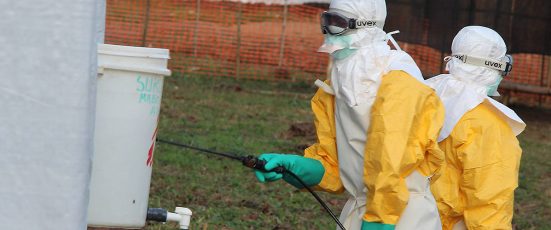
Other signs point to a higher level of speed, coordination, and engagement than occurred during the initial stages of the West Africa response in 2014. Less than three weeks transpired between the first reports of suspected cases and identification of the virus by the Congolese health ministry; the WHO Regional Director for Africa met with national authorities in Kinshasa on Sunday and has deployed a team of technical experts to conduct a field investigation; and personal protective equipment has been shipped to the northern city of Kisangani. Epidemiologists backed by WHO are currently attempting to trace 125 people with suspected ties to the victims, according to reports.
In West Africa, by contrast, it took nearly three months for health officials to identity the Ebola virus in Guinea, by which time it had already infected hundreds of victims, entered urban population centers, and spread undetected into neighboring Liberia and Sierra Leone.
Numerous NGOs are also responding to the outbreak. Médecins Sans Frontières dispatched, along with medical equipment and supplies, a team of 14 experts to meet with officials from the national health ministry. They will discuss the possibility of vaccinating the local population with an experimental vaccine funded by vaccine alliance Gavi. The vaccine was developed by Canada’s Public Health Agency and manufactured by pharmaceutical company Merck.
Although the potential scale of the outbreak is still unknown, it appears likely to be brought under control fairly quickly given its rapid detection and remote location, following in the pattern of previous outbreaks in the DRC. If the situation escalates, multiple in-country partners, including the World Food Programme (WFP) and UNICEF, are standing ready to lend their support, according to an official WHO statement.
Source: IPI Global Observatory. Read full article here.
17 May, 2017