

Add us as your preferred source on Google to see more of our content in Search.
 Add to Preferred Sources
Reliable access to clean water for drinking, agriculture and sanitation is one of the biggest challenges facing the 135 million people who live in Africa’s Sahel region. Fortunately, this vast area—covering 5 million square kilometres from western Africa to central and northern Africa—is also home to rich bodies of water underground.
Through a technical cooperation (TC) regional project carried out from 2012 to 2017, the IAEA provided equipment and trained local scientists from 13 Member States—Algeria, Benin, Burkina Faso, Cameroon, Central African Republic, Chad, Ghana, Mali, Mauritania, Niger, Nigeria, Senegal, and Togo—to help manage these joint water resources in support of sustainable socioeconomic development. Five main cross-border aquifer systems were studied and mapped during the initial phase: the Iullemeden aquifer system, the Liptako-Gourma-Upper Volta system, and the Senegalo-Mauritanian, Chad and Taoudeni basins.
Following extensive training in water sampling and analysis focused on isotopic techniques, all counterparts have applied their new skills to develop national reports and interpret data with the goal of enabling better decision-making in the water sector. Water resource management capacities in the region have been enhanced, and an active and engaged network of local counterparts is now in place.
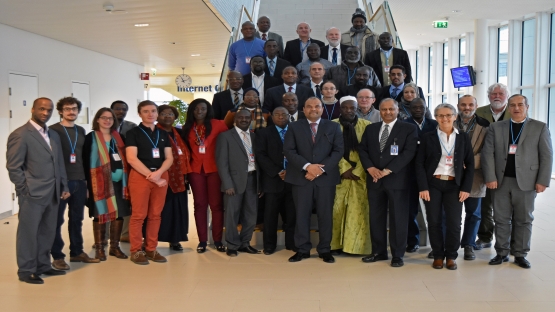
IAEA staff and national counterparts at the launch of the second ‘Sahel project’.
Building on the scientific evidence acquired during this earlier TC regional project, as well as complementary data from current and previous IAEA and development partner activities in the region, the IAEA and these same Member States recently launched a new TC regional project to address remaining capacity and information gaps through additional and improved data collection and interpretation, and training.
At the project’s first coordination meeting, held at the IAEA’s Vienna headquarters from 12 to 16 February 2018, project counterparts defined the workplans to be carried out by each participating Member State in Phase II. Experts presented the IAEA’s Water Availability Enhancement (IWAVE)methodology and approach, working with counterparts implementing this framework to agree on roles, responsibilities, and mechanisms for coordination and communication.
The meeting also covered case studies and identified a series of IAEA activities, from supporting post-graduate technical education to equipping national laboratories, that will help participating countries achieve self-reliance in analytical work.
During the week, counterparts had the opportunity to interact with potential donor and partner countries, whose support and contributions would help ensure that the project achieves sustainable impact in all 13 countries.
Original source: IAEA
Published on 19 February 2018