

Add us as your preferred source on Google to see more of our content in Search.
 Add to Preferred Sources
There is an economic hardship that currently plays out daily for teenage girls in Nigeria. Sanitary products, once priced at 700 naira ($0.44) in 2021, now cost a minimum of 3550 ($2.21) in 2024.
With the minimum wage being just US$18 per month and 88.4 million Nigerians living on less than US$1.90 per day, this price increase represents a major burden. A terrible reality for many families is to choose between meeting their basic food needs and buying sanitary supplies.
A study by BBC Africa discovered that for many women, two packs of sanitary towels containing eight pads will cost between 3 and 13% of their monthly income based on the minimum wage.
Back in 2021, Nigeria’s former Minister for Women’s Affairs, Dame Pauline Tallen, said that 37 million women did not have access to menstruation products due to financial constraints. The rising cost of living from 2023 to 2024 has now made that situation even worse.
What is period poverty?
Period poverty arises from the inability of women and girls to afford and access basic period hygiene products and educational materials which forces them to seek unhealthy substitutes such as paper, rags, and leaves. As well as endangering their health, this situation feeds the cycle of poverty and gender inequity.
Hannah, who recently graduated from a secondary school in the Pykassa community near Nigeria’s capital Abuja, stated that the toilets did not offer a conducive environment and lacked tissue paper, pads, pain medication for cramps, and flowing water to use when their periods began while they were at school.
The options were to remain at school and be wet, uncomfortable, and stained or leave.
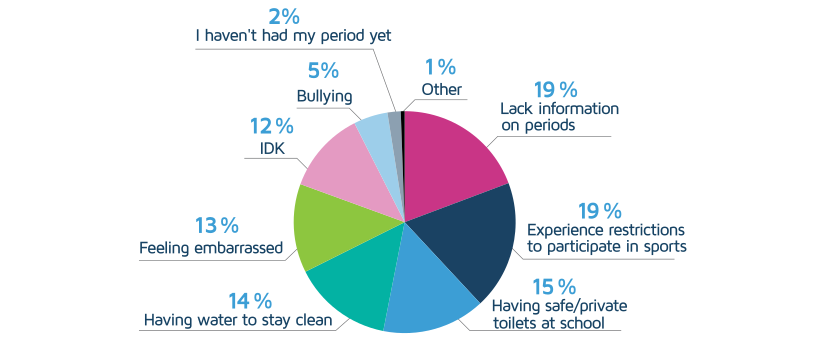
Girls challenges during menstruation
Source: UNICEF
Odion Ikyo, the founder of the Theodora Anavhe Adamu Foundation (TAAF), a nonprofit organization devoted to improving maternity and child health outcomes in Nigeria, commented that across Africa, the high cost of disposable menstrual products, combined with limited income and lack of awareness, drives many girls and women to unsafe practices which increases the risk of infections.
The shame associated with menstruation only makes these problems worse. Shame and silence breed isolation which exacerbates the effects on everyday life, education, and health by limiting honest conversations about menstruation requirements.
Consequences of period poverty
Losing the possibility of attending school is one of the worst effects of period poverty. Because of the negative results of being frequently absent, students often fall behind in their studies and may drop out of the education system completely.
Although there are no up-to-date statistics regarding the number of girls in Nigeria who miss school during their periods, research conducted in South Africa by Stellenbosch University Hospital shows that 3 out of 10 girls between the ages of 9 and 18 miss school for several days every month because of menstruation.
Poor hygiene measures during menstruation periods come with significant health risks such as reproductive and urinary tract infections. Furthermore, the lack of access to menstruation products forces females to adopt desperate methods, particularly in underprivileged communities. Commenting on the matter, Odion Ikyo noted that teenage girls residing in a camp for internally displaced people in Abuja were coerced into engaging in transactional intercourse to be able to afford menstruation pads which put them at risk of HIV/AIDS.
The problem extends far beyond Nigeria’s borders. Approximately 10% of 15-year-old girls in rural Kenya engage in transactional sex in order to be able to purchase sanitary goods. In Uganda, teenage girls are driven to have sex in return for pads which puts their health in danger. An alternative difficulty exists in Namibia where females are encouraged to utilize injectable contraception to avoid unintended births resulting from coerced or transactional sex.
Menstruation-related cultural taboos make the problem even more complicated. Menstruation is associated with impurity and uncleanliness in many African communities, which leads to social isolation and limitations on women’s activities. Some cultures even separate women during their periods by continuing to use detrimental customs such as menstruation huts.
Menstrual stigma results in bullying, taunting, and negative effects on schooling and employment prospects. This is proven by the heartbreaking story of a 14-year-old Kenyan girl who killed herself after experiencing humiliation at the hands of her teacher, as reported by BBC Africa.
Progress and solutions
However, the battle against period poverty is making headway despite these obstacles. With cooperation from organisations like BBC Africa, UN Women, and Ballard Brief, increased awareness and advocacy activities have brought the menstruation health debate into the public domain. Period product taxes have been eliminated in a few African nations, including South Africa and Kenya, making the items more accessible. Since 2017, the Kenyan government has given free sanitary pads to schoolgirls.
NGOs in Nigeria are focusing on providing free sanitary pads to girls living in underprivileged and rural regions through programs like the Pad a Girl Project. The TAAF Foundation has also raised awareness and provided supplies for relief efforts during emergencies, as well as established the TAAF bank in the Area 1 IDP camp.
Moving forward
Odion Ikyo pointed out several steps that are necessary to combat period poverty:
- Increased Government Funding: Provide funds for a thorough education on menstrual health and subsidize menstrual products to lower their cost.
- Local Production: To lower costs and lessen environmental effects, encourage the production of menstruation products locally.
- Reusable Products: To offer a sustainable alternative, promote the use of reusable menstruation products, such as cloth pads and menstrual cups. Groups like Days for Girls and Afripads are already making progress.
- Tax Removal: To decrease costs and increase accessibility, push for the elimination of taxes on menstruation products.
- Start a Discussion: Encourage candid conversations about menstruation to dispel stigma and cultural taboos. Menstrual health education initiatives could foster empowerment in both girls and boys to promote a supportive environment.
Finally, to combat period poverty, society must support campaigns for reusable products, encourage candid communication, and include the public in the cause of menstrual fairness. We can strive towards a future where menstruation health is valued and available to all via united efforts, Odion Ikyo commented.