
Add us as your preferred source on Google to see more of our content in Search.
 Add to Preferred Sources
The world’s water resources are in a critical state as a result of years of mismanagement and undervaluation, according to a recent report by the Global Commission on the Economics of Water. For the first time in history, human civilization has thrown the global water cycle out of its natural balance. This continuing negligence has left freshwater ecosystems degraded and vulnerable and also places food production at significant risk.
The water cycle is a sophisticated system that circulates water throughout the planet, according to the Commission. This cycle connects communities, nations, and regions, not only through the shared ‘blue water’ found in rivers, lakes, and aquifers that span over 263 watersheds and 300 aquifers across borders, but also through ‘green water’ which is held in soil and vegetation and released into the atmosphere through plant transpiration. Remarkably, green water accounts for nearly half of all rainfall over land.
However, after decades of harmful land use and poor water management practices, combined with the impact of climate change, this delicate cycle is now facing unprecedented pressure. Human activities such as draining wetlands and the deforestation of large areas have worsened the situation and contributed to an acceleration in global warming. Meanwhile, rising temperatures as a result of climate change are drying landscapes, reducing soil moisture, and increasing the risk of wildfires. A climate science professor at Reading University in England, Richard Allan, commented:
“The report paints a grim picture of human-caused disruption to the global water cycle, the most precious natural resource that ultimately sustains our livelihoods.”
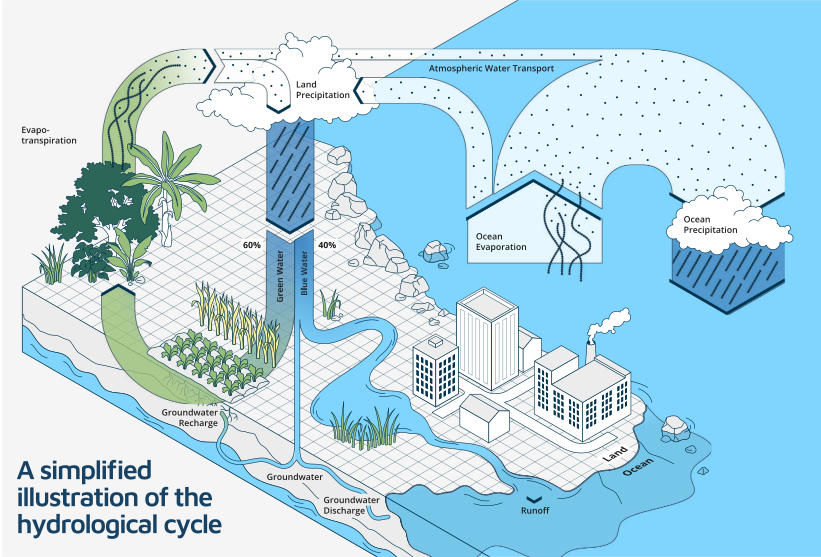
Source: The Economics of Water
The price of doing nothing
The cost of ignoring the global water crisis is immense, both in terms of human lives and economics. Across the globe, water resources both above and below ground are dropping, especially in densely populated regions. The urgency of the issue is already clear today as over 1,000 children under five are dying every day due to unsafe water and inadequate sanitation, while women and girls collectively spend around 200 million hours each day gathering water.
Areas with high population density, such as northwestern India and northeastern China are expected to face heightened vulnerability. However, for the world’s poorest 10%, the stakes are even higher, as they rely on local land-based rainfall for over 70% of their water needs. If the rainfall in deforested areas was to decrease significantly, growth in continents such as Africa and South America could potentially fall by 0.5 to 0.7 percentage points.
See also: Water scarcity statistics and future projections
In areas with intense irrigation practices, water reserves are also declining at alarming rates, often twice as quickly as in other regions. The report suggests that half of the world’s food production occurs in areas where water resources are predicted to fall. If we continue on this path, extreme declines in water storage could make irrigation unsustainable and potentially slash global cereal production by up to 23%. This concentration of food production in water-stressed countries leaves the global food supply highly vulnerable.
Taking actions
“The global water crisis is a tragedy but is also an opportunity to transform the economics of water. Valuing water properly is essential so as to recognize its scarcity and the many benefits it delivers,” said Ngozi Okonjo-Iweala, director general of the World Trade Organization and a co-chair of the Global Commission on the Economics of Water.
The authors of the Global Commission’s report stress the need to first acknowledge that the water challenges we face go beyond local issues and that these are global in scope. Governments should recognize the water cycle as a shared resource that demands joint action. They recommend transitioning from animal-based diets to more sustainable food production, enhancing water use efficiency, restoring ecosystems, and increasing wastewater treatment and recycling efforts.
See also: Bioremediation: a potential solution to the global water crisis
Mariana Mazzucato, a Professor and Director of the UCL Institute for Innovation and Public Purpose, also places responsibility on both governments and markets by commenting,
“We can do it, we’ve just chosen not to because we have inertia and because we have profits being made from not dealing with the crisis”.