
Add us as your preferred source on Google to see more of our content in Search.
 Add to Preferred Sources
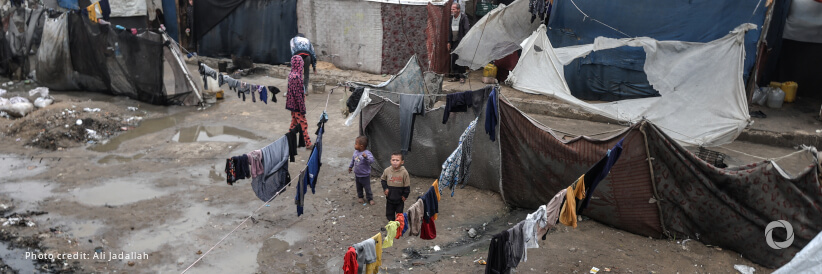
Only 23 per cent of Gaza’s shelter needs have been met this autumn, leaving nearly one million Palestinians vulnerable to exposure during the harsh winter months, according to the Norwegian Refugee Council-led Shelter Cluster in Palestine.
The Shelter Cluster estimated in September that 2,000 trucks of tents or 200 trucks of sealing-off kits were urgently needed to provide basic winter protection for 1.13 million displaced Palestinians in Gaza. By late November, only 285,000 displaced people had received essential shelter materials. Since early October, Israel’s offensive and siege on North Gaza have displaced an additional 100,000 Palestinians, and in total 945,000 people need shelter assistance.
The entry of shelter materials into Gaza has decreased as flour, essential to address growing starvation, is being prioritized for transport through Gate 96 along the Fence Road, the most secure route for aid convoys. The Shelter Cluster urges donor governments to press Israel to allow the entry of weather-proofing materials and ensure safe access for humanitarian workers to reach vulnerable Palestinians throughout Gaza.
“We’ve received only a fraction of the aid required to address the shelter crisis,” said Jeroen Quanjer, Shelter Cluster chair in Palestine. “Hundreds of thousands of displaced families are enduring the winter cold and rain without meaningful protection. Israeli authorities’ repeated denial of essential shelter materials prevents us from scaling up our response to build emergency shelters that can withstand Gaza’s winter conditions.”
A winter storm in late November flooded displacement sites, destroying tents and makeshift shelters and forcing many families to relocate. At least 101 displacement sites south of Wadi Gaza, hosting 450,720 Palestinians, are prone to flooding.
“We woke up to water flooding our tents,” said Mahmoud, a displaced Palestinian in central Gaza’s Deir al-Balah city. “Our children were asleep as the water reached them. Our mattresses and clothes are ruined. Now, there’s nothing left, just a lake of water. I’m trying to salvage what’s left, but I feel abandoned. No one seems to care, neither the Arab world nor decision-makers. We’ve been left on our own.”
Repeated displacements have forced families to leave behind essential shelter materials, often fleeing with only what they can carry. Many tents and supplies provided by aid agencies over the past year are unusable due to wear and tear. Replacement supplies have been scarce as shelter materials entering Gaza have drastically decreased in recent months.
Between 1 September and 25 November, only 123 trucks carrying shelter assistance entered Gaza— an average of just 10 trucks per week. Many of these trucks included items not directly related to winterization, such as mattresses and bedding. The limited supplies of tents and sealing-off kits, which include tarpaulins, plastic sheets, rope, and duct tape, have been insufficient to meet the overwhelming needs.
The Shelter Cluster calls for immediate action to address the shelter crisis in Gaza, warning that further delays in delivering critical supplies will leave hundreds of thousands of Palestinians exposed to life-threatening conditions this winter.