
Add us as your preferred source on Google to see more of our content in Search.
 Add to Preferred Sources
Germany is retreating from its global development commitments by scaling down its funding for international aid. At the same time, a new draft law proposes to reduce support for Ukrainian refugees who recently arrived in the country. Bitterly criticized by aid organizations and experts, these decisions follow the government’s announcement revealing a significant budget shortfall.
Germany is planning to make major cuts to its international development spending, dropping below €10 billion for the first time since 2018. According to the new plan, the aid funds disbursed through the Federal Ministry for Economic Cooperation and Development (BMZ) will be set at €9.94 billion. Moreover, the humanitarian emergency aid managed by Germany’s Foreign Office is expected to be halved by 2026. Aid organizations are concerned about the fallout, particularly for vulnerable communities around the world. Just prior to the budget announcement, a group of 17 major organizations, including Oxfam, One, Welthungerhilfe, and Bread for the World, released a joint statement condemning the move. They warned that not only would lives be at risk, but Germany’s standing and influence on the world stage could suffer.
See also: Germany’s deep aid cuts threaten millions worldwide
Oliver Müller, who leads Caritas International, an organization that helps in global emergencies, said the cuts will hit people in the Global South the hardest. According to Müller, some large projects will be cancelled due to financial shortages. He also stressed that some humanitarian crises are so severe that they will have to be helped using their own resources and donations, even if government funding dries up.
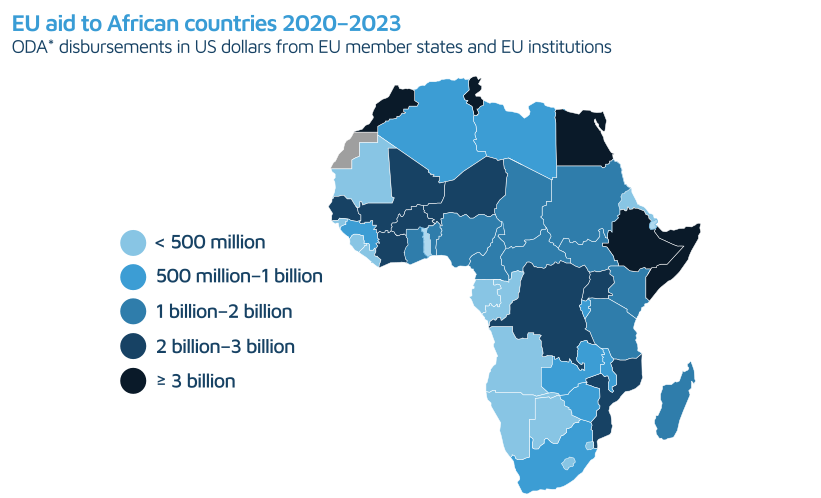
Müller mentioned eastern Congo as one example, calling it one of today’s worst humanitarian disasters. He said the German Foreign Ministry has already withdrawn its support from the region and, if this trend continues, there might be no help left at all. He also pointed out that other wealthy nations such as the USA, the UK, Belgium and other EU countries are also cutting back on aid to the world’s poorest.
Source: DW
VENRO, a major coalition that represents humanitarian and development organizations, has voiced serious concerns. It believes Germany is stepping away from its global responsibilities at a time when international cooperation is needed more than ever. According to VENRO, these financial cutbacks will make it impossible to maintain effective, long-term partnerships in global aid.
However, international aid is not the only area facing reductions. The German government is also planning to lower social benefits for newly arrived Ukrainian refugees. Since April 2025, Ukrainians coming to Germany no longer receive support under the EU’s temporary protection rules. Instead, they are moved to the national asylum system, which provides lower payments than German citizens receive. The government plans to reduce payments by around €100 per person each month.
Germany currently hosts around 1.25 million Ukrainian refugees, with 21,000 arriving between April and June 2025. The country spent over US$32 billion on aid last year, with €6.3 billion channeled specifically to support Ukrainians. Some leaders, particularly in Bavaria, are calling for further cuts across the board, not just for recent arrivals.
These moves come as Germany faces a large budget crisis. New estimates show the federal deficit will reach €171 billion – much higher than previously expected. Finance Minister Lars Klingbeil is preparing a revised budget plan through 2029, and it is clear that either deep spending cuts or new taxes will be necessary. The government is already planning to slash administrative and staffing costs and reduce funding for many programs, which also means cuts in development aid. Even with these reductions, however, experts warn that more action will be needed. Germany has long been among the world’s top largest donors of official development assistance (ODA), ranking second after the U.S., which has almost completely suspended its development aid in 2025. In 2020, Germany’s ODA stood at US$28.4 billion dollars increasing to US$36.7 billion euros in 2023. The declining trend then began in 2024, when it dropped to US$32.4 billion.