
Add us as your preferred source on Google to see more of our content in Search.
 Add to Preferred Sources
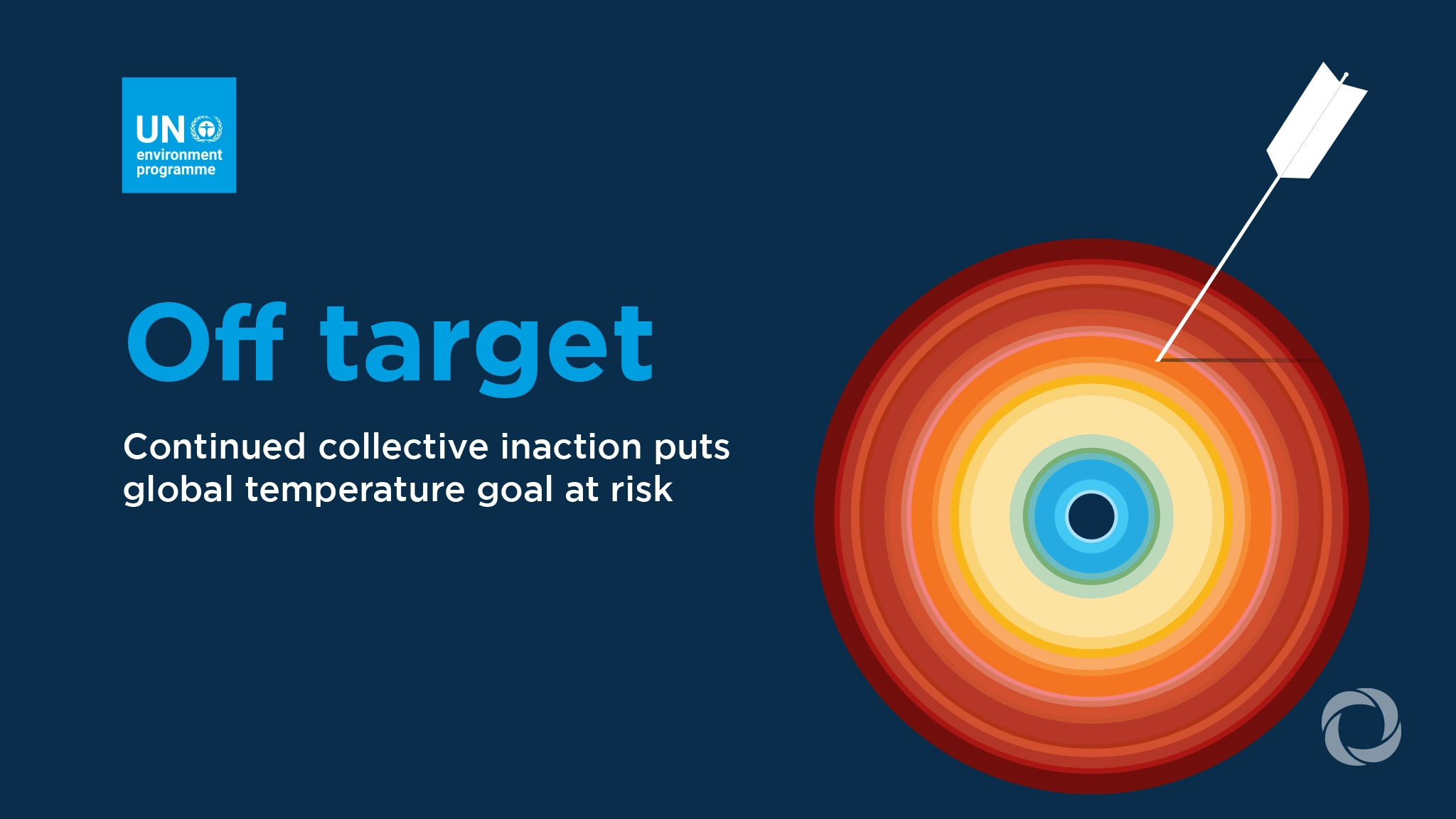
New climate pledges under the Paris Agreement have only slightly lowered predicted global temperature rises this century, leaving the world heading for a serious escalation of climate risks and damages, a UN Environment Programme’s (UNEP) Emissions Gap Report 2025: Off Target shows. UNEP’s report finds that global warming projections over this century, based on full implementation of Nationally Determined Contributions, are now 2.3-2.5°C, compared to 2.6-2.8°C in last year’s report.
However, methodological updates account for 0.1°C of the improvement, and the upcoming withdrawal of the US from the Paris Agreement will cancel another 0.1°C, meaning the new NDCs themselves have barely moved the needle. Nations remain far from meeting the Paris Agreement goal to limit warming to well-below 2°C while pursuing efforts to stay below 1.5°C.
The report finds that the multi-decadal average of global temperature rise will exceed 1.5°C, at least temporarily, starting at the latest in the early 2030s. UN Secretary-General António Guterres says scientists tell us a temporary overshoot above 1.5 degrees is now inevitable. “But this is no reason to surrender. It’s a reason to step up and speed up. 1.5 degrees by the end of the century remains our North Star,” he said.
UNEP Executive Director Inger Andersen says nations have had three attempts to deliver promises made under the Paris Agreement, and each time they have landed off target. “While national climate plans have delivered some progress, it is nowhere near fast enough, which is why we still need unprecedented emissions cuts in an increasingly tight window,” she said. Only 60 parties to the Paris Agreement, covering 63% of greenhouse gas emissions, had submitted or announced new NDCs containing mitigation targets for 2035 by September 30, 2025.
Aligning with the Paris Agreement requires rapid and unprecedented cuts to greenhouse gas emissions above the pledges—a task made harder by emissions growing 2.3% year-on-year to 57.7 gigatons of CO2 equivalent in 2024.