

Add us as your preferred source on Google to see more of our content in Search.
 Add to Preferred Sources
Key reasons to read this story
- Find out why half of Filipino families identify as poor in a country that is registering continual economic growth.
- Discover what is fueling the crisis. Is it corruption or population growth?
- Learn whether the government’s poverty-alleviation measures are effective or merely a PR stunt.
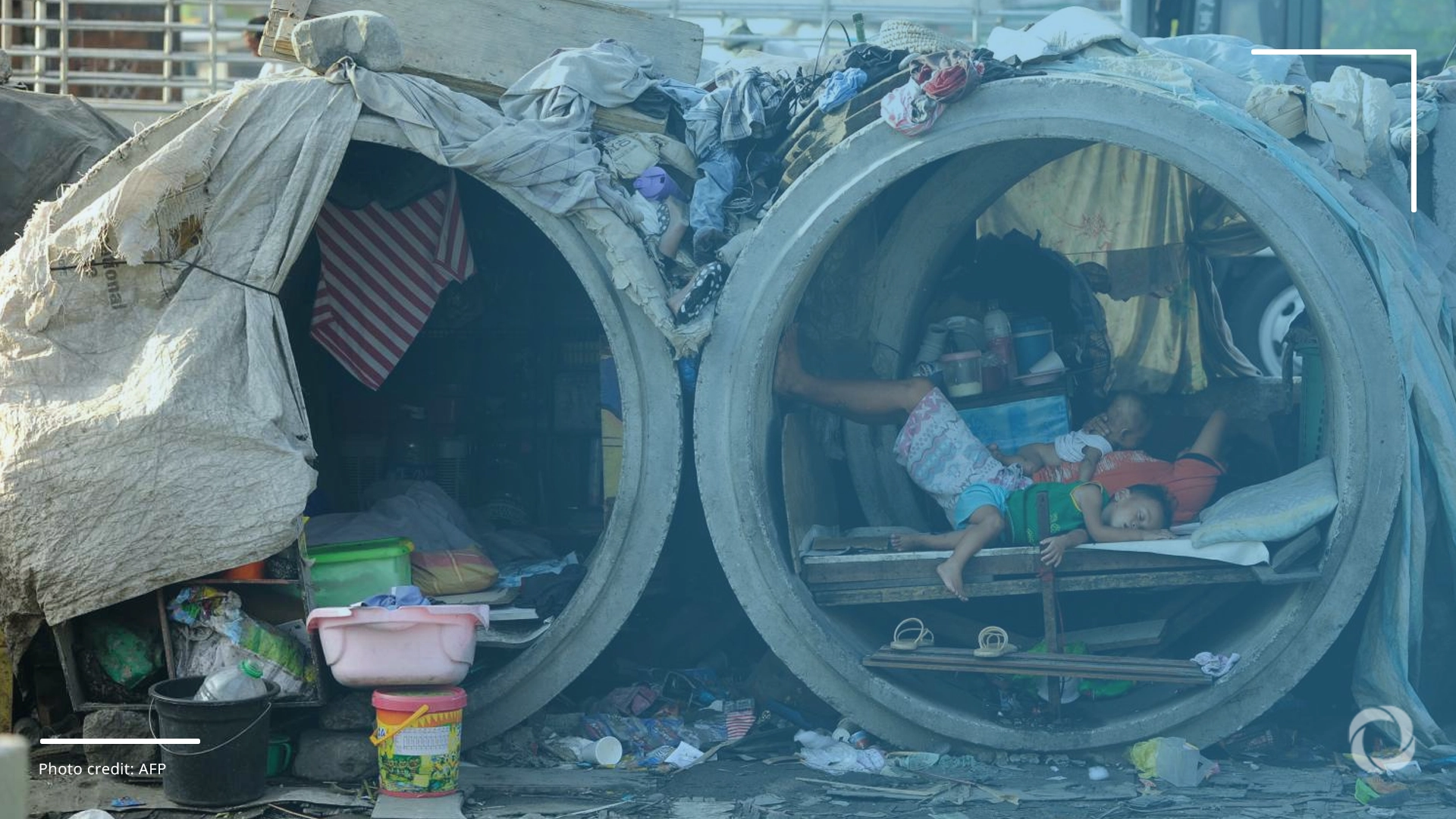
Poverty is a stark reality in the Philippines, where millions are struggling to access basic needs such as food, clean water, education, and healthcare. Governance challenges, economic inequalities, and environmental instability, coupled with a rapidly growing population, are trapping many in a daily fight for survival.
According to the Social Weather Survey, 50% of Filipino families considered themselves to be poor, including 1.6 million “newly poor” households, as of September 2025. Another 12% were on the borderline, while 38% identified as not being poor, down from 41% in June 2025. Also, 22% of Filipino families experienced involuntary hunger in September, up from 16.1% in June 2025.
With a gross domestic product (GDP) per capita of US$3,804, many Filipinos still see basic necessities as luxury, whereas other items that people normally take for granted remain a distant dream.
Poverty drivers: Corruption and population boom
Governance challenges are significantly exacerbating poverty. Corruption and misallocated funds are concentrating wealth among the elite and reducing the resources available for public services.
Analysts estimate that corruption costs the economy 1-2% of GDP annually, leading to resilience funds being siphoned off and infrastructure costs rising. As a result, borrowing increases, substandard roads and inflated transport costs persist, and goods become more expensive, all of which disproportionately affect the poor.
The country’s rapid population growth is compounding the problem. With 118 million people and 30.7% under 15, resources such as housing and food are coming under immense pressure. This demographic strain is deepening inequality, particularly in remote communities, and is also limiting economic opportunities.
Natural disasters and failing school system
The Philippines is highly vulnerable to natural disasters, with 60% of its land being disaster-prone and over 70% of the population being exposed to multiple hazards.
Schools and education are heavily affected, with 78% of public schools and 96% of students running the risk of being affected by disasters. Between 2021 and 2023, 4,000 schools were damaged, impacting 2 million children, and threatening livelihoods in disadvantaged communities.
But even without disasters, the education system is failing millions. As many as 18.9 million Filipinos struggle with basic literacy, while 11 million children are out of school due to unaffordable costs. In the face of limited access to quality education, child labor rises and poverty becomes a generational trap.
Economic growth fails to lift the poor
The Philippines’ economy is growing, yet the benefits of this are not reaching those most in need. Despite a growth in GDP of 5.5%, no relief is felt by disadvantaged families. Many Filipinos comment that the effects of rising prices and stagnant economic stability, inflation, debt, and job insecurity erode purchasing power and make any economic growth feel abstract.
Professor Ederson D T. Tapia of the University of Makati explains:
“Many Filipinos feel poorer not only because of rising prices but because their hard work no longer translates into stability. Inflation, debt and job insecurity have eroded purchasing power, turning economic growth into an abstraction rather than a shared reality.”
Government initiatives and criticism
President Ferdinand Marcos Jr. has committed to reducing poverty to single-digit levels by 2028, when his term ends. To achieve this, the government has introduced several programs:
- Ambisyon Natin 2040 and the Philippine Development Plan 2023-2028 encompass long-term economic transformation and poverty reduction strategies.
- The Sustainable Livelihood Program (SLP) and the Pantawid Pamilyang Pilipino Program (4Ps) aim to uplift disadvantaged communities.
Critics argue that although poverty alleviation programs help with human capital development, school attendance and immediate needs, they nevertheless highlight that they are often undermined by systemic problems, weak governance and poor coordination, thus turning potentially transformational aid into short-term relief that fails to break the cycle of poverty.