
Add us as your preferred source on Google to see more of our content in Search.
 Add to Preferred Sources
Why you cannot skip this story
- Discover how billions in climate finance are counted, miscounted and sometimes misused.
- Learn why hitting the US$100 billion target for climate projects masks a bigger truth and why the real needs run into the trillions.
- Find out how climate money turns into overwhelming debt, gets mislabeled and eludes those on the frontlines.
Climate finance is often talked about as a game-changer: wealthy nations pledging billions to help poorer countries to cut emissions, shift to cleaner energy, and prepare for climate disasters. On paper, it looks like the backbone of global climate action but, when you delve deeper into the numbers, the picture is uneven, often inefficient, and nowhere near the scale needed.
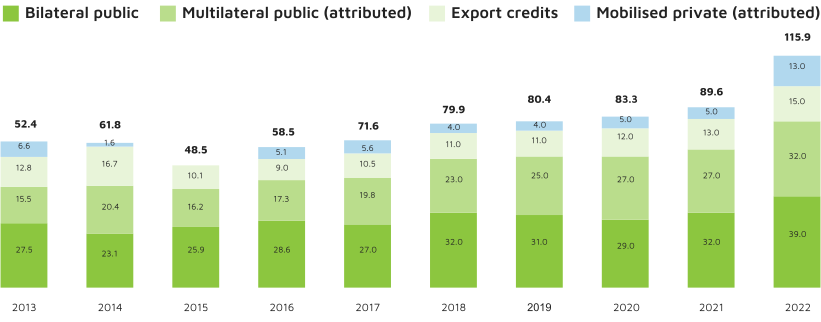
According to the most recent data from the Organisation for Economic Co-operation and Development (OECD), developed countries provided US$115.9 billion in climate finance to developing countries in 2022, finally surpassing the much-debated US$100 billion annual target set a decade ago. The jump was significant – a US$26.3 billion increase, or 30%, compared to 2021, the biggest year-on-year rise ever recorded. The amount represents the total flow, including money from public sources and private funds.
In 2024, countries pledged to further increase climate funding from US$100 billion annually to a minimum of US$300 billion per year by 2035, while aiming to mobilize up to US$1.3 trillion each year from mixed public and private contributors. This sounds like a remarkable achievement, but it is only part of the story.
Climate finance provided and mobilized in 2013-2022 ($ billion)
Source: OECD
A target met but is it enough?
While hitting the US$100 billion target is a political milestone, it masks a deeper truth – the gap between the allocations and what the world’s most vulnerable countries actually need is huge. Independent experts have long argued that the annual funding required to effectively reduce emissions and protect developing countries from devastating climate impacts run into the trillions annually.
The funding required for adaptation alone, that is the funding needed to help them to cope with increasing floods, droughts, heatwaves, and storms, could reach as much as US$387 billion per year by 2030, according to the United Nations Environment Programme. And adaptation is only part of the equation.
In other words, while governments have negotiated in the billions, the real price tag has quietly climbed into the trillions.
Unevenly distributed debt-growing loans
Another major issue is the structure of the money itself. For one thing, much of the reported ‘climate finance’ comes as loans rather than grants. This means that already debt-burdened countries are forced to borrow even more to pay back their debts.
This approach not only defeats the very point of development aid, it risks pushing developing countries further into financial distress, making climate resilience even harder to achieve.
Furthermore, climate finance flows are unevenly distributed. The money overwhelmingly favors ‘mitigation’ projects such as solar farms and energy-efficiency measures which are essential to cutting emissions. But for countries already facing extreme weather, ‘adaptation’ projects that can help them to cope with climate impacts, such as building sea walls or developing drought-resistant crops, are far more urgent.
Creative accounting
Finally, beyond the headline figures, the credibility of climate finance is coming under increasing scrutiny. Studies have repeatedly shown that the numbers are often inflated, largely due to existing development aid being rebranded as ‘climate aid’.
Many governments and institutions designate projects to be climate finance even when their main purpose has little to do with reducing emissions or actually causes environmental harm. There have been instances when funding for clearly non-climate-friendly initiatives, such as fossil fuel infrastructure and airports, were nevertheless reported as supporting climate action.
The goal for future climate talks is not just to raise the target figure, which is obviously necessary, but to demand greater transparency and more rigid definitions of what actually counts. The funds must be structured as grants rather than debt and there must be a genuine shift toward adaptation projects in the most vulnerable regions. Only by ensuring the money goes where it is truly needed can the climate finance system begin to build the trust required for unified global action.