

Add us as your preferred source on Google to see more of our content in Search.
 Add to Preferred Sources
With the same resources, NGO A can help 100 animals, while NGO B can improve the living conditions of 1,000 animals. If donors want their contribution to do the most good, which should they choose? In this article, we explore the principles of effective altruism and present four cost-effective charity ideas to inspire non-profit leaders and aspiring non-profit founders to explore more cost-effective ways to address their core animal welfare issues.
Today, there are over 10 million non-profit organizations worldwide. But not all have the same level of impact. In the case of the above, if donors want their contribution to have maximum impact and do the most good, then they could feel naturally inclined to donate to NGO B. This is the general principle behind effective altruism – a movement that uses evidence and sound reasoning to find the most effective ways to do good.
Charity Entrepreneurship is a charity registered in England and Wales that operates as an enabling platform for the creation of more cost-effective charities, based on the principles of effective altruism. To achieve this, Charity Entrepreneurship researches which ideas have the potential to become the chosen cause of highly impactful charities. These ideas are then matched with potential founders through its incubation program, which culminates in an investor pitch leading to 80% of the proposed ideas succeeding in securing up to US$200,000 in capital. Since 2018, Charity Entrepreneurship has directly contributed to the launch of 50+ charities worldwide.
In this article, we explore some of the most recent ideas proposed by Charity Entrepreneurship in animal welfare so that non-profit leaders or future non-profit founders can explore more cost-effective ways of addressing their core issues.
Let’s examine the most recent ideas in animal welfare for non-profit leaders.
#1 Introducing standards for keel bone fractures
Raising chickens for human consumption is often associated with persistent welfare issues, such as keel bone fractures. The enormous calcium demands experienced by laying hens in commercial settings, among other factors, mean that their bones are more susceptible to fractures, which can be caused by direct collisions with aviary equipment (e.g., perches) or other harmful movement. Based on reports from several countries, it is estimated that between 20% and 96% of egg-laying hens in commercial flocks are affected by keel bone fractures.
🔹 The idea
A new charity that works towards updating certification standards to include an outcome-based parameter for keel bone fractures (e.g., less than 30% of hens will have such fractures).
🔹 Cost-effectiveness and impact
This charity is expected to avoid, on average, about 78 suffering-adjusted days (SADs) per dollar. By scaling this intervention and based on an annual budget of ~$640,000, it is estimated that over 2 million SADs would be averted yearly.

#2 Advocating for a ban on low-welfare imports
Animal welfare standards vary greatly across the globe. Some regions – the EU, the UK, New Zealand, and Switzerland – are known to have high animal welfare standards, while others such as Brazil and Argentina, perform poorly in this respect. This uneven landscape leads to a problem in terms of importation when those countries with high welfare standards in place import animal products from countries that do not abide by these standards. What is the point in a country having demanding welfare standards if these imports are allowed? This is a question local producers and consumers are beginning to ask.
The European Commission recently approved the EU-Mercosur partnership agreement, in which some of these welfare concerns are considered. But critics comment that the agreement lacks enforceable measures to ensure imports comply with the same standards that are met by local producers.
🔹 The idea
A charity that advocates for a ban on the import of animal products from companies that do not meet the high-welfare standards of the importing country.
🔹 Cost-effectiveness and impact
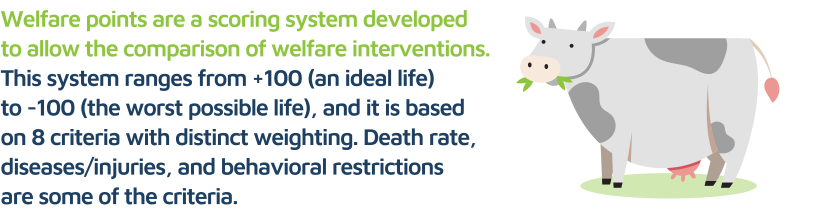
It is estimated that this intervention would yield an impact of 23.08 welfare points if implemented in New Zealand. At scale, this charity could improve the welfare of ~8 million fish, ~500,000 pigs, and ~370,000 chickens, each year.
#3 Improving milkfish welfare in the Philippines
It was recently estimated that about 120 billion farmed fish are killed annually, and this number is expected to grow as aquaculture scales up. In aquaculture, fish welfare can be compromised due to several factors, including poor water quality, high stock density, and disease spread. These issues are more prevalent in Asia, as this continent accounts for 90% of farmed fish volume. The Philippines is a particularly promising country where this charity could be implemented given the high number of fish farmed with milkfish (Chanos chanos) being the most farmed species in the country.
🔹 The idea
A charity that works to improve milkfish welfare in the Philippines by collaborating at farmer-level to improve water quality and reduce stock density.
🔹 Cost-effectiveness and impact
The report by Charity Entrepreneurship estimates that this idea could increase 24.39 welfare points per dollar spent, with the potential to improve the lives of thousands of fish.
#4 Advocate for cage-free husbandry in the Middle East
Raising chickens for human consumption in tiny, confined cages restricts their freedom, suppresses their natural behavior, and is associated with other welfare issues such as stress and muscle atrophy. In the U.S., it is estimated that 46% of egg-laying hens are kept in cage-free systems; in the UK, this percentage is higher – 75% of layers are cage-free. But while in these regions, cage-free systems are increasing, and many other countries are pledging to cage-free commitments, the Middle East is not following this positive welfare trend* (Table 1).
Table 1 – Number of cage-free systems commitments made by companies, per continent, until 2024. Data from Chicken Watch.
* Disclaimer: This data is from 2024, the same year as Charity Entrepreneurship’s report was published. Since then, the number of pledges in the Middle East has greatly increased.
🔹 The idea
A charity that runs corporate campaigns to promote the adoption of cage-free systems for egg-laying hens across the Middle East.
🔹 Cost-effectiveness and impact
It is estimated that this charity could avert around ~30 Suffering Adjusted Days per dollar. And, by operating at a larger scale, it could prevent a total of 3 to 25 million SADs every year.
Final thoughts
Any non-profit should be as effective as possible – that’s one of the guiding principles of this sector. For that reason, outcomes and effectiveness must be monitored, and strategies should be in place to increase resource maximization. Non-profit organizations that are guided by effective altruism principles take best practice to another level by positioning cost-effectiveness at the core – not as best practice but as a part of their identity.
And this will help non-profits to raise additional funding – be that to improve animal welfare or for other important causes.
GiveWell and Giving What We Can – two non-profits guided by effective altruism – regularly review and share information with the public about how NGOs perform. Their work has highlighted major discrepancies in the impact achieved by various non-profits, which in turn has become an incentive for organizations to measure impact and become more cost-effective. And this cost-effective approach is attracting a great deal of interest from funders. For instance, the charities incubated by Charity Entrepreneurship have already raised over US$68M in funding. And they also demonstrate some very interesting impact statistics, for example, the Fish Welfare Initiative launched in 2019 has already helped 2.7 million fish.
Whether you are considering starting a new non-profit or already leading one, you should definitely consider how it can become more cost-effective, even if you decide to not fully adopt effective altruism principles.

Read more about the criticism of effective altruism here.
DevelopmentAid offers regular access to insights, news, and opportunities within the international development sector, as well as expert opinions. Subscribe to the DevelopmentAid newsletter to have our updates delivered directly to your inbox.