


Add us as your preferred source on Google to see more of our content in Search.
 Add to Preferred Sources
The digital divide has become one of the defining development challenges of the 21st century. A few years ago, artificial intelligence (AI) entered this equation as another key element, with its importance rapidly growing. Yet, digital inequality is still widely misunderstood as a simple gap in internet access. In reality, it reflects a deeper structural imbalance between societies that possess the infrastructure, skills, governance capacity, and digital rights needed to thrive – and those that do not. As digitalization reshapes global markets, public administration, and social interaction, the divide increasingly determines a country’s economic competitiveness, social cohesion, and developmental trajectory.
At the same time, unlike earlier development challenges such as literacy or electrification, the digital divide is both dynamic as well as self-reinforcing. As the world becomes increasingly digitalized, marginalized populations fall further behind. By 2026, an estimated 2.2 billion people remain offline, while billions more are ‘under-connected’, and lack reliable broadband, and digital devices, or the skills required to participate in data-driven economies.
In this article, we examine the structural barriers that prevent equal digital literacy around the globe, the strategies and actions that could empower a holistic transformation in the sector, and the perspectives of the evolution of the gap.
Unequal access to the digital economy
The divide manifests most visibly in the limited access to the digital marketplace faced by emerging economies. Small enterprises that are unable to leverage digital tools struggle to compete in global e-commerce, where visibility, logistics integration, and payment systems require strong connectivity. Global e-commerce growth data illustrates this widening gap. Countries with weak cloud infrastructures, limited automation capabilities, or high data costs face an escalating productivity deficit thus widening the gap between digitally ready and digitally excluded nations.
See also: Internet access and digital divide: global statistics
Digital employment opportunities – from software development to platform-based work –are also concentrated in technologically advanced regions. Global digital job distribution studies highlight these disparities. This accelerates inequality as the skills demanded by new industries grow increasingly distant from those available in developing labor markets.
Structural barriers: Infrastructure, skills, and governance
🔹 Infrastructure deficiencies
Many developing regions continue to face an unreliable electricity supply, low-quality broadband, and prohibitively expensive data services. Research into broadband affordability shows that as technologies such as AI, IoT, and cloud computing require increasingly robust infrastructure, nations without these foundations risk being unable to digitalize education, healthcare, or government services.
🔹 Education and human capital
Digital literacy is now a foundational requirement for modern participation and is comparable to the need for reading and numeracy skills. Yet access to digital education still remains uneven. UNESCO reports regarding digital skills gaps show that entire communities lack computers, reliable connections, or learning materials and the continuing intergenerational exclusion resulting not from unwillingness but from systemic constraints is ongoing.
🔹 Governance and data inequality
Without strong digital governance, nations can be expected to become dependent on external platforms and therefore vulnerable to unregulated data extraction. OECD frameworks on digital governance show that weak regulatory environments limit a country’s ability to shape its own digital future and often relegate it to the role of consumer rather than the creator of new technologies.
🔹 The social dimension: Inequality and exclusion
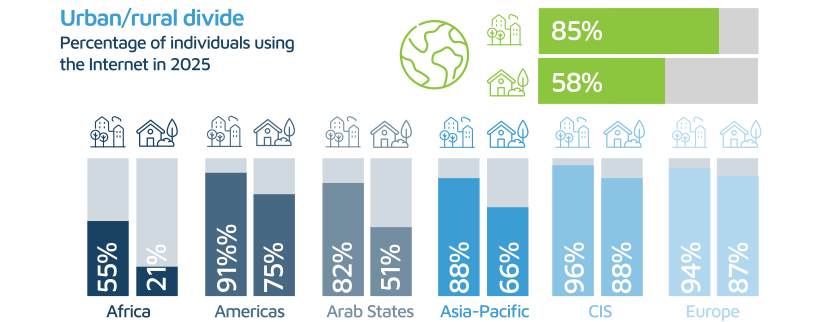
The digital divide does more than reflect inequality; it produces it. Studies into the social impact of digital inequality show income disparity widens as digital skills increasingly determine employment prospects. Gender gaps deepen in regions where women have less access to devices or training. Rural–urban divides solidify when rural populations remain disconnected. Civic exclusion arises when government services move online while citizens remain offline. Digital exclusion thereby becomes a social, economic, and political form of marginalization. Bridging the digital divide requires more than deploying infrastructure. It demands a holistic transformation strategy that can integrate investment, training, governance, and cooperation. A glimpse into such strategies and actions is shown below.
Fig.1. ITU Facts and Figures 2025: Across the world this year, 85% of urban dwellers are using the Internet, compared with 58% of #Internet users in rural areas.
Source: ITU
Bridging the digital divide through holistic transformation
🔹 Prioritizing digital infrastructure
Sustained investment in broadband networks, community access centers, and reliable electricity is essential to narrow the digital divide gap. In this regard, the World Bank digital infrastructure guidance stresses the value of public–private partnerships to expand coverage.
At the same time, enhancing digital skills must be incorporated into national curricula and supported through community programs. As an example, UNICEF digital skills initiatives highlight that training at all levels helps to create a resilient digital workforce.
🔹 Strengthening governance and data frameworks
Countries must regulate AI systems, protect data sovereignty, and build cybersecurity capacity. UN digital governance principles demonstrate the importance of an equitable and safe digital transformation.
Developing countries can learn from each other through shared innovations. The examples below from Kenya, India and Estonia indicate how a path towards more efficient digitalization could be achieved.
Kenya’s M-Pesa demonstrates that mobile-first financial inclusion can transform economies where traditional banking is inaccessible, while the Digital India initiative shows the power of coordinated national digital strategies. In Europe, Estonia’s e-governance ecosystem provides scalable insights into secure digital identity systems and transparent public service delivery.
These examples demonstrate that effective solutions must be adapted to local realities and not simply copy-pasted across the globe.
🔹 Looking forward: Digital inclusion as a global imperative
As the global economy becomes increasingly digital, nations that fail to build a strong digital foundation risk long-term exclusion from innovation, trade, and technological growth. This, in turn, will lead to their populations falling behind. This is why bridging the digital divide is not only a technical issue – it is a developmental, economic, and moral imperative.
Reports on global digital inclusion trends highlight that ensuring that digital transformation benefits all populations will define the next decade of development. Achieving this will require a shared commitment from governments, civil society, private industry, and international institutions to build not just the infrastructure, but inclusive, human-centered digital ecosystems that empower every person – not just the digitally privileged.
Perspectives on the digital divide in the coming years
Over the next decade, the digital divide is expected to evolve from a simple question of who is online into consideration of the more complex gap in the quality of connectivity, skills, and ability to use advanced technologies such as AI. Recent data from the International Telecommunication Union (ITU) shows that around 6 billion people are now online – about 75% of humanity – yet 2.2 billion remain offline, mostly in low- and middle-income countries. Even among those who are connected, many lack affordable high-speed access, a reliable electricity supply, and the devices needed for meaningful use.
🔹 From basic access to “meaningful connectivity”
Future debates will focus less on whether people are connected at all, and more on how well they are connected. The ITU’s updated ICT Development Index 2025 shows that low-income countries are progressing quickly but still lag far behind high-income nations in terms of broadband speed, affordability, and usage. Closing this gap will be expensive with recent estimates suggesting that achieving universal, affordable broadband by around 2030 could require an investment in the order of trillions of dollars globally.
🔹 The rise of an AI divide
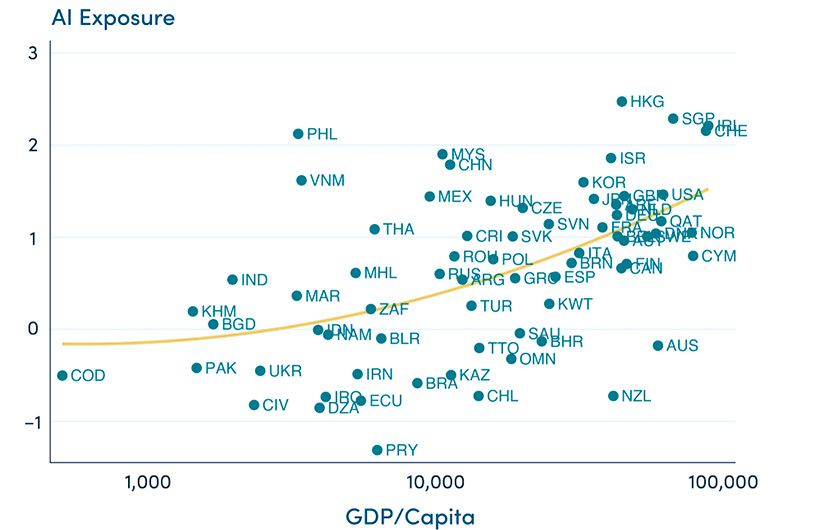
As AI tools spread, a new AI divide is emerging on top of existing connectivity gaps. A World Trade Organization analysis warns that AI could significantly boost global trade by 2040 but widen the wealth gap if poorer countries lack the infrastructure, data, and skills to adopt it. Similarly, Microsoft’s AI Diffusion Report finds AI use growing more quickly than any previous technology, yet adoption rates in many regions of Africa, South Asia, and Latin America remain below 10% due to limited infrastructure and language barriers.
If these trends continue, the coming years may see a small group of AI-ready economies capturing most of the productivity gains, while others remain stuck as consumers of imported digital services.
Fig.2.Correlation between national wealth (GDP per capita) and AI readiness.
Source: Center for Global Development
🔹 Skills and literacy as the new frontier
By the early 2030s, digital skills are likely to become the main line of separation between those who benefit from technology and those who do not. A World Bank Digital Progress and Trends report highlights that the share of companies investing in digital solutions has more than doubled, but workers in many low-income countries still lack the skills to use these productively. Other studies indicate that even in countries with large digital economies, basic and advanced ICT skills remain unevenly distributed across regions, gender, and income groups.
This means that simply deploying networks will not be enough. It can be expected that governments will have to invest heavily in education, reskilling, and lifelong learning to prevent the skills gap from hardening into a permanent social divide.
🔹 Governance, rights, and data sovereignty
Another emerging perspective on the digital divide concerns who sets the rules of the digital world. Many developing countries are concerned about becoming permanent “data colonies” that are dependent on platforms and cloud services controlled elsewhere. International discussions at the UN and other forums now frame connectivity not only as an infrastructure issue, but also as one of digital rights, data protection, and sovereignty. Without stronger domestic institutions and regulatory capacity, countries risk being locked into unequal relationships where they supply data but capture little of its value.
🔹 Inclusion as a global development priority
At the same time, there is cause for optimism. Initiatives such as the World Economic Forum’s EDISON Alliance aim to improve affordable digital access for 1 billion people by expanding connectivity and basic services in health, finance, and education. The UK’s Digital Development Strategy 2024–2030, for example, explicitly aims to halve the connectivity gap in at least 20 partner countries by 2030. These efforts signal that many governments and organizations now treat digital inclusion as a core development priority rather than being a side issue.
🔹 Likely scenarios for the next decade
Looking ahead, analysts have defined two contrasting potential scenarios:
- In a fragmented scenario, investment and policy coordination would remain limited. Connectivity would improve but remain expensive and uneven. AI capabilities would be concentrated in a handful of countries and the digital divide would deepen into a structural “opportunity gap” that would reinforce existing inequalities between and within countries.
- In a cooperative scenario, global finance, regulation, and public–private partnerships would align around universal, meaningful connectivity goals. Targeted investments in infrastructure, skills, and inclusive innovation – such as AI for accessibility, translation, and education – would make digital technologies the driver of broader social and economic inclusion.
Which path will become reality depends on the decisions taken in the next few years – how much countries invest, how they regulate new technologies, and how seriously they treat digital access as a human development priority.