

Add us as your preferred source on Google to see more of our content in Search.
 Add to Preferred Sources
The text you’re reading right now on your screen, in a split second, has already traveled thousands of kilometers via optical fiber networks and underwater cables from a data center halfway across the globe.
Data centers are invisible behemoths that form the foundation of the internet and the digital economy, and their importance cannot be underestimated.
Fun fact. Did you know that the vast majority (around 95-99%) of international internet traffic relies on undersea fiber-optic cables that span hundreds of thousands of kilometers across ocean floors to connect data centers?
Understanding data centers: Definition and importance
In its most basic form, a data center is a physical facility with servers and IT equipment, where businesses store important data and applications, according to Cisco. Thousands of powerful machines are housed in these facilities, being kept temperature-regulated and operational around the clock.
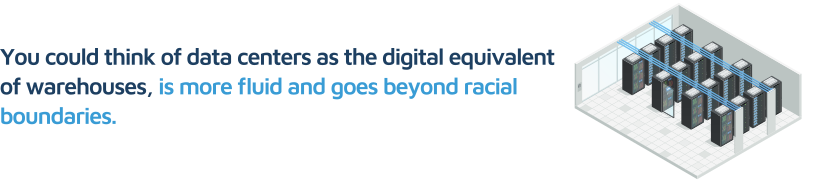
At the heart of a data center’s architecture lies an interconnected network of:
- Computing resources such as servers and processors
- Storage systems, including drives and arrays
- Essential networking infrastructure like switches, routers, and firewalls
Together, these components facilitate the efficient processing, storage, sharing, and transfer of data and applications across users and systems.
Data centers’ work explained
Ranked: The leading countries by number of data centers
In November 2025, the United States reportedly had 4,165 data centers – more than any other nation in the world. Furthermore, this number is almost equivalent to the total of all other data centers in the remaining 19 countries out of the Top 20! For comparison, there were 499 in the United Kingdom and 487 in Germany, which ranked second and third, respectively, according to Statista.
Top 20 countries dominating the data center market
The graph below shows the number of data centers in the top 20 nations as of November 2025.
Source: Statista
 The United States
According to a recent report by Axios, about 3,000 new data centers are being built or planned throughout the United States, adding to the 4,165 currently operational.
Virginia is the leading U.S. state in terms of the number of data centers with 663 active and 595 either scheduled or under development.
Other top states include:
- Texas with 405 in operation and 442 planned or under construction
- Georgia, with 162 data centers, and plans for another 285
- Pennsylvania with 98 data centers and 184 in the pipeline
 The United Kingdom
The UK had more data centers than any other country in Western Europe in 2024, according to Watson Farley and Williams.
As of December 2025, there were around 500 data centers across the UK, according to the latest estimates.
The sector is expected to grow to US$22.7 billion by 2030 as a result of the extraordinary demand for capacity brought about by generative AI and advanced analytics, cloud services, the introduction of 5G, and the Internet of Things.
 Germany
Germany already has the most data centers in the EU, with about 120 located in the Frankfurt region alone.
In addition, over the coming years, Google intends to spend more than €5.5 billion (US$6.37 billion) developing and growing data centers across Germany, according to DW, but it is not the only company who has such big plans.
A €1 billion data center project involving American AI chipmaker Nvidia and German telecom provider Deutsche Telekom was revealed on Nvidia’s official blog.
Investment trends in the data center market
McKinsey predicts that around US$6.7 trillion in capital expenditure will be needed globally for data center infrastructure by 2030 to meet demand:
- US$5.2 trillion will focus on AI‑optimized facilities
- US$1.5 trillion will be capital expenditure for data centers that power typical IT applications
Global data center capacity growth by region (2020–2030)
Source: JLL
The top 10 biggest data centers globally by floor space
This ranking, created by Datum, lists the largest data centers by floor space. The capacity of each data center is also shown apart from that of the data center operated by Apple Inc., which remains undisclosed.
10 largest data centers by floor space
Power capacity reflects the total electricity load that can be handled by the data center.
Top 10 data center companies
Based on the latest available rankings from Data Center Magazine, the top 10 data center companies are dominated by hyperscale cloud providers and major colocation* operators.
*Colocation is the practice of renting space for your own servers and IT equipment in a third-party data center.
Emerging markets: Regions gaining ground in data center presence
According to Global Data Center Hub, three regions are currently influencing the digital infrastructure development:
Southeast Asia
Southeast Asia boasts 542 facilities (managed by 164 providers) with floor space totaling around 2,115,867 square meters (22,775,013 sq. ft) and a total capacity of 3,366 megawatts, according to Baxtel.
In nations such as Indonesia, Malaysia, Thailand, and Vietnam, enormous populations and rapidly expanding digital economies are propelling an increase in new data center construction.
- Jakarta in Indonesia, with a population of more than 30 million, is currently one of the world’s most rapidly developing colocation markets.
To meet demand, both domestic operators such as DCI Indonesia and ST Telemedia and international companies, including Equinix, Google, and Amazon, are increasing the number of facilities in the region, as detailed by Global Data Center Hub.
- Malaysia has established itself as a prospective hub thanks to lower land and power costs. It has therefore attracted investments from American companies such as Microsoft, Amazon, and Alphabet, as well as Chinese companies like Huawei and Alibaba, reports Reuters.
Latin America
The data center sector in this region is expected to nearly double in size, from around US$5 billion in 2023 to more than US$10 billion by 2029, according to the same Global Data Center Hub.
The region is home to 338 data centers operated by 74 providers, states Baxtel.
Countries experiencing growth are Brazil, Mexico, and Chile, where dozens of new facilities are being built and where large populations are coming online, which in turn attracts cloud providers.
Africa
Currently, this continent accounts for less than 1% of global data center capacity, and is still often regarded as being the final digital frontier.
According to industry figures, the continent needs over 700 additional facilities with no less than 1,000 MW of new capacity to satisfy its rapidly increasing demand.
- South Africa is currently the key hub with large cloud regions for AWS, Microsoft Azure, and Google Cloud, but fresh investment is extending north and west.
- Nigeria and Kenya, with the help of high-capacity undersea cables, including Google’s Equiano and the 2Africa cable, have significantly increased their connectivity.
Global data center landscape: Current trends and insights
Global data center capacity will double between 2026 and 2030 with the addition of about 100 GW of new data centers, according to the JLL 2026 Global Data Center Outlook.
Here are a few interesting extracts from the report:
- By 2030, the sector is expected to grow at a 14% CAGR, with the main drivers being hyperscalers like AWS, Azure, and Google Cloud.
- Since AI, cloud computing, and digital services are increasing, companies are pouring trillions into data centers worldwide with the report mentioning this could be up to US$3 trillion by 2030.
- Between 2026 and 2030, almost 100 GW of additional capacity is predicted to come online, equating to US$1.2 trillion in real estate asset value.
- Companies could spend another US$1-2 trillion just to fill data center facilities with IT equipment.
The graph below illustrates three scenarios of potential growth of the demand for data centers:
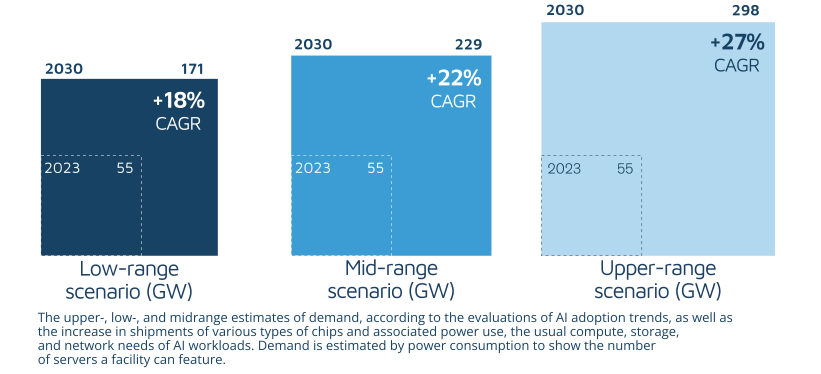
Source: McKinsey & Company
The role of data centers in the digital economy
Organizations rely on data centers to support a wide range of vital business functions and modern workload, including:
- Email and secure file sharing
- Customer Relationship Management and Enterprise Resource Planning platforms
- Core business databases and transactional systems
- Virtual desktop infrastructure and unified communications and collaboration tools
- Big data analytics, artificial intelligence, and machine learning workloads
- Advanced AI use cases such as large-scale model training, retrieval-augmented generation (RAG)*, and real-time inference*
*RAG is an AI technique that improves Large Language Models by linking these to external, trustworthy knowledge bases to gather real-time, relevant, and factual data prior to providing an answer, thus avoiding hallucinations and enhancing accuracy.
*Real-time inference means using a trained machine learning model in real time on new, unknown information to provide predictions or decisions almost instantly.
Hyperscale data centers: The New Frontier
The rapid growth of the global data center sector necessitates innovative energy solutions to avoid overloading power grids.
Big tech corporations (hyperscalers) will continue to drive this growth by both renting data centers and creating their own.
Understanding hyperscale data centers and their impact
A hyperscale data center is a gigantic data center designed for large-scale workloads, with efficient network infrastructure, streamlined network connectivity, and reduced latency.
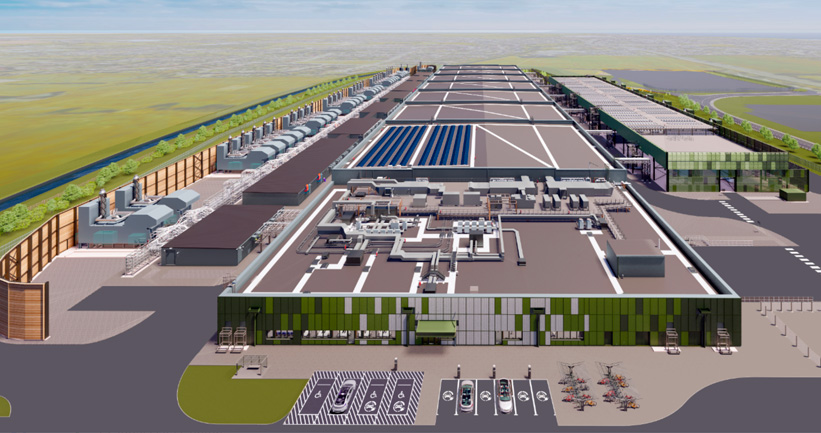
Source: Data Centre Dynamics
Since the need for data storage is constantly growing, hyperscale data centers are widely used worldwide by many providers for a wide range of purposes:
- Artificial intelligence
- Automation
- Data analytics
- Data storage
- Data processing and other intensive data computing tasks
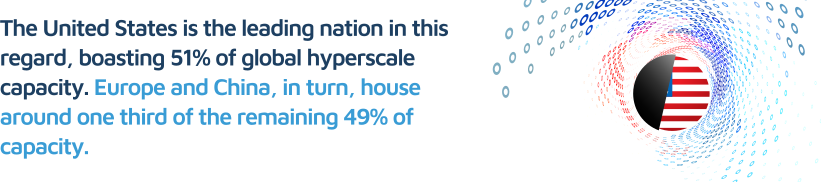
There were 992 large data centers managed by hyperscalers at the end of 2023, and by 2024, this number exceeded the thousand mark.
Conclusion
Data centers are at the beginning of a major growth wave, mostly powered by LLMs. But this growth is dominated by the trend of going beyond the construction of giant facilities towards those that are also smarter.
Global data center investment continues to be led by the United States, the United Kingdom, and Germany.
However, Latin America, including countries like Brazil, Chile, Mexico, and Colombia, and Southeast Asia (Singapore, Malaysia, and Indonesia, among others) are rapidly gaining ground and attracting significant capital due to power availability, cost advantages, regulatory support, and the growing need for distributed AI infrastructure.