


Add us as your preferred source on Google to see more of our content in Search.
 Add to Preferred Sources
Key reasons to read this article
- A disease thought to be extinct is quietly returning and spreading quickly.
- Real-life stories reveal how measles still kills despite modern healthcare systems.
- New data shows outbreaks are no longer isolated blips but part of a wider trend.
- Popular measles myths are set against proven public health facts.
A young child in the UK died of measles in mid-2025, the first UK measles death in a year. Health authorities confirmed the child was too ill to survive despite care. Sixteen-year-old Nastasia from France fell into a coma from measles encephalitis and has only recently begun to recover from what had started as just a sore throat. These cases, separated by borders but linked by the same virus, illustrate how measles can turn from a forgotten illness into a medical emergency.
Measles, once thought to have been effectively eradicated in Europe and North America, is reemerging, raising the risk that several countries could lose their long-held elimination status. Measles-free nations have recently reported large outbreaks, a reminder that public health victories are often provisional rather than permanent.
A virus that never truly left
Health officials describe measles as “the most contagious virus” known to humans. It spreads through respiratory droplets and can linger on surfaces or in the air for up to two hours. A single infected person typically infects 12 to 18 others. There is no specific cure, only supportive care, but a safe and effective vaccine can prevent nearly all cases.
Before vaccination was launched in the 1960s, measles was a routine childhood illness, globally causing millions of infections and about 2.6 million deaths each year. The arrival of a vaccination transformed the disease from being an almost childhood certainty into a rarity.
By the 2000s, the Global North had largely eliminated endemic measles. In Canada, it was deemed to have been eliminated in 1998 largely due to immunization, and the U.S. had officially eliminated measles in 2000. Europe likewise had almost eradicated measles by the mid-2010s while the Americas were certified measles-free in 2016.
Successful elimination has, however, proven to be reversible. Beginning in 2018–2019, measles outbreaks surged as immunization rates slipped. In January 2026, the WHO declared that the UK and five other European and Asian nations – Spain, Austria, Armenia, Azerbaijan, and Uzbekistan – had re-established endemic transmission and had therefore lost their measles-free status.
Even Canada, measles-free since 1998, lost its status in late 2025 after a year-long outbreak that had been sparked by a single imported case. An intense outbreak in South Carolina has raised concerns that the United States could also lose its own long-held elimination status.
Current outbreaks – a shift not just a spike
Recent figures suggest these are more than just isolated flare-ups. They point to a broader change in trend rather than a temporary surge.
In Europe, WHO/UNICEF reported 127,350 cases in 2024, the highest since 1997. Children under 5 accounted for over 40% of cases, and hospitalizations were frequent.
Canada’s outbreak, which began in October 2024, had led to over 5,000 cases by late 2025, shattering previous national records.
In the United States, confirmed cases surged dramatically in 2025, with 49 outbreaks across various states as opposed to 16 in 2024. The CDC reported 2,267 confirmed cases in 2025, nearly eight times the 285 cases recorded in 2024.
Roughly 30% of global cases in 2024 were in Europe, and North America saw a 30-fold jump in infections between 2024 and 2025.
Why is measles returning?
A report by BlueDot and other public health analyses points to one main driver – falling vaccination coverage. Measles requires roughly 95% two-dose immunization rates within communities to prevent sustained spread. In many regions, that threshold is no longer being consistently met.
Reports of outbreaks and surveys cite several other contributing factors, including vaccination reluctance, misinformation, and policy changes. Experts also note that access and affordability, not just refusal, can influence coverage gaps.
Even high-coverage countries remain vulnerable whenever measles is active elsewhere. Travelers introduce the virus, often to under-vaccinated communities. Canada’s 2024–25 outbreak began with a single imported case from a traveler, which then sustained circulation for over a year. In early 2025, Utah and Texas saw the same strain linking New Mexico cases to an outbreak in Texas in late 2024.
According to Dr. Deborah Greenhouse from the American Academy of Pediatrics, as measles numbers continue to rise, there is a likelihood that cases will be seen in new areas, mainly caused by importation.
Measles: Myths vs. facts
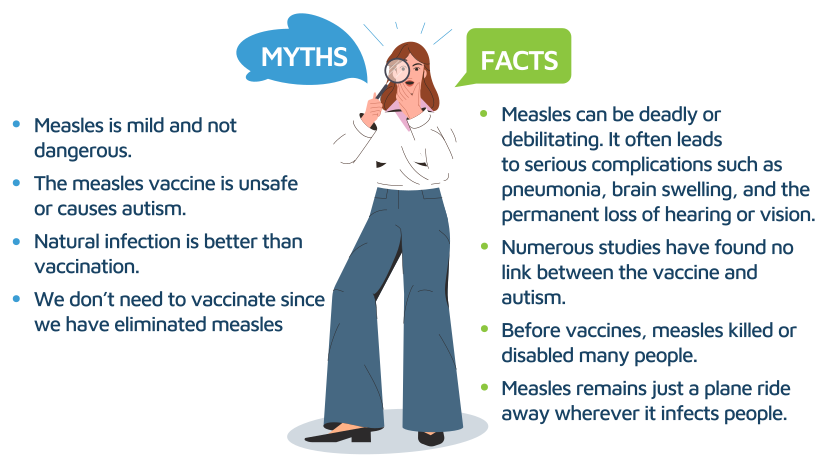
Thousands of real-life testimonies, across decades and continents, all echo the same lesson – measles is not harmless and can leave a trail of death and disability. Unless every country maintains 95% coverage, any gap can spark an outbreak. According to PAHO Director Jarbas Barbosa, until measles is eradicated globally, several regions will continue to face the danger of viral reintroduction and transmission among unvaccinated or under-vaccinated people.