
EU Deforestation Regulation and its external effects: Compliance and adaptation in producer countries

Add us as your preferred source on Google to see more of our content in Search.
 Add to Preferred Sources
The EU Deforestation Regulation (EUDR) is one of the most far-reaching instruments of the European Green Deal. With access to the EU market conditional on proof that certain commodities are both deforestation-free and legally produced, the EUDR’s effects will extend well beyond Europe’s borders. Producers and exporters in the Global South will be particularly affected, as they will be required to provide information to enable compliance.
Compliance with the EUDR requires operators to generate, manage, and transmit extensive supply-chain information before placing products on the EU market. This entails collecting detailed product and supplier data, ensuring full traceability back to the point of production through geolocation coordinates, and establishing internal systems that are capable of assessing and documenting risk.
At the same time, the EUDR will be implemented against a broader backdrop of regulatory simplification at the EU level. In recent months, the scope of several Green Deal initiatives has been narrowed, with an increasing focus on larger corporations. Amendments to the EU Taxonomy, the Corporate Sustainability Reporting Directive (CSRD), and the Corporate Sustainability Due Diligence Directive (CSDDD) reflect this shift.
The simplification agenda has also resulted in the postponement of the EUDR’s application which is now scheduled for 30 December 2026. However, despite delayed timelines and a tightening of the EU’s requirements, the combined effects of these regulatory frameworks are expected to impact global trade and value chains.
These effects are likely to be more pronounced for small and medium-sized enterprises (SMEs) and smallholders in developing countries. This applies both to those regulations with direct impact, such as the EUDR, and to those with indirect supply-chain consequences, notably the CSRD and the CSDDD. As EU companies adapt to new sustainability reporting and due diligence requirements, suppliers in third countries are increasingly expected to provide detailed environmental, social, and governance data, including information on greenhouse gas emissions. Meeting these requirements poses a significant challenge in contexts where data availability, technical capacity, and financial resources remain limited.
What is the EUDR?
It was adopted in 2023 to reduce the EU’s contribution to global deforestation and forest degradation. The EUDR requires that coffee, cocoa, palm oil, beef, rubber, soy, wood, and their derivatives placed on the EU market are not linked to deforestation or forest degradation occurring after 31 December 2020. In addition, importers and traders must demonstrate that these products have been produced in compliance with all the relevant laws in the country of origin.
As a major global importer, the EU’s demand has historically contributed to substantial forest loss. According to the World Resources Institute, the aforementioned commodities account for approximately 57% of global agriculture-driven deforestation. By promoting deforestation-free supply chains, the EUDR is also expected to reduce greenhouse gas emissions by at least 32 million tonnes of CO₂ annually.
To comply with the regulation, importers must establish and operate a due diligence system. This includes collecting information on products, suppliers, and countries of origin, geolocation data and mapped land boundaries for larger production plots; assessing deforestation and legality risks; and implementing measures to mitigate any identified risks. Companies must then submit a due diligence statement via the EU’s Deforestation Regulation information system.
Economic impact of the EUDR: the case of Honduras
Large exporting companies in the Global South are generally better positioned than smallholders and SMEs to meet the EUDR requirements and absorb the associated costs of compliance. This highlights the need for greater outreach and awareness-raising among small producers and smaller firms. In countries where production is dominated by smallholders, exporters risk losing suppliers, while the most vulnerable actors in the value chain may be excluded from EU market access. In this context, international cooperation plays a vital role in supporting governments and value chains to identify compliance gaps and develop effective adaptation roadmaps.
Figure 1: EU imports of affected commodities as a percentage of each trade partner’s GDP
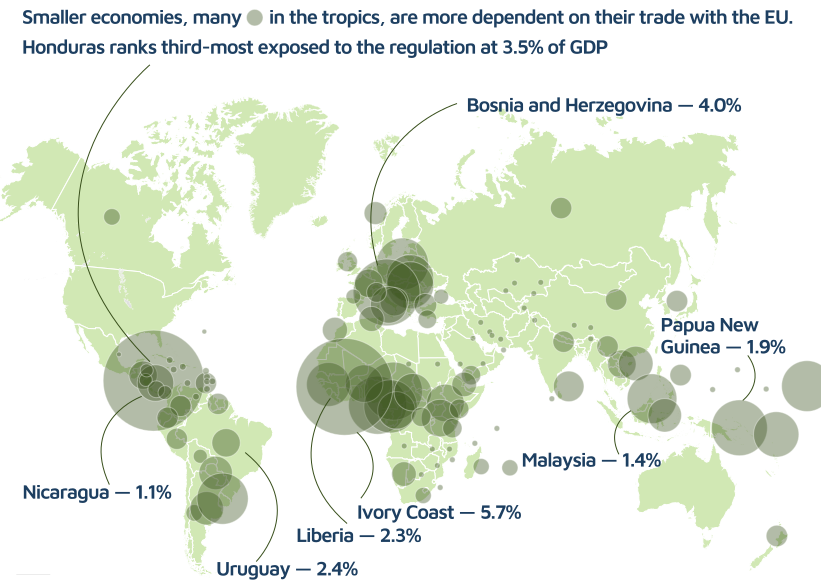
Source: Bloomberg
The economic impact of the EUDR is closely linked to the extent to which a country’s export portfolio falls within the regulation’s scope. Honduras illustrates this dynamic very clearly: 54% of Honduran coffee exports are destined for Europe. According to data from the Central Bank of Honduras, the EU is its second-largest trading partner, and in 2024 the country exported US$976 million worth of goods to the European market. Coffee alone accounted for US$603.5 million — nearly 62% of all exports to the EU. Beyond its export value, coffee plays a critical socio-economic role, generating more than one million direct and indirect jobs and being dominated by smallholders who cultivate plots of between one and four hectares.
Crude palm oil is the second most important export to the EU, with shipments valued at US$198.1 million, or just over 20% of total exports to the European market. This volume represents approximately 55% of Honduras’s national palm oil production. Taken together, the coffee and palm oil value chains accounted for more than 82% of Honduras’s exports to the EU in 2024. Both sectors, however, face substantial compliance challenges under the EUDR, driven primarily by high levels of informality and persistent land tenure issues, including land grabbing.
The predominance of smallholders in the Honduran coffee sector and the complex land tenure dynamics in palm oil mean that high levels of informality significantly weaken traceability, geolocation, and documentation systems. Informal production, unclear land titles, and the absence of environmental licenses hinder the ability of operators to demonstrate legal origin and deforestation-free status. Consequently, informality becomes a structural obstacle to EUDR compliance, increasing the likelihood that substantial segments of the country’s export base could be excluded from the EU market.
Given the diversity of producer countries, adapting to the EUDR will require tailored regulatory, value-chain, and institutional capacity responses that reflect local production structures and governance systems. In Argentina, for example, this kind of coordinated response is already emerging through the industry-led platform Visión Sectorial del Gran Chaco Argentino (VISEC), which brings together producers, exporters, government authorities, and civil society to build national traceability and certification systems for soy and beef. VISEC’s monitoring, reporting, and verification framework tracks products from their origin to a port, issues deforestation-free certificates, and aligns domestic data with EUDR due-diligence requirements, illustrating how sector-specific institutional arrangements can help to reconcile compliance with international regulations and national production realities. Certification schemes can enhance traceability and improve data availability, but are not a substitute for a full due diligence system under the EUDR.
Capacity determines market access
The EUDR illustrates how the EU’s Green Deal is reshaping global trade by externalizing sustainability standards into international value chains. Its effectiveness will depend not only on regulatory design in Europe, but on the capacity of exporting countries, particularly smallholder-based economies, to build traceable and legally robust production systems. Without targeted support and coordinated adaptation, the regulation risks deepening existing asymmetries in market access even as it pursues legitimate environmental objectives.
This factsheet outlines the key requirements of the EUDR and provides stakeholders with a concise and practical overview of the regulation’s compliance obligations:
Source: Author’s interpretation based on the EUDR