
Add us as your preferred source on Google to see more of our content in Search.
 Add to Preferred Sources
Key reasons to read this article
- Discover why humanitarian symbols are failing in Iran, where over 20 aid workers have been killed in just two months of the ongoing military conflict.
- Understand how underreporting hides the true toll.
- Explore how international humanitarian law is being tested.
- Learn why Iran’s humanitarian network is struggling like never before.
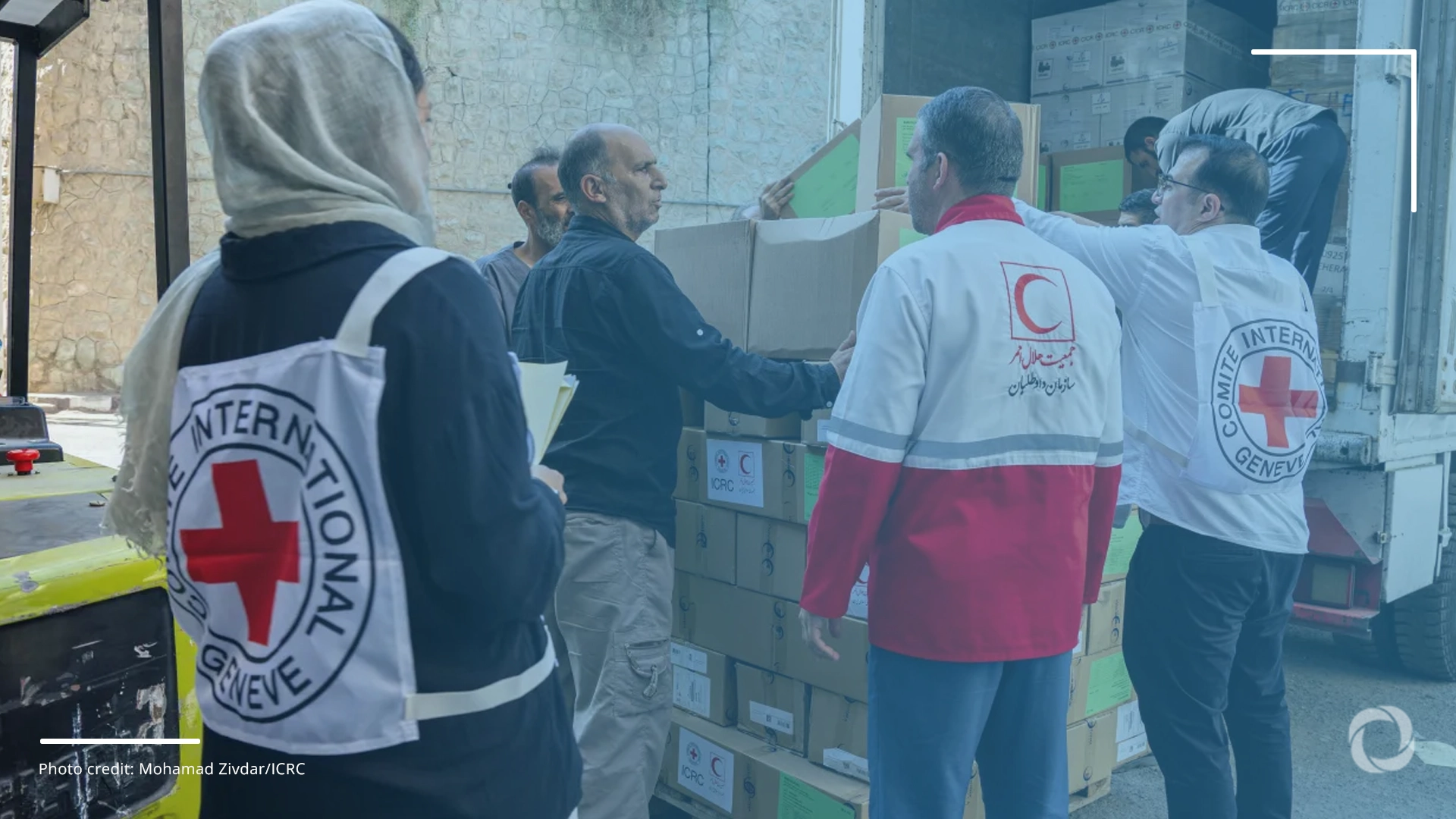
Hamidreza Jahanbakhsh, an Iranian Red Crescent Society employee, was pulling survivors from the rubble in Iran’s Isfahan province when he was killed. He was wearing the Red Crescent emblem. Three weeks later, Dr. Somayeh Mir Abo Eshagh was delivering psychosocial support in Khansar when she was killed. She was wearing the emblem, too. On 31 March, Alireza Sohbatlou was assisting civilians in Zanjan when an airstrike found him. All three were identifiable as humanitarian workers. All were killed while responding.
At least 24 healthcare workers have been killed and 114 injured since the U.S.-Israel-Iran conflict began in late February, according to Iran’s Emergency Organization. The Iranian Red Crescent Society reports that 18 centers have been hit and nearly 100 ambulances damaged or destroyed. Independent monitors, including the Human Rights Activists News Agency (HRANA), warn that these numbers are almost certainly underestimates. The conflict, which some officials initially claimed would last a couple of weeks, is now testing whether the humanitarian system can still guarantee safety.
This pattern is neither random nor new. Sudan, the Democratic Republic of the Congo, Gaza, and Ukraine have all witnessed humanitarian workers being killed during conflicts. The developments in Iran highlight the increasing risk to humanitarian workers and raise concerns about adherence to international humanitarian law, which is designed to protect humanitarian personnel and facilities.
Humanitarian toll – confirmed minimum figures
| Healthcare workers killed | 24 |
| Humanitarian workers injured | 114 |
| Red Crescent centers damaged | 18 |
| Ambulances damaged or destroyed | 100 |
| Hospitals shut down | 12 |
A system under strain before the war
Iran’s humanitarian landscape is unique among contemporary conflict zones. The state-mandated Iranian Red Crescent Society is “the only humanitarian group working across the country”, Maria Martinez, head of the International Federation of Red Cross and Red Crescent Societies delegation in Tehran, told Reuters. This reflects its nationwide operational reach, unlike other actors.
To operate in the country, other humanitarian organizations, including the International Committee of the Red Cross and United Nations agencies such as the World Health Organization (WHO), United Nations Children’s Fund, and the World Food Programme (WFP), must navigate dual approval processes from both the Iranian government and the U.S. Treasury’s Office of Foreign Assets Control.
International sanctions already in place against Iran formally exempted medicine and food, but the indirect effects have long constrained humanitarian operations. International banks have often refused to process Iran-related transactions even if these are humanitarian in nature, as documented by the Norwegian Refugee Council in 2019.
The ongoing conflict has worsened this situation. Currently, containers of health supplies remain blocked at the border. The UN’s primary staging hub in Dubai had virtually no ships moving through the Strait of Hormuz during the first weeks of the war.
The IFRC’s US$50 million emergency appeal, already likely to require revision upward, is just 6% funded. “The needs are exponentially increasing,” Martinez told Reuters. “Resources are not unlimited.”
As Iran is one of the world’s top refugee-hosting countries, sheltering almost 4 million forced migrants, in late March, the UN appealed for US$80 million to address the urgent humanitarian needs of about two million refugees.
Counting the cost: What the data shows and what is unrevealed
The true human toll within the humanitarian system in Iran remains unknown, shaped as much by what can be verified as what cannot. The disparity between confirmed and actual casualties may be one of the conflict’s most troubling aspects.
HRANA noted that the reported 24 healthcare workers who have been killed and 114 injured represent minimum confirmed cases, reflecting constraints imposed by limited access and risks faced by those sharing information.
Part of the problem is structural. WHO tracks verified attacks on facilities. HRANA tracks confirmed personnel casualties. The IFRC tracks its own staff separately. The UN Office for the Coordination of Humanitarian Affairs has noted that there is no single entity responsible for tracking casualties across contexts.
The Aid Worker Security Database, one of the most widely used data trackers, has faced funding and data collection constraints after losing U.S. government funding when the United States Agency for International Development was dismantled in 2025. It has no established data pipeline for this conflict as it relies on voluntary public data from organizations.
What is clear is that local humanitarian staff account for the overwhelming majority of casualties. With few international organizations operating in the country, Iranian responders are absorbing most of the operational risk. Martinez has described situations when rescue workers recovered the bodies of their own relatives while on duty, a convergence of personal loss and professional duty rarely captured in official data.
The pattern is not unique to Iran. In 2024, a record 383 aid workers were killed globally, according to the Aid Worker Security Database, most of them national staff serving their own communities. UN officials warn that such numbers are likely to underestimate the true toll, particularly among national staff working in underreported environments.
Neutrality under pressure
Humanitarian neutrality, the principle that aid workers and medical facilities must be protected precisely because they serve all sides, is one of the oldest commitments in the laws of war. In Iran, there are growing concerns about whether this is being consistently upheld.
WHO has recorded more than 20 attacks on healthcare facilities and personnel since the conflict began. Gandhi Hospital in Tehran was struck on 2 March when a nearby target was hit. Patients, including newborns, were evacuated through smoke and broken glass. The Iranian health department revealed on 25 March that 190 medical centers had been damaged and 12 hospitals had been closed due to the war.
The United States and Israel have accused the Iranian military of using civilian infrastructure for military purposes, complicating targeting decisions, a claim the Iranian government has refuted.
Legal experts emphasize that obligations remain regardless of the context. “If there is substantial doubt, then you should refrain from attack,” explained Adil Haque, Professor of the Law of Armed Conflict at Rutgers University.
Rohini Haar, co-chair of the Safeguarding Health in Conflict Coalition, commented that attacking medical facilities “without making the distinction and proportionality” is “particularly egregious”.
Gabor Rona, a former ICRC legal adviser, has warned that when wars are framed around sweeping goals such as a change in regime, adherence to international humanitarian law is often eroded.
A system under test
The funding crisis that preceded this war has made everything more difficult. Global development assistance fell by up to 17% in 2025. The WFP had already suspended support to 135,000 Syrian refugees in Jordan and 250,000 Sudanese refugees in Egypt before the conflict escalation in Iran.
Across Iran, ambulances sit idle, health facilities are shuttered, and aid workers continue to operate under threat.
The question they face is simple: whether the emblem they wear still offers protection or whether, in this war, it has become a mark that makes them visible.