

Add us as your preferred source on Google to see more of our content in Search.
 Add to Preferred Sources
Key reasons to read this article
- A war thousands of kilometers away from the Philippines is driving up daily costs in this archipelagic country.
- The global oil crisis has exposed the country’s dangerous dependence on imported fuel.
- From transport strikes to soaring electricity bills, the shock is rippling through every economic sector.
- Despite ambitious renewable energy targets, something is holding the country back. What is it?
- Will the crisis serve as a turning point in the Philippines’ energy future?
The Philippines has declared a national energy emergency as a global oil shock triggered by the escalating U.S.-Israel-Iran conflict disrupts fuel supplies and drives up costs across the country. On March 24, 2026, the Philippines’ President Ferdinand Marcos Jr issued an executive order citing serious risks to the country’s energy security as traffic through the Strait of Hormuz, a vital artery for global oil shipments, is being disrupted in the wake of the conflict.
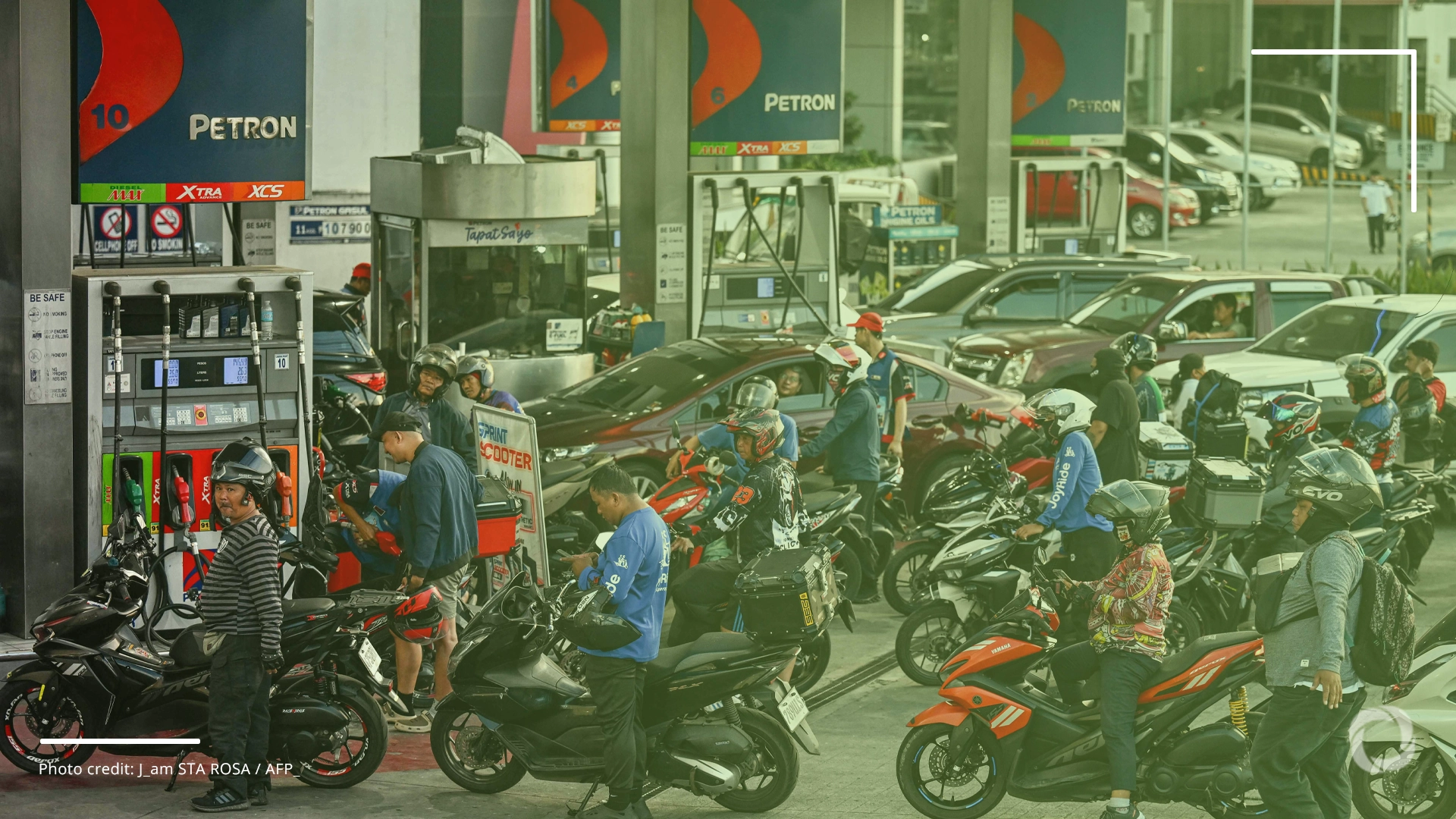
For the Philippines, which relies heavily on imported fuel, the consequences have been immediate and severe.
Rising fuel prices squeeze households and businesses
Energy Secretary Sharon Garin warned in late March that diesel supplies could only last for 45 days, and liquefied petroleum gas may run out in just 25 days.
Against this background, fuel prices surged sharply. Diesel rose from 54 pesos (US$0.90) to 76 pesos (US$1.26), while kerosene increased from 79 pesos to 114 pesos, and gasoline from 55 pesos to 62 pesos.
For many Filipinos, the impact has been immediate. Jayson Naga, a Manila tricycle taxi driver, earns about 500 pesos a day to support his family of four. He needs roughly 4 liters of fuel daily to ferry passengers in the city. The fuel hike has wiped almost a third of his daily earnings. “If gas prices go up any further, there will be nothing left for us,” he told The Guardian.
Electricity prices set to surge
The effects are spilling over into electricity generation. Power prices are predicted to surge by 16% to 20% this April, according to Department of Energy Undersecretary Rowena Guevara. She attributes the increase to the higher costs of transporting coal, which accounts for about 60% of the country’s electricity supply.
The price spike underscores how deeply fossil fuel dependence is embedded in the Philippines’ energy system, with experts having warned for some time now that outages and disruptions expose the structural vulnerability of a grid that has been built around imported fuels.
Oil dependency leaves Philippines exposed
The Philippines imports 98% of its crude oil, most of it from the Middle East, particularly Saudi Arabia. It also depends on foreign sources for 97% of liquid petroleum products, and 91% of liquid petroleum gas, which is mainly sourced from Asian refineries.
At the same time, domestic energy sources are coming under pressure. The Malampaya natural gas field, which supplies 20% of the country’s energy needs, is anticipated to have been depleted by 2027.
Together, all these factors have exposed the energy gaps in the Philippines and the need to explore alternative energy sources.
Renewable energy targets face challenges
The government set ambitious goals in March 2025 in order to shift towards cleaner energy, aiming for renewables to account for 35% of power generation by 2030, and 50% by 2040.
In response to the current oil crisis, the Department of Energy (DOE) announced plans to fast‑track procedures to ensure that 22 approved renewable power projects will be connected to the grid immediately, delivering an additional 1,471 MW of electricity by April 2026.
However, the scale of the challenge remains significant. Officials estimate that more than 14,200 MW of additional capacity are needed to boost the country’s power supply by 2030. Of these, 11,600 MW are expected to come from renewable sources.
Setbacks have also slowed progress. In 2025, the DOE cancelled 84 energy service contracts due to regulatory violations and project delays. These were estimated to have the equivalent capacity of more than 5,370 megawatts.
Harassment claims and public protests
While the government is pushing for the expansion of renewable energy, activists comment that the transition is being undermined by political pressure.
Rights groups state that individuals and organizations involved in climate action and community renewable‑energy projects have faced harassment, terrorism‑related accusations, and asset freezes under what is commonly referred to as “red‑tagging”. Many are contesting terrorism‑financing charges and frozen bank accounts in court.
In the meantime, as fuel prices surge to record levels, protest rallies have intensified across the Philippines. In late March and April 2026, transport workers launched nationwide strikes, disrupting public transport in Manila and other major cities. The unrest expanded into street protests at gas stations and oil company sites. Pressure has also moved into the political arena, with transport groups calling for the suspension of fuel tax and tighter state control over pricing, claiming that the crisis has exposed deep weaknesses in the Philippines’ energy security.
Government’s response
The tension on the streets eased slightly on April 14 when the government temporarily suspended fuel taxes under new emergency laws, resulting in diesel prices being slashed by over 20 pesos per liter (US$0.34). While this move defused several planned transport strikes in Manila, the respite remains fragile.
For the protesters at gas stations and government offices, these temporary price cuts are viewed to be a “band-aid solution” that fails to address the country’s deeper problem: a dangerous reliance on expensive, imported oil that is able to paralyze the economy at any moment.
Will the crisis reshape the Philippines’ energy future?
While the immediate focus remains on stabilizing fuel supplies, the broader question is whether this crisis will accelerate the energy transition. Energy groups have described the current shock as a “warning bell” to move away from fossil fuels, while development organizations like Oxfam Philippines argue it should prompt an urgent shift toward renewable energy. With officials acknowledging that the crisis is driving up costs across the entire economy, not just fuel, the spike is increasingly seen not as an isolated disruption, but as evidence of how deeply fossil fuel dependence is embedded within the country’s energy system.