

Add us as your preferred source on Google to see more of our content in Search.
 Add to Preferred Sources
Key reasons to read the article
- Learn how the particles in smog in the Philippines are small enough to bypass the lungs and enter directly into the bloodstream.
- Understand what is actually responsible for the vast majority of air pollution.
- Discover how toxic air is not just a health crisis, but a massive economic drain that costs the Philippines 12% of its annual GDP.
- Find out if, despite outdated environmental regulations, a surge in EV sales means the country can actually start to win the battle for clean air.
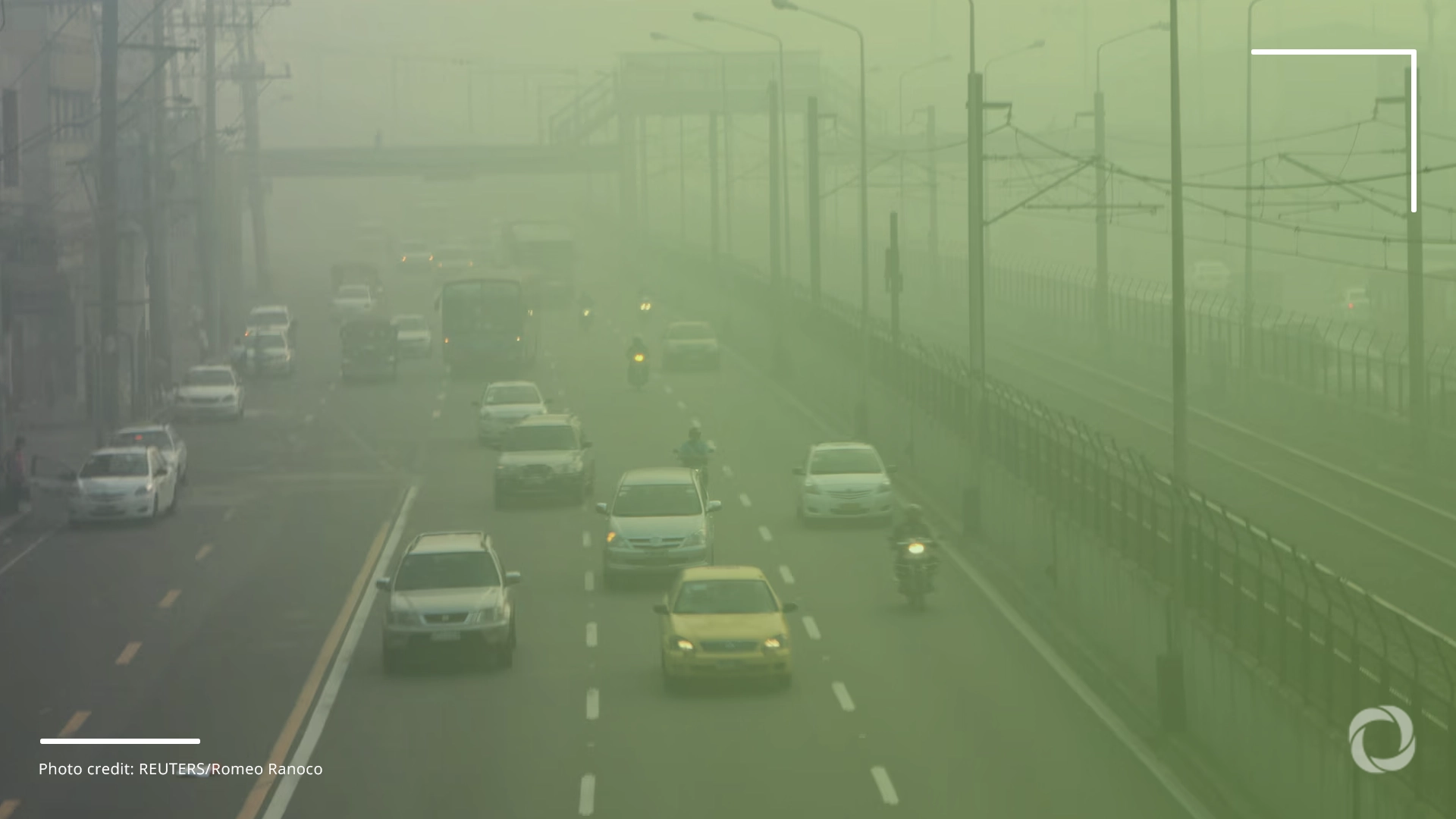
The Manila skyline has not just disappeared; it has been swallowed by heavy smog. A thick, yellowish veil of toxic particles fine enough to enter the human bloodstream has settled over the capital, making breathing a health risk.
Beginning on April 13, air quality plunged to “very unhealthy” levels across many areas in the Philippines. In some areas, concentrations of PM2.5 (microscopic soot particles smaller than 2.5 micrometers) were reportedly labeled as “acutely unhealthy”.
Health officials have warned that children, pregnant women, the elderly, and those with heart problems or lung disease face a higher risk of serious respiratory complications, while people with no prior health issues may develop throat irritation, coughing, or shortness of breath.
Landfill fire worsens air quality
The situation became worse after fire broke out at the disused Navotas Sanitary Landfill on April 10, which affected 28.6 hectares, or 71.5% of the 40-hectare site. The media reported that 11 days later, the fire had still not been extinguished, with the smoke likely to have contributed to the worsening air quality in Metro Manila and nearby areas.
Geminn Louis Apostol, Environmental Health Program Head at the Ateneo Center for Research and Innovation, explained the seriousness of the situation extends beyond the Navotas issue.
“Even if the fire on the surface is put out, the burning below will still contribute to the pollutants. Plus with the lack of rain, the pollutants remain trapped in the breathable zones.”
However, the landfill fire is only one aspect of a wider range of conditions that allow pollution to build up.
Weather conditions and vehicle emissions drive spike in PM2.5
The persistence of the haze as well as its spread are being further intensified by the fine particles that are trapped in populated areas by weak winds, high temperatures of 25-30°C with heat indices up to 37°C, and thermal inversion, which occurs when warm air traps pollutants near the ground.
These weather conditions not only trap emissions but also prevent smoke from sources such as the Navotas landfill fire from dispersing, allowing pollutants to accumulate over time.
Apart from the weather, the current hazardous air quality is also being caused by vehicle and industrial emissions in highly urbanized areas, according to Arthur Niño Calupig, an environmental management air quality monitoring specialist. Some estimates suggest that vehicles may contribute as much as 60% to 70% of air pollution, and dust may further worsen particulate levels.
In rural Philippines, air pollution is mainly associated with agricultural and open waste burning. These practices persist due to limited waste collection systems and the uneven enforcement of environmental regulations.
Health and economic impacts remain severe
Experts and environmental groups warn that air pollution in the Philippines is a major public health issue that has serious economic costs.
Research scientists link air pollution to 100 deaths per 100,000 people annually in the Philippines. A 2019 report estimated that 66,000 premature deaths, from non-communicable diseases and lower respiratory infections, were associated with exposure to air pollution. This included 1,310 children.
The latest available data indicates that the total economic cost of exposure to air pollution exceeded US$44.8 billion in 2019, which accounted for almost 12% of the country’s GDP. Premature deaths alone accounted for US$42.8 billion.
Mitigation efforts and safety measures
Officials and experts have proposed both short- and long-term measures to address air pollution.
To tackle worsening air quality and achieve lower carbon emissions, the country is considering a transition toward cleaner transport, including expanding the electric vehicle sector. According to Statista, EV sales surged from approximately 1,000 units in 2022 to about 18,000 in 2025. In early 2026, EVs accounted for nearly 12% of new vehicle sales.
In the short-term, water is being sprayed onto unpaved roads and dust suppression is being used on construction sites to limit airborne pollutants.
Disaster risk reduction and management officials have advised residents in areas deemed to be “very unhealthy” to:
- Stay indoors with all windows closed.
- Avoid outdoor activities, especially for children, the elderly, pregnant women, and those with respiratory or heart conditions.
- Wear a fitted N95 mask if going outside is necessary.
- Seek medical help for breathing difficulties, chest tightness, headaches, or eye irritation.
- Limit the time spent outdoors, even in less polluted areas, particularly for outdoor workers.
Structural challenges in air quality control
Despite the 1999 Clean Air Act, air pollution regulation in the Philippines remains uneven due to outdated policies, inconsistent enforcement, and gaps in the monitoring infrastructure.
Sustainable transport and pedestrian infrastructure remain underfunded, while transport modernization has progressed only slowly. Policies often focus on tailpipe emissions, ignoring non-exhaust sources, such as road dust and tire wear.
Real-time air quality data remains limited, which means that during recent pollution episodes, limited monitoring reduced public access to comprehensive information. Public compliance also remains inconsistent.