

Add us as your preferred source on Google to see more of our content in Search.
 Add to Preferred Sources
Cities in Small Island Developing States (SIDS) have leveraged nearly US$800 million in green climate funding to support coastal resilience, says a new Inter-American Development Bank (IDB) report.
The study, A Blue Urban Agenda: Adapting to Climate Change in the Coastal Cities of Caribbean and Pacific Small Island Developing States, estimates that 4.2 million people in SIDS in the Caribbean and in the Pacific are living in areas that are prone to flooding due to rising sea levels. As a result the region has now become a reference for other port cities.
“Caribbean and Pacific coastal cities are on the frontlines of climate change. It is critical to adapt and improve the resilience of cities in coastal zones, especially those experiencing rapid urbanisation,” Michael G. Donovan, senior urban specialist at the IDB
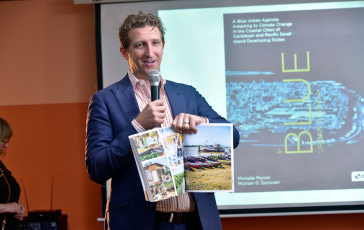
The international community has responded by providing US$55.6 billion in aid and private sector flows to Caribbean and Pacific SIDS over the last 20 years. These programmes have included coastal engineering to protect cities from flooding and coastal erosion, wetland restoration, coral reef conservation and watershed rehabilitation, urban planning and the enforcement of coastal setbacks and flood-resistant building codes.
The study reviewed 50 projects financed by the IDB, World Bank, Asian Development Bank and others, and the efforts made by Caribbean and Pacific SIDS to implement adaptation strategies aimed at reducing vulnerability and enhancing sustainability. It shows an increasing emphasis on urban governance and institutional capacity building within city planning agencies.
It includes several policy recommendations for cities, including improving coastal planning, land reclamation, coastal setbacks, enforcement of building codes, climate-proofing infrastructure, mangrove reforestation, and coastal surveying and monitoring.
Source: DevFinance. Read full report here.
24 May, 2017