

Add us as your preferred source on Google to see more of our content in Search.
 Add to Preferred Sources
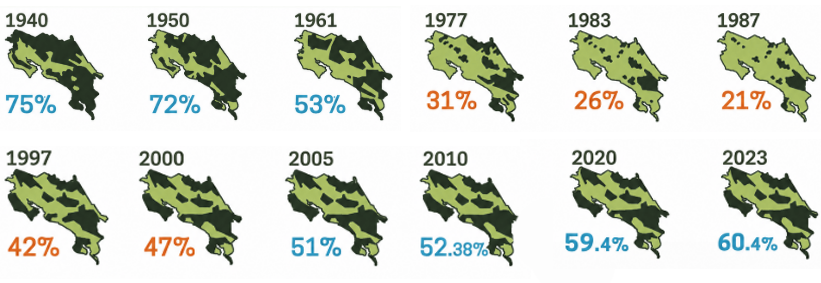
In 1987, Costa Rica was facing an environmental crisis. Decades of aggressive logging and cheap cattle ranching had wiped out most of its forests. The national forest cover had plummeted from 75% in 1940 to just 21%. The country was clearing away its most valuable natural resource in real time, and scientists feared the damage was permanent.
Then, the government shifted tactics. Instead of just urging people to protect nature, the state changed its approach to land ownership. It introduced a tax on fossil fuels and used the money to pay landowners directly to leave their trees standing. By 2010, the trend flipped.
Forest cover – Costa Rica
Source: alvaroumana.com
As World Environment Day invites governments, businesses, and citizens to reflect on environmental progress, Costa Rica’s experience highlights an important question: What separates environmental policies that deliver lasting results from those that remain well-intentioned ambitions?
The country’s historical turnaround reflects a broader finding in environmental policy research: policies are most effective when they align incentives with measurable environmental outcomes.
Success stories
♻️ Costa Rica’s Payments for Environmental Services (PSA)
To preserve millions of hectares of trees and prevent logging, Costa Rica’s government introduced the PSA program in 1997. They placed a 3.5% tax on fossil fuel sales and used the resulting revenue, approximately US$10 million annually, to pay local farmers and landowners directly for every hectare of forest they left standing or replanted. Today, the revenue from the tax reached US$26.5 million and is still used for the same purposes.
The authorities transformed trees from a timber commodity into a steady source of income, paid by the state itself. The PSA program played a major role in reversing deforestation, but it was not the only factor behind Costa Rica’s recovery. The expansion of protected areas, the growth of ecotourism, stronger environmental regulations, and broader economic shifts away from cattle ranching also contributed to the country’s forest resurgence. Together, these changes helped increase national forest cover from a low of 21% to more than 57%.
Carlos Manuel Rodríguez, the country’s former Minister of Environment and Energy, has noted that conservation fails when it is treated merely as a moral obligation. He emphasized that the PSA program succeeded because it transformed standing forests into a competitive economic service, making tree conservation more financially viable for local landowners than traditional cattle ranching.
♻️ The Montreal Protocol (Protecting the Ozone Layer)
In 1987, the world faced a growing concern over chemical gases called chlorofluorocarbons (CFCs), widely used in fridges and aerosol cans, which were making a massive hole in the Earth’s protective ozone layer.
The Montreal Protocol, signed the same year, did not just ask companies to be nicer to the planet. It established legally binding limits and phaseout schedules for ozone-depleting substances, creating strong incentives for companies to develop alternative, safe cooling technologies.
Global consumption of these destructive chemicals dropped by 99% by the mid-2000s. Tracking data from NASA showed that at its worst, the ozone hole reached a record-breaking average peak area of 26.6 million sq. km. (an area slightly larger than the total land area of Canada and the United States combined), whereas in 2025, the average peak area contracted to 18.71 million sq. km. This represents a 30% reduction in the size of the ozone hole since its historic peak.
Scientists do not have to rely solely on projections to assess the treaty’s impact, as its effects can be measured through atmospheric monitoring and satellite observations. Atmospheric scientist, MIT Lee and Geraldine Martin Professor of Environmental Studies, Susan Solomon noted that the Montreal Protocol proved how a structured phaseout timeline can help reverse global environmental damage. According to the World Meteorological Organization, the ozone layer is on track to fully recover across most of the globe by 2040.
♻️ The EU’s Euro Emissions Standards
For decades, diesel and gasoline engines choked European cities with thick, toxic smog. In 1992, the EU introduced the “Euro 1” standard, setting strict legal limits on the pollutants a new car could release from its tailpipe. Over the years, these rules have been updated, leading up to the strict “Euro 6” and upcoming “Euro 7” rules.
If a car manufacturer exceeds certain regulatory emission targets, they may face substantial financial penalties of 95 euros for every single gram per kilometer of excess pollution, multiplied by every vehicle they sell. Thus, if a manufacturer misses its target by even 2 grams and sells 500,000 cars in the EU, the fine is 95 million euros.
Automakers responded by developing catalytic converters, particulate filters, and modern electric car fleets to protect their profit margins. European environmental data confirms that since 1990, sulfur oxide emissions have fallen by over 90% and nitrogen oxide emissions by more than 60% across Europe, contributing to improved air quality and public health outcomes. The emission standards did play an important role in this trend, alongside other air-quality- improving policies.
♻️ Ireland’s PlasTax
In the early 2000s, billions of single-use plastic bags littered Ireland’s landscapes, tangled in trees and clogging urban drainage systems. In 2002, Ireland passed a simple 15-eurocent tax (later raised to 22 eurocents) on every single-use plastic bag at grocery registers.
The financial penalty was associated with a rapid shift in consumer behavior. Within less than a year, plastic bag use plummeted from 328 bags per person annually down to just 21 bags, a 90% drop.
As environmental economists have noted, the true power of the levy was behavioral disruption. By turning a free habit into a visible transaction at checkout, the tax encouraged consumers to consciously choose reusable alternatives and contributed to the decrease of plastic waste in Ireland.
The common thread: Why these policies succeeded
When you strip away the legal language, these four entirely different policies succeeded because they share a rock-solid foundation:
They targeted the source, not the symptom:
- They did not try to clean up the mess after it happened.
- They changed the rules for clearing the land (deforestation), making the chemicals, selling the cars, and buying the bags.
- They made it profitable to protect the environment (Costa Rica), or expensive to harm it (Ireland, EU, the Montreal Protocol).
They aligned economic incentives with environmental goals:
- Costa Rica made conservation financially rewarding.
- Ireland made wasteful consumption more expensive.
- The EU and Montreal Protocol increased the cost of environmentally harmful practices while encouraging cleaner alternatives.
They established clear, measurable outcomes:
- Forest cover could be monitored through land surveys and satellite imagery.
- Ozone depletion could be tracked through atmospheric measurements.
- Vehicle emissions could be tested against regulatory limits.
- Plastic bag consumption could be measured through retail sales data.
They created accountability through enforcement and monitoring:
Payments, taxes, penalties, and legally binding targets ensured that environmental goals were backed by real consequences rather than voluntary commitments.
On World Environment Day, these examples offer a reminder that environmental progress is neither automatic nor inevitable. From restoring forests to repairing the ozone layer, meaningful change has often come from policies that combine clear economic incentives, measurable outcomes, and effective enforcement.
What is the next environmental policy that will become the success story of the current decade?