

Add us as your preferred source on Google to see more of our content in Search.
 Add to Preferred Sources
According to the UN Refugee Agency (UNHCR), globally, approximately 117.8 million people remain forcibly displaced due to persecution, human rights infringements, and violence. At the end of 2025, displacement led to more than 41.6 million becoming refugees worldwide, including those refugees under the care of UNHCR, and Palestine refugees supported by the UN Relief and Works Agency (UNRWA), as well as almost 9 million asylum seekers. In addition, there are almost 69 million internally displaced refugees in various conflict or hunger-stricken nations.
The displaced refugees are not only a burden on their countries of origin but also to the host nations, which incur the costs of providing essential services.
As the world observes the annual Refugee Day on June 20, let’s examine the trends and statistics and highlight the humanitarian funding crises in the nations of origin and those countries hosting refugees.
An overview of refugee statistics in 2025-2026
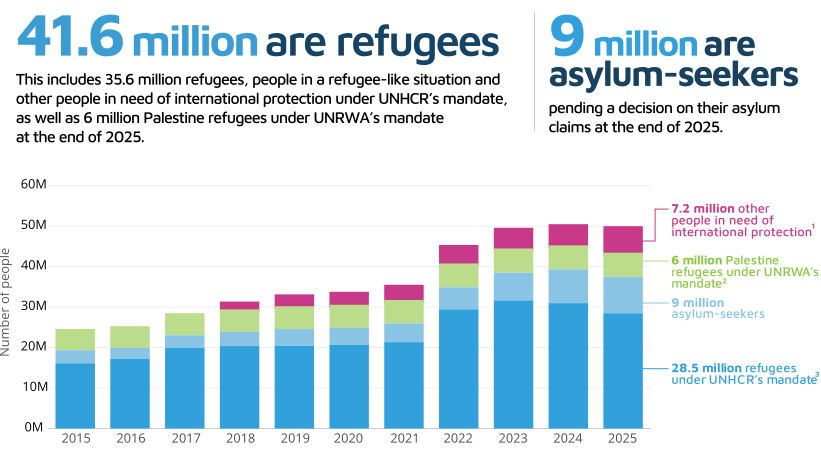
At the end of 2025, there were over 35.6 million refugees in the world, including 28.5 million under UNHCR’s care, 7.2 million in need of protection, and 6 million Palestinian refugees under UNRWA’s care (See Figure 1).
There were also about 9 million asylum-seekers awaiting a decision on their asylum claims and almost 69 million internally displaced people (IDPs), according to the UNHCR 2025 report.
Figure 1: An overview of the number of refugees and asylum seekers as of the end of 2025
Source: UNHCR 2025 Global report on forced displacement
However, in 2025, the total number of refugees in the world reduced to roughly 41.6 million, representing a 3% decrease compared to the previous year as a result of more people returning to their home countries.
Nevertheless, most returnees live in vulnerable circumstances, and the process of their reintegration is challenging. Being exposed to hunger, diseases, and recurring conflicts or wars, they require humanitarian support, but the question is, is there enough humanitarian support available?
Inadequate humanitarian financing for refugees
The sudden cuts to the humanitarian budget are putting pressure on the international protection structure for refugees. Aid for refugees and IDPs shrunk to approximately US$3.9 billion in 2025, a decrease of over US$1.2 billion compared to 2024. As a result, UNHCR’s global funding gap increased to roughly 63%, leaving around US$6.7 billion of humanitarian needs for refugees unmet.
Due to budget constraints, UNHCR managed to assist just 30.7 million refugees in 2025, 16% fewer than in 2024. For people, the aid cuts mean less access to healthcare, sanitation, education, and protection at a time when global conflicts are escalating.
Maureen Magee of Norwegian Refugee Council (NRC) explains that the impacts of aid cuts are becoming even more evident on the frontline. Most humanitarian organizations and NGOs are therefore prioritizing refugees in dire humanitarian situations.
“The humanitarian system must prioritize its efforts on assisting people with dire humanitarian needs, offering urgent and emergency interventions in crises. Simultaneously, the development system should provide long-term solutions to solve the underlying causes of humanitarian need”, said Maureen Magee, Field Operations Director at NRC.
Read also: Top 10 world problems and their solutions
Top countries of origin for forcibly displaced refugees
🔷 Venezuela
Across Latin America and the Caribbean (LAC), there are at least 6.9 million Venezuelans seeking refuge in neighboring Brazil, Colombia, and Guyana, due to the tough economic climate and political insecurity in their home nation. However, most Venezuelans who flee their country are facing restrictive migration and visa regulations in the LAC, which are increasing their exposure to exploitation.
🔷 Syrian Arab Republic
As of early 2026, 70% of Syrians, or over 15.6 million people, needed urgent humanitarian aid. UNHCR 2025 data indicate that there were almost 5 million Syrian refugees in dire humanitarian situations among the population. This is despite the fact that approximately 1.3 million refugees returned to the country despite the prevailing difficult economic situation and political insecurity.
🔷 Ukraine
The ongoing war between Russia and Ukraine has also caused mass displacement. According to the 2026 report by the International Organization for Migration, this conflict on the European continent has led to the internal displacement of about 3.7 million people and at least 5.6 million Ukrainian refugees.
🔷 Afghanistan
According to the UNHCR trends report, there were approximately 3.7 million Afghan refugees or other populations in need of international protection as of late 2025. Despite about 3 million Afghan refugees returning to the country, they face significant challenges due to the limited resources and poor civilian infrastructure in the country. Food insecurity is a major cause of mass displacement since about 17.4 million Afghans are estimated to be facing acute hunger in 2026.
🔷 Sudan
The continuing conflict caused almost 2.8 million refugees in Sudan as of December 2025. Also, at that point of time, Sudan had the largest internal displacement crisis with over 9 million IDPs. Despite some displaced refugees and IDPs returning to secure areas in recent years, they face challenges due to inadequate essential services and limited income-generating opportunities.
🔷 South Sudan
Climate change, ethnic violence, disease outbreaks, and economic instability are causing acute humanitarian emergencies in this country’s refugee camps. By late 2025, about 1.3 million refugees and returnees were in South Sudan, with another 380,000 returnees anticipated by the end of 2026. The refugee influx is straining basic services, particularly among women and girls who are primary caregivers.
🔷 Myanmar
Recurring conflicts, natural disasters, and human rights infringements in Myanmar are causing internal displacement and forced relocation to neighboring nations. As of March 2026, there were almost 3.8 million IDPs and over 1.6 million refugees and asylum-seekers from Myanmar. According to the Reliefweb 2026 report, almost one in three citizens in Myanmar needs humanitarian aid as natural disasters and war-caused displacement worsen the situation.
🔷 The Democratic Republic of Congo
UNHCR’s report indicates that there were more than 8.2 million forcibly displaced people in the DRC, including over 5.8 million IDPs as of early 2026. There are also at least 1.2 million refugees of Congolese origin in neighboring African countries. Recurring disease outbreaks, conflicts, and food insecurity are worsening the humanitarian situation of vulnerable populations such as refugees, children, and women. As a result, the humanitarian situation in DR Congo is anticipated to remain dire as more than 28 million Congolese are food insecure.
🔷 Somalia
Mass displacement and migration are occurring in Somalia due to prolonged armed conflicts, climate change, and disease outbreaks. The displacement is growing sharply, with over 680,000 people being displaced in 2025, amounting to around 3.3 million IDPs in the country. In 2026, over 4.8 million Somali citizens will require humanitarian aid worth over US$852 million.
🔷 Yemen
Millions of Yemenis are living in dire conditions, struggling to access essential services due to protracted conflicts, displacement, and climate-caused shocks. Marginalized populations, such as IDPs, refugees, and women, are highly vulnerable to hunger and preventable diseases. As of 2026, over 22 million Yemenis require humanitarian aid, including about 5.2 million IDPs, 329,000 migrants, and 63,000 refugees.
Final thoughts
Ongoing regional wars, climate change impacts, and natural disasters are causing forced displacement, particularly in the Global South. Displacement is worsening the refugee and IDP crisis due to immense pressure being put on local and host communities and humanitarian aid organizations. The situation is further exacerbated by humanitarian funding gaps as a result of cuts to aid budgets, which are leaving millions of refugees and IDPs vulnerable to hunger, preventable diseases, and malnutrition.