

Add us as your preferred source on Google to see more of our content in Search.
 Add to Preferred Sources
Key takeaways:
- Chile and Argentina revived the 1997 mining treaty to intensify copper and lithium supply to Asian markets.
- Access to Chilean ports drastically reduces the transit corridor for Argentine copper and lithium to Asia.
- Engineering firms, consultancies, and specialists in the environmental, social, and technical sectors connected to mining face a window of opportunity ahead of an intense bidding period.
The reactivated cross-border agreement is expected to accelerate copper, lithium and gold developments across the Andes, creating new opportunities not only for mining companies but also for engineering firms, consultants, contractors and development organizations.
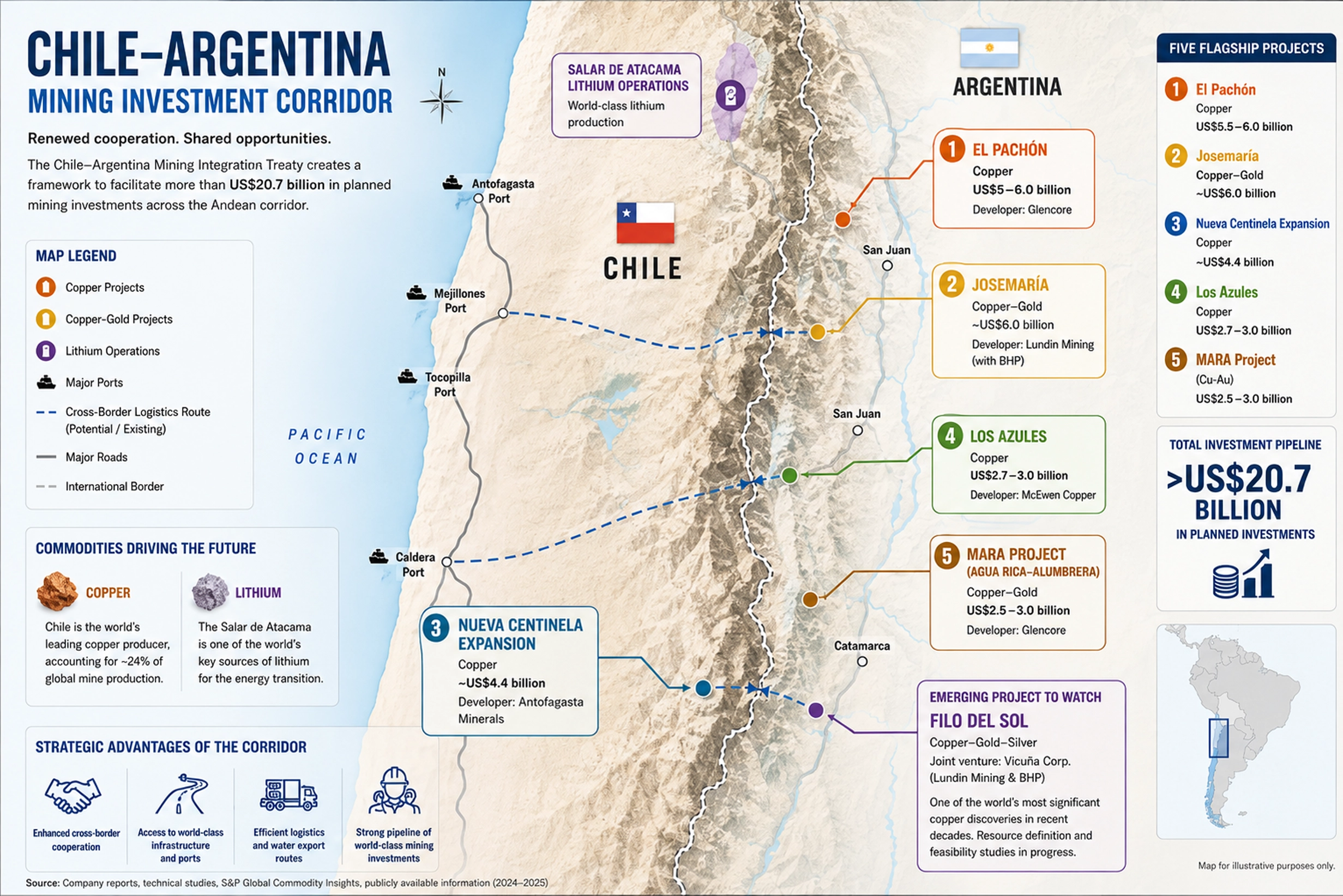
Nearly three decades after signing a pioneering agreement on cross-border mineral development, Chile and Argentina have revived the Mining Integration and Complementation Treaty (MICT), signaling a renewed commitment to unlocking more than US$20.7 billion in planned mining investments.
The move comes at a pivotal moment for the global mining industry. Demand for critical minerals, particularly copper and lithium, continues to surge as countries accelerate the transition toward renewable energy, electric vehicles and low-carbon infrastructure.
The International Energy Agency (IEA) predicts the demand for minerals required for renewable energy technologies will grow substantially over the coming decades, placing South America’s vast mineral wealth at the center of global supply chains.
For Chile and Argentina, the renewed treaty is more than a diplomatic milestone. It provides a framework for reducing administrative barriers, improving logistics and facilitating investment in mining projects located along the Andes, where some of the world’s largest undeveloped copper deposits straddle the international border.
But beyond mining companies, the renewed investment cycle also presents considerable opportunities for engineering consultancies, environmental specialists, construction firms and development organizations involved throughout the project lifecycle.
Why the treaty matters now
The MICT, signed in 1997, established a legal framework allowing mining projects located within a designated border integration zone to operate more efficiently across both jurisdictions. The agreement enables cooperation on customs procedures, taxation, infrastructure access and workforce mobility, making cross-border mining developments more commercially viable.
Although the treaty has existed for nearly 30 years, its importance has grown considerably as governments seek to capitalize on unprecedented demand for critical minerals.
Three major factors explain the renewed momentum.
First, the global energy transition has transformed copper and lithium into strategic resources. Copper is indispensable for electricity grids, renewable energy installations and electric vehicles, while lithium has become essential for rechargeable batteries.
Second, both Chile and Argentina are seeking to attract new foreign direct investment following several years of regulatory uncertainty and fluctuating commodity markets.
Third, many of the region’s largest undeveloped mineral deposits are located near the international border, making closer bilateral cooperation essential for efficient project development. In short, access to Chilean ports will significantly cut the transit time for Argentine critical minerals compared to Atlantic routes.
Mining regions set to benefit
The treaty primarily affects mining regions along the Andes.
Greater cross-border integration could enable Argentine projects to access Chilean infrastructure more efficiently, reducing logistics costs and shortening export routes to Asian markets.
Two mining giants with complementary strengths
Although neighboring countries, Chile and Argentina have distinct but complementary mining industries.
 Chile
Chile
Chile remains the world’s largest producer of copper, accounting for approximately 23% to 24% of global mine output, according to the U.S. Geological Survey (USGS).
The country is home to world-class operations such as Escondida, Chuquicamata and Collahuasi, while also expanding lithium production from the Salar de Atacama.
Mining contributes roughly 14% of Chile’s GDP and represents the country’s largest export sector, with metallic mining consistently generating more than half of Chile’s merchandise exports, according to the Central Bank of Chile and the Chilean Copper Commission (COCHILCO).
 Argentina
Argentina is emerging as one of the world’s most promising copper and lithium producers.
Its northwestern provinces form part of the globally significant Lithium Triangle, shared with Chile and Bolivia, which contains more than half of the world’s known lithium resources.
At the same time, Argentina possesses several of the world’s largest undeveloped copper deposits, many of which are approaching construction readiness after years of exploration.
According to Argentina’s Secretariat of Mining, the country has one of the largest pipelines of advanced copper projects globally.
Major mining companies operating in the region
International mining companies already active in Chile and Argentina include:
These companies collectively represent tens of billions of dollars in planned investments over the coming decade.
What will the US$20.7 billion investment pipeline fund?
The announced investment pipeline extends far beyond mine construction.
Large mining developments require spending across every stage of project preparation and execution, including:
- Geological exploration, drilling programs, resource modelling.
- Environmental and social impact assessments, feasibility studies, engineering design.
- Water supply infrastructure, renewable power integration, roads and bridges, transmission lines, processing plants, tailings facilities.
- Worker accommodation, digital monitoring systems, commissioning and operational readiness.
Each stage generates procurement opportunities for specialist consultants, engineering firms and contractors.
Five flagship mining projects shaping the investment pipeline
The following projects represent the largest mining developments underpinning the renewed Chile-Argentina Mining Integration Treaty. Ranked by their estimated capital investment based on publicly available company disclosures and industry reports, they collectively account for well over US$ 20 billion in planned investment and illustrate the scale of the region’s future mining pipeline.
Top five mining projects
* Estimated capital investment based on publicly available company reports, technical studies and industry publications. Actual investment values may change as projects progress through feasibility studies and final investment decisions.
1️⃣ El Pachón (Argentina)
Developer: Glencore
Located in San Juan Province near the Chilean border, El Pachón is one of the world’s largest undeveloped copper deposits. Estimated to require US$9 billion in capital investment, the project is expected to become a major source of copper concentrate. Its proximity to Chile makes cross-border infrastructure and logistics critical to its future development.
2️⃣ Josemaría (Argentina)
Developer: Lundin Mining (with BHP)
Josemaría is one of Argentina’s most advanced copper/gold projects. With an estimated investment of around US$5 billion, it is expected to generate significant demand for engineering, procurement, construction and environmental consultancy services while benefiting from improved transport links to Chilean ports.
3️⃣ Nueva Centinela Expansión (Chile)
Developer: Antofagasta Minerals
The Nueva Centinela Expansion is among Chile’s largest current mining investments, with an estimated capital expenditure of approximately US$4.4 billion. The project will expand copper production while incorporating new processing facilities, water infrastructure and renewable energy solutions, reinforcing Chile’s role as the world’s leading copper producer.
4️⃣ MARA Project (Argentina)
Developer: Glencore
The MARA Project combines the Agua Rica deposit with the existing Alumbrera processing infrastructure in Catamarca Province. By leveraging existing facilities, the project reduces infrastructure costs while extending the productive life of regional mining assets. Estimated investment ranges between US$4.0 billion.
5️⃣ Los Azules (Argentina)
Developer: McEwen Copper
Located in San Juan Province, Los Azules has emerged as one of the world’s largest undeveloped copper projects following successive resource upgrades. Current development plans envisage investment of approximately US$2.7-3 billion, with an emphasis on renewable energy integration, lower carbon operations and sustainable mine design.
Emerging project to watch: Filo del Sol
While not among the five largest projects by currently reported capital investment, Filo del Sol has rapidly become one of the world’s most significant copper discoveries in recent decades. Located on the Chile-Argentina border and jointly being advanced by Vicuña Corporation, a 50:50 joint venture established by Lundin Mining and BHP following their acquisition of Filo Corporation in 2025, the project has delivered exceptional exploration results in recent years. As resource definition and feasibility studies advance, Filo del Sol is widely expected to become one of the region’s most strategically important mining developments and could feature prominently in future investment pipelines under the renewed treaty.
Development opportunities across the mining value chain
Mining projects generate procurement opportunities long before production begins.
A typical project value chain includes:
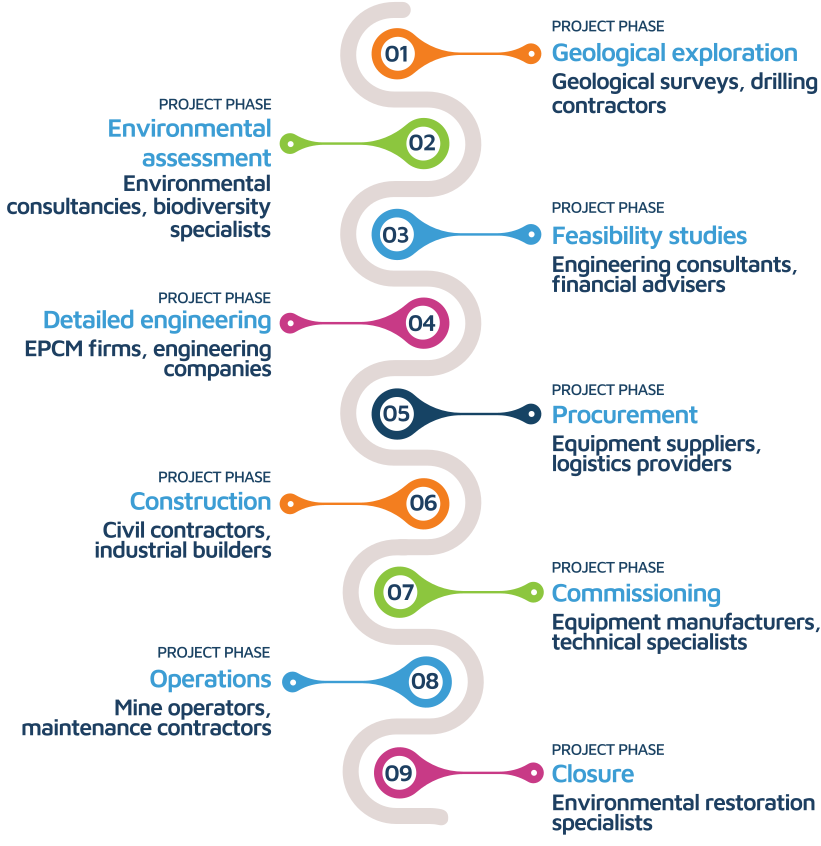
This diversity creates opportunities for both private companies and development organizations supporting sustainable mining practices.
DevelopmentAid insights: consulting and engineering opportunities
Analysis of DevelopmentAid procurement data highlights continued donor and industry investment in mining-related technical assistance. It indicates that international donor support for sustainable mining in Latin America has been continuous over the past decade. Between 2015 and 2024, major contracts have ranged from engineering consultancy for mine restoration and environmental management to regional cooperation platforms, responsible sourcing initiatives and contract mining services. This demonstrates that investment opportunities extend well beyond mine construction to encompass governance, environmental sustainability, digital knowledge platforms and institutional capacity building.
Among the notable awards are:
🔹 Mining Environmental Restoration Project (Argentina)
Donor: World Bank
Awardee: CESEL S.A.
The consultancy supports detailed engineering services for environmental restoration of legacy mining sites, demonstrating growing demand for environmental expertise alongside resource development.
🔹 EU–Latin America Minerals Development Platform
Donor: European Commission
Awarded to a consortium led by Projekt-Consult GmbH, together with ZABALA Innovation Consulting, Euromines and DMT GmbH, the initiative strengthens cooperation on sustainable mining, knowledge exchange and innovation.
🔹 EU Partnership on Raw Materials
Also financed by the European Commission, this program promotes responsible mineral value chains, geological cooperation and capacity building across Latin America.
🔹 Encuentro Oxides Project (Chile)
According to DevelopmentAid award data, Thiess, together with Emeco Group, secured a contract worth approximately US$137 million from Antofagasta Minerals to provide contract mining services.
Here is a chronological summary table.
Leading consulting and engineering firms
As investment accelerates, several firms are expected to remain prominent across the region:
- Hatch
- Worley
- Ausenco
- Fluor
- Bechtel
- CESEL
- DMT GmbH
- Projekt-Consult GmbH
- ZABALA Innovation Consulting
- Stantec
These companies provide services ranging from prefeasibility studies and engineering design to environmental management and project supervision.
Opportunities for development organizations
Mining projects increasingly incorporate environmental, social and governance (ESG) considerations throughout their lifecycle.
Development organizations can support governments and mining companies through:
- institutional capacity building
- environmental governance
- biodiversity conservation
- water resource management
- community engagement
- Indigenous consultation
- workforce development
- mine closure planning
- responsible sourcing
- digital monitoring systems
Multilateral institutions including the World Bank, Inter-American Development Bank and European Union have supported initiatives promoting sustainable mining governance across Latin America.
Challenges remain
Despite the positive outlook, several issues could influence implementation.
Water scarcity remains a major concern across the Andes, while environmental permitting and Indigenous consultation processes continue to shape project timelines.
Infrastructure investment will also be essential, particularly roads, electricity transmission and border crossings capable of supporting large-scale mining logistics.
Finally, commodity price volatility and changing regulatory frameworks may affect investment decisions over the coming years.
Nevertheless, long-term demand projections for copper and lithium suggest the strategic rationale for these projects remains strong.
Final thoughts
The revival of the Chile-Argentina Mining Integration Treaty reflects a broader shift in global mining, where critical minerals have become central to economic development, industrial policy and the clean energy transition.
For Chile and Argentina, the agreement has the potential to unlock more than US$ 20.7 billion in planned investments while strengthening regional supply chains and improving cross-border infrastructure.
For DevelopmentAid members, however, the significance extends well beyond mining. Every major project creates demand for geological surveys, environmental assessments, engineering design, procurement, construction, technical assistance and long-term operational support. As governments and mining companies move from exploration to development, opportunities are expected to expand across the entire mining value chain, offering new prospects for consultants, engineering firms, contractors and development organizations committed to advancing sustainable resource development.