

Add us as your preferred source on Google to see more of our content in Search.
 Add to Preferred Sources
The United States used to be the world’s largest foreign aid donor, distributing tens of billions of dollars annually to more than 210 countries and regions, according to ForeignAssistance.gov. In 2025, the country ceded the title of the biggest donor to Germany, but still ranked second, with US$29 billion distributed as foreign assistance, according to preliminary OECD data.
In this article, we explore the latest full data on the U.S. foreign aid available, reported for the fiscal year 2024.
FY2024 shows that the total volume of U.S. foreign aid reached US$72 billion (disbursements), and around 25% was received by just three nations:
- Ukraine (US$10.1 billion)
- Israel (US$6.8 billion)
- Jordan (US$1.7 billion)
In our latest piece, we give a country-by-country snapshot and practitioner-focused information on the nations that benefited the most from US assistance, how aid is categorized, regional patterns, and what the 2025 aid freeze means for international development.
Which countries receive the most U.S. foreign aid?
Ukraine and Israel received over US$16 billion in FY2024, more than any other nation (security/military aid dominates). This figure represents disbursements, an indicator of foreign assistance that shows when funds are really moved out of United States government accounts.
Jordan, Taiwan, Ethiopia, and the Democratic Republic of the Congo received over US$6.5 billion, with the most emphasis being on security, the economy, health, and humanitarian aid.
The FY2024 vs. FY2023 shift: Israel jumped from US$3.3 billion (FY2023) to US$6.8 billion (FY2024) due to emergency supplemental funding. Ukraine dropped from US$24.8 billion to US$10.1 billion.
What does the FY2025 data show?
The information released by the official U.S. agencies for the full fiscal year 2025 for sectoral- and country-level foreign aid managed by the United States Agency for International Development (USAID) from October 1, 2024, to September 30, 2025, encompassed the last three months of the Biden administration, along with the first nine months of the Trump administration.
Overall, there has been a 23% decrease in expenditures (outlays) and a 43% decrease in commitments to future spending (obligations) as opposed to FY2024.
Source: ForeignAssistance.gov
Source: ForeignAssistance.gov
Humanitarian aid witnessed the most drastic decline, with obligations dropping from US$15.3 billion to US$5.8 billion and spending falling from US$12.8 billion in 2024 to US$8.9 billion in 2025.
*The Centers for Disease Control and Prevention (CDC) for HIV/AIDS, the Department of Agriculture for food aid, and the State Department for migration and refugees all have substantial foreign aid spending that is not included in the USAID data, since the FY2025 figures from ForeignAssistance.gov are currently not full.
Why do these numbers change from year to year?
Annual funding for each nation may change significantly because of decisions made by Congress and emergency funding packages. Take, for example, Israel and Ukraine, which represent the most notable examples of these drastic changes:
Moreover, the Trump administration’s aid freeze in January 2025 and the following stop-work orders and funding review led to even more uncertainty for foreign aid flows in FY2025 and FY2026, which, as a result, created serious problems for organizations looking forward to or currently running programs.
What types of aid does the U.S. provide?
Foreign aid from the United States is obviously more than just bilateral assistance – it encompasses aid via grants, various projects set up and run by nonprofits and international organizations, private firms, and government agencies.
When it comes to real-world situations, a U.S.-funded initiative may embrace several forms of aid. A health program, for instance, includes medical supplies, training for healthcare staff, infrastructure improvements in the region of interest, and assistance for government health systems, all at the same time.
According to data from Congress.gov, assistance delivered by the United States can be grouped as follows:
Which regions receive the most U.S. foreign aid?
🔹 Sub-Saharan Africa
Disbursements in FY2024: US$16 billion
Activities: ~6,800
Sub-Saharan Africa is the largest recipient region by number of countries, with such nations as Ethiopia, Nigeria, Kenya, the DRC, and Somalia benefiting from billions in annual development, health, and humanitarian assistance. For a long time, this region has been the highest concentration of USAID-funded programs, tenders, and implementing partner opportunities.
Explore tenders in the development sector in Africa on DevelopmentAid.
🔹Middle East and North Africa
Disbursements in FY2024: US$13 billion
Activities: ~3,100
The Middle East and North Africa (MENA) region is dominated by security-heavy allocations to Israel (US$6.8 billion), Jordan (US$1.7 billion), Yemen (US$0.64 billion), and Syria (US$0.58 billion). In addition, the Gaza humanitarian crisis has driven additional emergency supplemental spending since late 2023.
🔹 Eastern Europe/Eurasia
Disbursements in FY2024: US$12 billion
Activities: ~4,100
Explore tenders in Asia, EU27, and non-EU27 on DevelopmentAid.
The conflict in Ukraine has turned into a central factor that has shaped the security sector along with economic ties across Eastern Europe and Eurasia. According to ForeignAssistance.gov, Ukraine received US$16.6 billion in disbursements from the U.S. in 2022; the following year, the figure was US$24.8 billion, and in 2024, it was US$10.1 billion.
🔹 East Asia and Oceania
Disbursements in FY2024: US$4.9 billion
Activities: ~1,800
Since the United States withdrew from Afghanistan, the share of U.S. aid in Asia has undergone significant change. The U.S. assistance after withdrawal is now restricted to humanitarian initiatives. The leading recipients in terms of U.S. foreign aid in the region include Taiwan (US$1.5 billion), Indonesia (US$0.8 billion), the Philippines (US$0.72 billion), and Vietnam (US$0.35 billion).
The 2025 aid freeze: What development professionals need to know
In January 2025, the Trump administration issued an executive order pausing all U.S. foreign aid programs for a 90-day period, aiming to carry out a policy alignment review.
Under the directives issued by the Department of Government Efficiency, led by Elon Musk, accounts were frozen, offices closed, and thousands of aid workers dismissed around the world.
By July 1, 2025, USAID was formally closed, causing a catastrophic impact on organizations operating in the development sector:
- Implementing partners saw active awards paused or terminated across multiple sectors.
- New procurement activity slowed considerably.
- Some sectors, like military aid and global health programs with strong US domestic political support, were impacted to a lesser degree.
- By mid-2026, some programs have resumed, including food assistance programs operated by the World Food Programme in Lebanon, Syria, Somalia, Jordan, Iraq, and Ecuador, as well as some programs run by the International Organization for Migration.
- The U.S. budget for 2026 aims to allocate US$50 billion on international affairs, diplomacy, national security partnerships, and global cooperation.
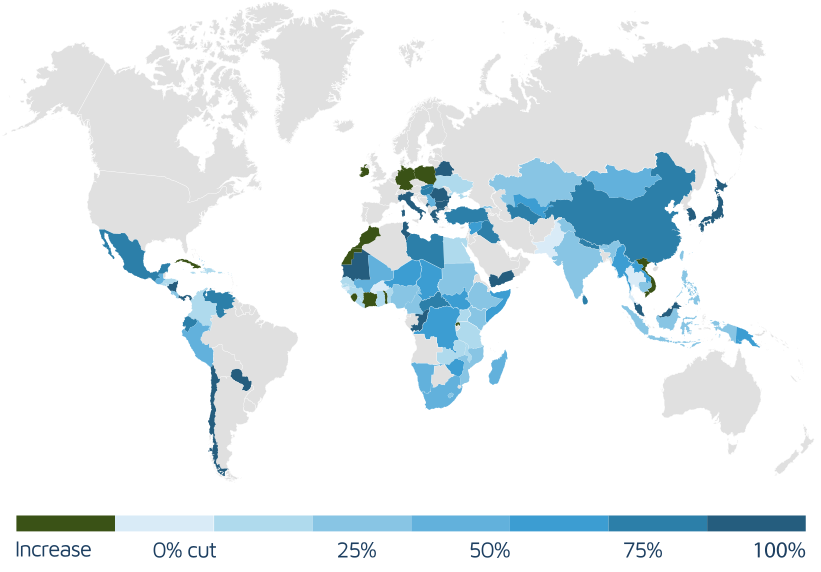
The table below illustrates the share of USAID spending cuts (in disbursements) by country (FY2024–FY2025)
Source: Center for Global Development
Where to find U.S. foreign aid data and how to use it
Three primary sources anchor the data landscape for development professionals:
ForeignAssistance.gov is the official U.S. government transparency portal with year-by-year downloadable data across all agencies and recipient countries. It acts as the main platform for financial and budgetary statistics presented by U.S. government agencies that oversee foreign aid programs. Best for historical analysis and bilateral breakdowns.
DevelopmentAid – the largest platform for development experts, consulting companies, NGOs, and funding agencies that bridges the gap from “where does aid go” to “what active opportunities exist right now.”
- Browse tenders from foreign organizations, including U.S.-funded programs.
- Search grants from international organizations.
Explore DevelopmentAid’s country-specific opportunity trackers to stay current.
Frequently Asked Questions (FAQ)
1. What countries get the most U.S. foreign aid?
In FY2024, the top recipients were Ukraine (US$10.1 billion), Israel (US$6.8 billion), and Jordan (US$1.7 billion), based on ForeignAssistance.gov data.
2. How much does the U.S. give in foreign aid per year?
The U.S. disbursed approximately US$72 billion in foreign assistance in FY2024 (in FY2023 the figure reached US$81 billion), reaching 213 countries and regions, according to ForeignAssistance.gov. On an obligations basis (legally binding spending commitments), the figure reached approximately US$86 billion in FY2024 (in FY2023 the figure was US$100 billion).
3. Who are the top recipients of USAID?
In FY2024, the top 10 recipients of USAID-managed funds were (in descending order) Ukraine, the Democratic Republic of Congo, Jordan, Ethiopia, the West Bank and Gaza, Sudan, Nigeria, Yemen, Afghanistan, and South Sudan, according to Congress.gov.
4. How has U.S foreign aid changed under Trump?
The Trump administration issued an executive order freezing most foreign assistance programs in January 2025, USAID officially closed on July 1, 2025, and secured approximately US$9 billion in rescissions of previously appropriated aid funding.
Congress responded with the FY2026 appropriations bill, providing US$50 billion for international affairs. Aid planning, distribution, and tracking have undergone significant changes as a result of the structural transition from USAID-run programs to State Department administration.
Suggested reading: Trump’s $9 billion rescission package cuts foreign aid and public broadcasting funding