

Add us as your preferred source on Google to see more of our content in Search.
 Add to Preferred Sources
A mother’s milk is a baby’s first line of defense against diseases as it provides a natural vaccine against diarrhoea, pneumonia, and many other illnesses. It also prevents nearly 600,000 child deaths per year, according to the World Health Organization (WHO) and the United Nations Children’s Fund (UNICEF). But despite its “by default” availability, many infants face challenges accessing breastfeeding due to multiple factors, such as limited knowledge and inadequate health-service support. This results in only 48% of infants under six months being breastfed globally – below the 60% target set to be achieved by 2030.
To raise awareness of the importance of breastfeeding and promote this among mothers, World Breastfeeding Week (WBW) is coordinated and organized globally during the first week of August by the World Alliance for Breastfeeding Action (WABA), in collaboration with WHO and UNICEF.
In spite of the 2025 cuts to humanitarian aid, donor organizations are nevertheless funding newborn-friendly hospital initiatives and supporting sustainable maternal and child nutrition.
In 2026, WBW’s main theme is “Breastfeeding for a Sustainable Start in Life: Strengthen What Works,” focusing on assessing the progress and impact of strategies that aim to improve breastfeeding outcomes.
Despite shrinking health aid, donors and governments are therefore focusing on sustainable financing by incorporating breastfeeding into routine maternal care, training health workers, and allocating domestic investments to reduce reliance on external funding.
This DevelopmentAid article provides readers with insights into donor-funded breastfeeding programs in Africa, as healthcare funding in the Global South is shrinking at a pace much faster than the rest of the world.
Why World Breastfeeding Week (WBW) is important
WBW is observed in at least 175 countries worldwide and focuses on promoting breastfeeding as a fundamental right for the health of children and mothers. According to the WHO, breastfeeding is important because breast milk provides the essential nutrients and antibodies a newborn requires in the first six months of life.
This year, World Breastfeeding Week activities concentrated on monitoring progress, assessing impact, and improving breastfeeding outcomes. The events called on healthcare stakeholders to strengthen the continuum of care for breastfeeding.
The WBW events are funded by WHO, the UN Children’s Fund (UNICEF), and civil society organizations around the world.
Trends and statistics of breastfeeding prior to the health aid cuts
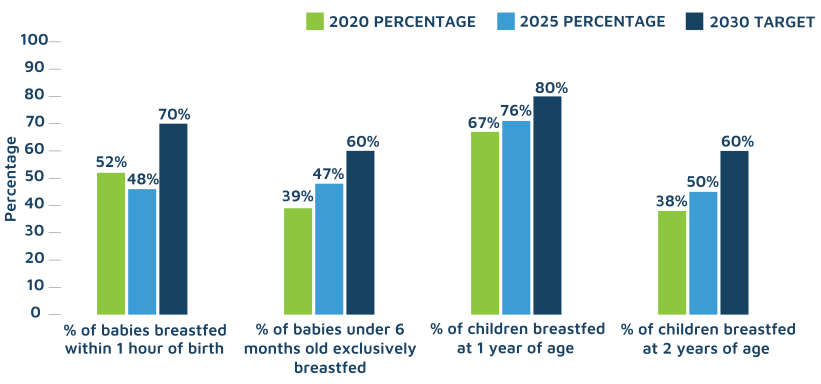
According to the Global Breastfeeding Scorecard by WHO, the global rate of continued breastfeeding for children aged one to two years grew by over 10 percentage points between 2020 and 2025, while breastfeeding for a child’s first two years increased from approximately 38% to 50% in the same timeframe.
However, some statistics remain alarming as the number of babies breastfed within one hour of birth has fallen by 4% in the last five years, highlighting the need for continued action.
The overall increase in the prevalence of breastfeeding illustrates the commitment of those nations and organizations that are collaborating to protect, enhance, and support breastfeeding as a core investment in maternal and child wellbeing.
At the same time, the sharp drop in foreign aid by the largest international donors could hamper ongoing improvement.
Figure 1: 2020 & 2025 rates of breastfeeding compared to 2030 world targets
Source: 2025 Global Breastfeeding Scorecard by WHO
Donor funding for breastfeeding initiatives is falling and is now insufficient to support the 2030 Global Breastfeeding Collective goal.
Furthermore, only 40% of countries have exclusive data on breastfeeding for the period 2020 to 2025 – a figure likely to decrease due to less funding for maternal and child health information and services.
An overview of the reduced funding for breastfeeding initiatives
The dismantling of the United States Agency for International Development (USAID) and the significant reduction in aid budgets by major European nations are threatening maternal health and nutrition services such as breastfeeding.
The budget cuts are reversing decades of progress made in reducing malnutrition among breastfeeding children. According to UNICEF, the funding cuts are causing disruptions to nutrition and support services for more than 14 million children.
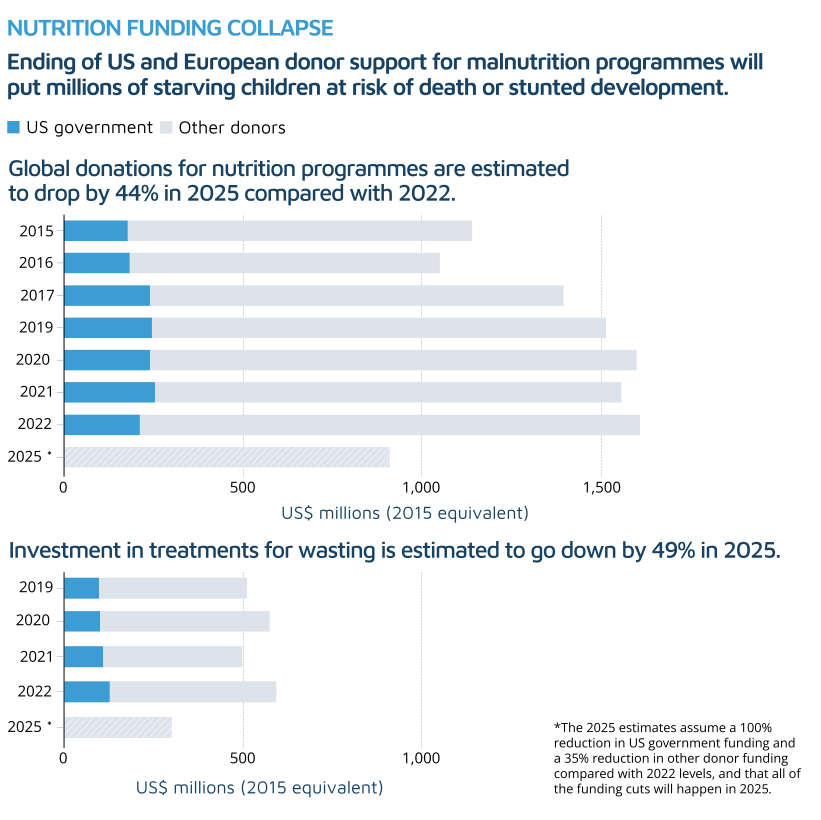
The 2025 figures demonstrate that global donations for nutrition initiatives dropped by 44% compared to 2022.
Figure 2: Estimated drop in global donations for children’s nutrition programmes in 2015 -2025 after aid cuts
Source: Nature
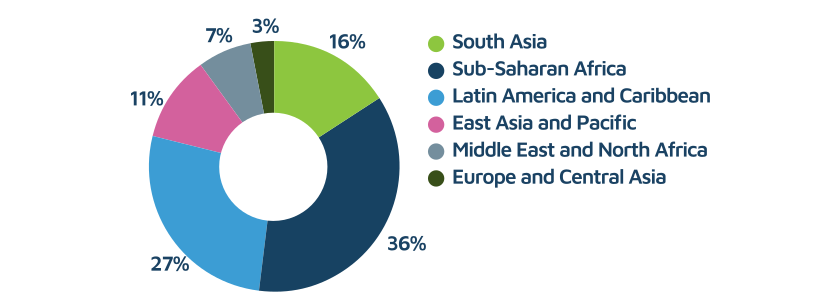
To expand breastfeeding initiatives, roughly US$7.2 billion will be needed over the next 10 years. Of this, 91% will be required to widen access to infant and child nutrition counselling. The financing requirements for the Global South are the highest, with sub-Saharan Africa needing 36% and Latin America and the Caribbean 27%.
Figure 3: Infant and child nutrition financing need by region
Source: 2025 Global Breastfeeding Scorecard by WHO
The health funding cuts are forcing African nations to pause or reduce essential services for child, maternal, and newborn health. Lack of funding is also leading to health facilities closing, a loss of health staff, and disruptions to supply chains for lifesaving maternal care supplies and medicines. Based on research undertaken by modelling the population in six African nations with dire humanitarian needs – Burkina Faso, the Central African Republic, Chad, Mali, Niger, and Nigeria – the funding cuts could cause maternal deaths to surge by 45% among the most desperate populations.
Donor-funded breastfeeding initiatives in Africa
🔹 Pumwani Hospital Human Milk Bank Initiative, Kenya
Since its launch in March 2019, more than 2,500 mothers have donated to Kenya’s first human milk bank at Pumwani Hospital in Nairobi. As of late 2025, it had donated breast milk to approximately 1,887 newborns. The initiative also supports premature and sick children who are unable to breastfeed and extends its services to local health institutions.
🔹 Mother-Baby Friendly Initiative Plus (MBFI+, Kenya)
Developed and supported by the Programme for Appropriate Technology in Health (PATH), the MBFI+ model has reconfigured the healthcare system to ensure human milk is accessible to Small and Sick Newborns during their time in hospital and following their discharge. The program strengthens the approach that links kangaroo mother care, nurturing care, and an appropriate human milk bank to help breastfeeding mothers.
🔹 South African Breastmilk Reserve (SABR)
This is an NGO that develops and supports human milk banks in neonatal units. It relies on corporate grants, local governments, and donations to supply pasteurized donor milk to premature and underweight infants. During its 18-year activity, the organization has launched approximately 30 milk banking facilities across South Africa and helped over 31,360 premature babies.
🔹 Kalafong Hospital Milk Bank, South Africa
This operates through public-private partnerships with institutions such as Discovery and the South African Breastmilk Reserve. It uses clean-room labs and advanced pasteurization equipment to serve the needs of fragile neonates. It also focuses on teaching pregnant women and new mothers to become proactive in antenatal care and breastfeeding.
🔹 ATTA Breastmilk Community, Uganda
This program provides safe donor milk with wrap-around care for mothers and demonstrates that even in low-resource environments, the appropriate connections and evidence-based practices can save lives. Since its inception, the initiative has dispensed roughly 1,870 liters of breastmilk, onboarded 232 donor mothers, and ensured 840 infants received donor milk.
🔹 Netcare Ncelisa Human Milk Banks, South Africa
This program supports breastfeeding for the initial six months of life, mainly for babies in neonatal intensive care units (NICUs). The program developed Ncelisa human milk banks in 2017 with the aim of offering premature and medically vulnerable children who cannot breastfeed naturally to secure donor breast milk. As of 2022, it had approximately 35 human milk depots and five milk banks storing and distributing breastmilk to babies in need in NICUs.
🔹 Management of Small and Nutritionally At-Risk Infants (MAMI), Nigeria
Funded by Catholic Relief Services and other local partners, the pilot programs provide clinical care, maternal health services, and specialized pathways for fragile infants. With support from Save the Children’s MAMI Mission, this initiative enables children younger than six months to survive through increased services for small and nutritionally at-risk infants.
🔹 The Partnership for Nutrition in Tanzania (PANITA)
This program supports Tanzania’s Ministry of Health and other agencies to organize activities at the national and local level in acknowledgement of WBW. The national-level activities include media seminars on breastfeeding, press conferences, community engagements, and infant and young child feeding counselling and mobile advertisements.
🔹 Alive and Thrive, Ghana
This initiative was established in 2009 to fight global child undernutrition by supporting effective infant and young child feeding practices. The program focuses on dynamic social norms, improves public policy, and assesses the health and financial costs of not breastfeeding to shape government policy.
🔹 Milk Booster Foundation, Nigeria
This was first donor human milk bank in Nigeria, founded by breastfeeding expert Dr. Chinny Obinwanne. The foundation invites breastfeeding mothers with excess milk supply to offer this to Nigerian children facing a limited or inadequate milk supply.
Final thoughts
World Breastfeeding Week is a time to reflect on the significance of breastfeeding for the survival of children, their healthy development, and improved nutrition. Despite funding cuts that have impacted maternal care and nutrition services, breastfeeding initiatives continue to play a key role in protecting maternal and child health but now sustainable breastfeeding programs must rely on stronger domestic funding and investment in healthcare infrastructure.