

Add us as your preferred source on Google to see more of our content in Search.
 Add to Preferred Sources
This article intends to give an overview of a European Framework, designed by the European Commission’s Joint Research Centre in 2013, that provides theoretical background, classification, and guide to practical use of digital competences in various sectors. While digitalisation is spreading across the world rapidly and the development sector also has a good share of work in it, in many countries, including EU members, digital skills of the adult population are still low and industries often lack professional IT experts.
Digitalisation – it is not just about the hardware
The emergence of information and communication technologies since the 2000s led to the proliferation of widely accessible information. The idea of information society valorised the role of information; however, the quick explosion of information (as raw data) has had unintended impacts, like the digital divide as another layer of social iniquity, new existential and mental risks from immersion in the virtual space, just to name a few.
The 21st-Century concept of knowledge society realises the role of ICT in economic growth by turning information into knowledge, value, and free expression accessible for everyone. So does the Lifelong Learning approach, which also perceives digitalisation as a tool for competitiveness and employability, social inclusion, active citizenship, assisted living, and a solution for ageing societies.
Hence, adapting to the 21st-Century requires new skills in learning, working, and participating in social life. Beyond technical skills, used to refer to as “button knowledge” related to ICT tools, more sophisticated content-related skills have also gained importance, requiring cognitive, emotional, social, and analytical skills. A recent literature analysis on 21st-Century skills identified technical, information, communication, collaboration, critical thinking, creativity, and problem-solving skills as highly relevant for thriving in the digital economy.
By today, digital skills have become transversal, together with literacy and numeracy. Digital transformation challenges both individuals and organisations, which must be aware that this is not just about professional “ICT staff.” It is a digital culture they need to adapt to.
However, available international data show a huge lack of such skills in the workforce. OECD (2016) reported that 56% of the adult population had no ICT skills or could fulfil only the simplest tasks in a technology-rich environment. In Europe, 85% of jobs needed at least a basic level of digital skills in 2017, while 43% of the population had no or low-level digital skills.
Skills Agenda set up the goals, that by 2025, 70% of the 16-74 age group should have a basic level of digital skills (reached 55,6% for 2023) and for 2030, minimum 80% of the whole EU population attains basic level digital skills. Digital targets for 2030 (“Digital Decade”, 2021) envision 20 million ICT experts, and digital transformation of businesses and public services.
Policymaking at the European Union level
Obviously, one of the most significant European responses to digitalisation was the EUROPE 2020 Strategy (2010), which – as a reflection to the global financial crisis in 2008 – identified digitalisation as a potential for smart and sustainable growth. One of its flagship initiatives, the Digital Agenda (2010), described the concept of the European Digital Single Market (2015), that provides access to online and cross-border transactions and hastened a digital competence reference framework that identifies digital competences of ICT experts and users, in line with the European Qualification Framework (EQF, European Commission, 2008) and EUROPASS.
Education and Training (ET) 2020 Framework (2009) declared that national education and training systems, including adult education and lifelong learning, should serve a better adaptation to current societal and labour-market needs through strengthening basic (reading, math, and science) and key transversal skills.
As a result of previous initiatives, the European Skills, Competences, Qualifications and Occupations (ESCO, 2010) classifies digital skills as transversal job skills. While ESCO’s European e-Competence Framework (e-CF) – had been formulated since 2006 – became a standard for ICT professionals in 2016, regarding individual/user digital skills, a UNESCO guide (2013), the Media and Information Literacy Framework (MIL), served as an orientation.
The Digital Competences Framework for Citizens (DigComp)
The first version of the Digital Competence Framework for Citizens (1.0) was published by the European Commission’s Joint Research Centre in 2013. DigComp provides a common understanding of digital competences, so that individuals can use digital technologies in a confident, critical, collaborative, and creative way. Furthermore, it supports individual development to achieve goals related to work, learning, leisure, inclusion, and participation in our digital society.
The structure of DigComp:
- Five competence areas: (1) Information search, evaluation, and management, (2) Communication and collaboration, (3) Content creation, (4) Safety, well-being, and responsible use, and (5) Problem identification and solving.
- 21 competencies with titles and descriptions.
- Four proficiency levels describe progression by completing more complex tasks more and more autonomously in digital environments.
- Learning outcomes, which are short statements on what individuals are capable of doing after any learning process.
Since 2013, DigComp underwent several updates, always maintaining continuity with previous versions. Modifications affected competence descriptors, proficiency levels, and samples in education and the labour market. Its latest version, DigComp 3.0 (2025), incorporates AI skills into the 21 competencies (involving terms like cybersecurity, digital rights, responsibilities, mis- and disinformation), as the most challenging development since its previous version in 2022. More than 300 individuals and organisations gave inputs to this version.
DigComp is a high-level conceptual framework, which is free of changes in the functionalities of tools, software, and apps. DigComp, and particularly its learning outcomes, serve as a practical tool; they help translate digital competences to local policies, develop training materials, create self-assessment tools, define qualifications, or identify digital skills for specific jobs or roles.
Recognition of DigComp
As an organic development, DigComp has been further specified to several sectors over time:
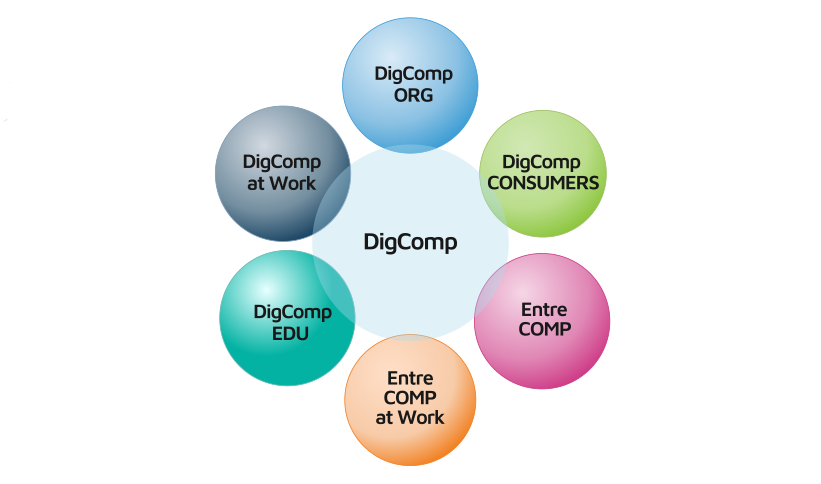
- DigCompORG (2015) serves educational institutions’ self-reflection and self-assessment.
- DigCompCONSUMERS (2016) promotes consumers and relevant organisations to be active, safe, and assertive in digital markets.
- EntreCOMP (2016) conceptualises entrepreneurial competences as “skills for life” not only for SMEs, but for companies and third sector organisations (NGOs). EntreComp at Work (2020) gives insights into labour-market intermediaries’ case studies.
- DigCompEDU (2017) identifies educators’ and learners’ digital competences.
- Finally, DigComp at Work and its Implementation Guideline (2020) help labour-market intermediaries in upskilling the workforce to enhance employability.
DigComp is a unique European value due to its European origin, consensus-based genesis, credibility and reliability, clear and solid structure, completeness of competences, and its flexible, technology-neutral design.
More than 10 EU countries have already translated some version of DigComp and almost 50 significant case studies (see DigComp at Work) proved its adaptation in education & training, lifelong learning and inclusion, and employment by public, private and third sector actors.
Eurostat’s Digital Skills Index (DESI) and measures for digital skills also employ DigComp’s competence areas.
Yet, experiences show that in the business and professional world, it is still hardly known.
Why discover DigComp?
DigComp helps understand digital competences and skills development pathways. Should you work in the NGO or SME sector, education, consumer protection, health and social care, or public administration, DigComp may add new perspectives to further development. Delving into digital skills development opens up new territories in your career, as it did in the author’s life, as well.