


Add us as your preferred source on Google to see more of our content in Search.
 Add to Preferred Sources
When a user asks an artificial intelligence (AI) agent a question, a computer in a data center powered by electricity, cooled by water, situated on a plot of land and running on minerals mined thousands of kilometers away returns an answer within seconds. Every AI query carries a cost for the planet and the environment.
Apparently, it seems accurate to state that the countries housing the data centers servicing AI bear these costs alone. The reality, however, is more complex.
AI’s ferocious hunger for power and water
By 2030, the energy consumption of data centers powering AI could hit 380 terawatt-hours per year–a 300% increase from around 90 TWh in 2025, according to a United Nations University report published in June 2026.
Energy demand aside, AI also requires water to cool the ICT infrastructure, land needed to build data centers, and minerals for hardware manufacturing, including copper for wiring, cobalt for strong connections, and lithium for batteries that ensure backup power.
None of that pressure on the environment is uniformly distributed. Raw materials are mined in one part of the world, while the infrastructure that supports AI sits in other regions.
Let’s attempt to examine how AI affects the environment in real-world terms, how much it really costs our planet, and who is ultimately responsible for those costs.
How big is AI’s environmental footprint, really?
Let’s explore artificial intelligence’s environmental footprint in detail.
Cooling data centers requires water (in some cases, the volume can reach millions of liters daily).
AI systems need hardware like graphics processing units (GPUs) and servers, and that hardware in turn requires critical minerals. Their mining requires a lot of energy, and the whole extraction process has a negative impact on the environment.
AI systems turn into e-waste when they get outdated or damaged. That waste needs to be properly managed; otherwise, it would put more pressure on the environment and expose people to toxic substances.
AI-related electricity usage
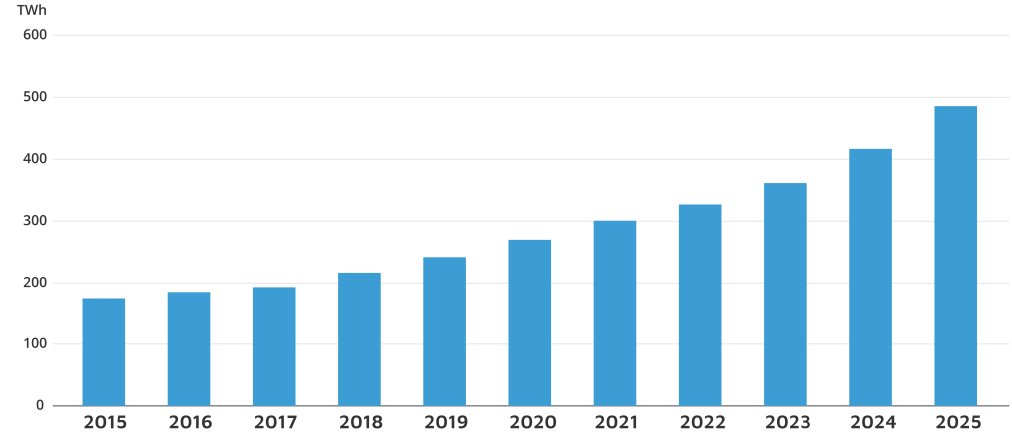
Figures presented by the IEA in 2024 showed that data centers used about 415 TWh of electricity, which represented around 1.5% of global consumption, a figure that had been climbing roughly 12% a year. At the same time, AI is accountable for nearly 20% of the total electricity used by data centers, or around 93 TWh, according to the UN.
However, considering AI’s popularity and rapidly increasing usage, the share can climb to 40% by 2030, hitting 380TWh.
Source: IEA
Based on the IEA projections, power consumption will reach 945 TWh by 2030 and thus represent around 3% of global demand.
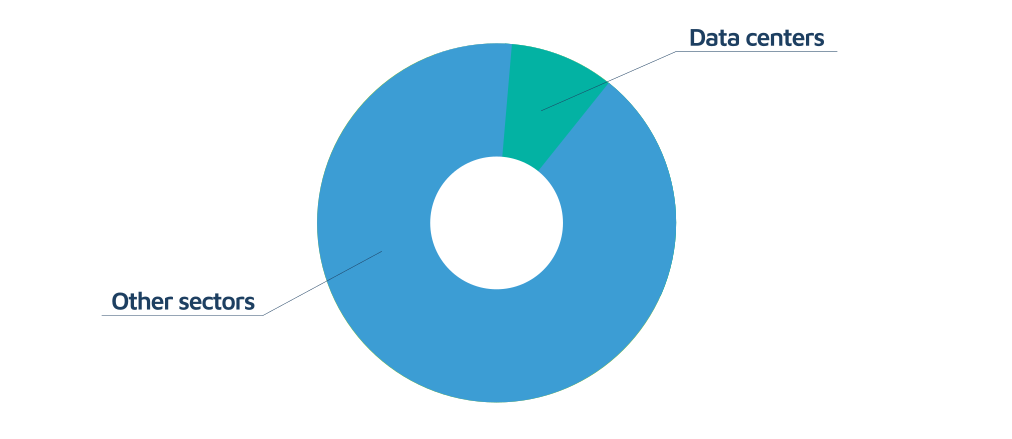
The 2026 IEA update provided another interesting figure: data center power demand in 2025 registered a 17% increase.
The graph below shows power demand growth in 2025:
Source: IEA
When it comes to the top three nations by the share of global data center power consumption, the United States is first with 45%, China second with 25%, and Europe third with 15% (IEA, 2025).
AI-related water usage
Water is used in data centers, cooling systems, and for electricity generation. A study published in the Patterns magazine estimated that AI’s water footprint ranges between 312.5–764.6 billion liters in 2025.
Based on data from the United Nations University (as of June 2026):
- In 2025, data centers required approximately 4.5 trillion liters of water, which could potentially provide more than 600 million people in sub-Saharan Africa with the essential home water they require each year.
- By the end of the decade, the amount of water usage that data centers would require could reach 9.3 trillion liters, matching the basic yearly domestic needs of 1.3 billion people.
Did you know that Google’s Mesa data center in Arizona is authorized to utilize 5.5 million cubic meters of water every year, according to The Guardian?
Land usage
This AI’s land footprint is even harder to estimate, but some data was still obtained. The UN University report describes the land footprint as associated “with the electricity demand by data centers”: “the associated land footprint of this much electricity is 5,744 km², 3.6 times the size of Greater London, equivalent to 95 Manhattans.”
To train GPT-4 and GPT-5 alone required a territory of 0.9 sq. km (approximately the area of 126 football fields) and 1.5 sq. km (around the area of 210 football fields), respectively, says the UN University report.
Who actually bears these costs?
The UN University researchers behind this data are more direct: the benefits of AI are global (healthcare, transportation, scientific discoveries, financial activities, and more), but its costs are concentrated in specific areas.
Naturally, countries with most data centers (the U.S. and China) bear the energy, land, and water footprints.
At the same time, critical minerals used in hardware manufacturing and the effects of mining are endured by developing and poor countries hosting the mines.
The “environmental bill” extends further: if electricity for powering data centers is generated by burning fossil fuels (coal in China, for instance), the atmosphere warming and climate change is felt by almost all the population of the planet.
However, we can identify three of those specific areas that matter the most for people working in the development sector. Let’s explore them.
The compute divide
Did you know that just 16% of nations around the world have cloud computing infrastructure specifically built to support AI, and only two nations account for 90% of that capacity – the United States and China.
What this means is a lot of countries either don’t have or have limited domestic sovereignty over the infrastructure, investment and governance decisions that drive the AI craze.
Note: This does not imply that those countries don’t benefit from AI. It means someone else decides where AI infrastructure gets built and how it gets governed.
Suggested reading: Africa’s offline majority risk missing out on the AI revolution
According to the UN University report, 150 nations currently lack access to domestic AI computing infrastructure, including the majority of South America and Africa.
The minerals
Critical minerals, including cobalt, copper and lithium, are extremely important for running AI hardware. According to African Business Insider, the Democratic Republic of Congo is the major source of cobalt in the world (with a share of around 70%) and is also the second-largest producer of copper.
Even though that’s a general mining statistic (cobalt is also used to manufacture EV batteries and phones, for instance), the main idea here is the issues created by mining these minerals near DRC mining sites:
- A March 2026 investigation from the Environmental Investigation Agency outlined serious health issues among people, including children, linked to air pollution near the Tenke Fungurume mine.
- A June 2026 report carried out by RAID documented air and surface water and sediment contamination across local communities near Kolwezi and Fungurume.
Suggested reading: UN warns AI threatens Indigenous peoples worldwide
The e-waste
Once hardware wears out, it generates e-waste, and the tech linked with AI development is no exception. Estimates show that AI infrastructure could potentially produce 2.5 million metric tons of e-waste by 2030 (it’s like taking apart nearly 250 Eiffel Towers annually).
Besides, it’s likely that most of that e-waste will be processed in lower-income nations, where the ability to handle it safely is lower, says the same UN University report.
Suggested reading: Mapping donor-funded AI governance in sub-Saharan Africa
If we combine all of the above-mentioned, we get a picture of asymmetry, in which the computers, the money, and the control are found in a couple of places, while the mining and the waste are located somewhere else.
The graph below shows where most data centers are located:
Source: UNU
Can AI help the environment?
Yes, it can, and it’s worth saying directly that even though a lot of credible pieces on this topic talk about the negative side of AI’s environmental impact evolution, this isn’t an argument against it.
According to the UN University researchers, it is important to develop the technology behind AI within planetary limits, not abandon it.
Accurate solar and wind predictions
MIT researchers managed to discover that AI-based forecasting models can be used to make solar and wind predictions much more accurate, which in turn helps utilities integrate more renewables and match power supply to demand with more precision, according to the World Resources Institute, citing MIT research.
Identify tree cover loss
AI that is well-designed can assist organizations in detecting, focusing, and acting on the signal within the noise. For instance, Peru is using near-real-time satellite alerts to spot tree cover loss, and AI is used to forecast illegal deforestation months before it happens. This tech already helped them cut deforestation in their areas by 52%, compared with similar communities that did not make any changes in the way they keep track of their land, says WRI.
Improving renewable energy systems
According to the Renewable Energy Institute, since wind and solar provide a growing share of the world’s power, grid operators make use of AI tech to match renewable energy supply with electricity demand.
Ultimately, the advantages do not cancel out the impact AI development has on the environment; it’s just that the honest picture about it has two sides.
What’s being done about it?
In the European Union, the EU AI Act includes Article 40 establishes energy-efficiency reporting requirements for high-impact AI systems.
In the United States, the National Institute of Standards and Technology (NIST) has created a framework to more effectively handle risks to people, companies, and society related to AI, under the direction of the Information Technology Laboratory (ITL) AI Program and in partnership with the public and commercial sectors.
Suggested reading: AI’s environmental impacts: Emerging regulations and policies
Within the industry itself, players have mostly focused on efficiency and procurement:
- Newer chips do more operations per watt.
- Cooling systems are developed to require less water.
- Companies operating large data centers are signing long-term renewable energy buying agreements.
Considering the fast development of AI and its quick adoption and wider usage, it’s yet unclear whether the above-mentioned will keep pace with demand.
UN University’s researchers, in their report call for a “responsible AI ecosystem” that stands on six principles:
- Transparency.
- Efficiency by design.
- Equity and environmental justice.
- Lifecycle responsibility.
- Global cooperation.
- Sustainable use.
The question, thus, arises: will this framework get adopted, or will it just get cited in various reports?
Frequently asked questions
How does artificial intelligence impact the environment?
AI’s impact is mostly related to electricity, water, and land use for data centers, plus the minerals and e-waste linked with the hardware that powers the tech. Data centers could use around 945 TWh of electricity by 2030 (IEA), which is enough to cover the basic domestic needs of 1.3 billion people (and AI will be responsible for 40% of that).
Can AI actually help fight climate change?
Yes, it can, but within limits. AI improves weather forecasting, helps promptly track and examine the level of deforestation via satellite analysis, and assists grid operators in balancing renewable supply. Even though these advantages are real, they don’t offset AI’s own impact on the environment and should not be considered a trade-off.
How can organizations reduce AI’s environmental impact?
Organizations can optimize their software efficiency, choose eco-friendly infrastructure, choose more efficient providers where the option exists, avoid energy-intensive tasks (image or video generation, if a simpler tool would do), and request openness from suppliers regarding the sources of water and electricity used in their data centers.
Why is AI’s environmental impact hard to measure?
Studies on AI resource usage are still in their infancy, and it can be difficult to tell the truth when assertions about AI and water use vary greatly between sources. In addition, carbon emissions get most of the attention and most of the reporting requirements, while water and land use mostly don’t. Besides, a data center may switch to certain renewable power sources to lower its carbon footprint while subsequently increasing its water or land use, a trade-off that rarely makes it into the headline numbers.
Final word
Calculating AI’s environmental cost only in tons of carbon dioxide emissions misses where that cost actually lands.
The electricity is mostly consumed in wealthy economies. The water and land pressure shows up in specific host regions. The minerals come disproportionately from places like the DRC. The e-waste ends up in nations that are not fully capable of recycling it.
If your work touches environmental-impact assessments, e-waste governance, or AI-related tenders, DevelopmentAid’s Individual Professional Membership gives you access to the tender intelligence and expert network coverage built for exactly this kind of work.