

Add us as your preferred source on Google to see more of our content in Search.
 Add to Preferred Sources
The global age-standardized suicide rate decreased by almost 40% between 1990 and 2021, according to the Institute for Health Metrics and Evaluation 2025 report. The World Health Organization (WHO) defines suicide as a preventable and controllable global public health concern, caused not by a single issue but a range of factors that are preventable.
The decline between 1990 and 2021 confirms that suicide is a preventable public health issue whose rate varies across time, countries, and regions.
In developing states with limited preventive initiatives and an underdeveloped reporting system, suicide is the third leading cause of death, mostly among young people, according to WHO.
Most suicides (73% of the registered cases) occur in low- and middle-income countries (LMICs) because this is where the majority of the world’s population lives (almost 6.7 billion people). In developed countries, suicide rates do not differ significantly from those in developing states, supporting the claim that wealth does not mean fewer suicides.
To raise awareness, reduce the stigma around mental health, and to support life-saving initiatives, Suicide Prevention Awareness Month is observed every September. This DevelopmentAid article explores age-standardized suicide rates in various countries, with a focus on LMICs, and the initiatives in place to prevent and control this public health issue.
An overview of suicide cases in LMICs
Cases of death by suicide impact both developed and developing nations. In high-income nations, the average age-standardized suicide rate is 11.8 per 100,000. Developing countries report lower average rates: 10.5 per 100,000 in low-income nations, 9.4 per 100,000 in lower-middle-income, and 7.0 per 100,000 in upper-middle-income nations
Figure 1: Age-standardized suicide rates (per 100,000 population), 2021
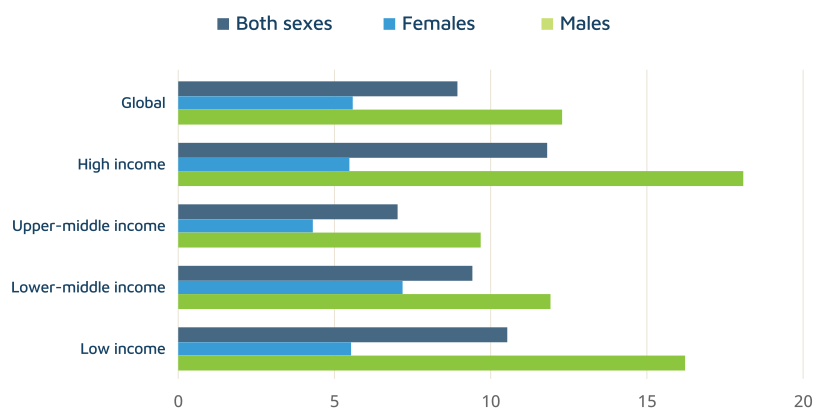
Source: WHO’s global suicide rate estimates in 2021
Global statistics of age-standardized suicide rates by country
Age-standardized suicide rates in developing nations appear to be lower mainly due to under-reporting. However, these countries record the most dynamic suicide rates based on suicide deaths per 100,000 population:
Lesotho
According to WHO, this country recorded an age-standardized suicide rate of 36.7 per 100,000 in 2021, decreasing from 41.3 per 100,000 in 2020. This decline indicates that with effective control and mental health counseling measures, suicide rates can fall within a year.
Eswatini
This sub-Saharan country registered an age-standardized rate of 31.8 per 100,000 in 2021, according to WHO. This indicator is rather dynamic, demonstrating the need for increased accuracy when reporting the suicide rate for prevention purposes.
Guyana
This small country in Latin America and the Caribbean region has an age-standardized suicide rate of 26.3 per 100,000, one of the highest in the world and the highest in South America. Death by suicide is common among its young people, putting Guyana above the regional average for youth suicides in the Americas. The rate is associated with drug and substance abuse, high rates of agricultural pesticide use, and underdeveloped mental health infrastructure.
Zimbabwe
This African nation’s age-standardized suicide rate is roughly 25.4 per 100,000, according to WHO. The rate is higher among men than women, reflecting global patterns whereby the male suicide rate is almost double the female rate. Urban male youth and young adults are also highly vulnerable to suicide due to social pressure, cultural stigma, and emotional distress.
Suriname
The age-standardized rate in this South American country is 22.5 per 100,000, as per 2021 data, having decreased from 29.0 per 100,000 in 2020, suggesting that suicide prevention initiatives are having an impact. Prevention relies on early intervention, accessible mental health services, and reducing stigma for those seeking help.
Solomon Islands
This developing small island state has an age-standardized suicide rate of 22.5 per 100,000 with a mortality rate of approximately 19.6 per 100,000. The rate is mainly accounted for by youth suicide attempts and increasing rates of self-reported suicidal ideation among adolescents, with the suicide rate among 10 to 19-year-olds standing at almost 4.7 per 100,000 people.
Uruguay
In 2021, the age-standardized suicide rate in Uruguay was 22.0 per 100,000, and although the rate varies from year to year, this does represent a decline. According to Amnesty International, in July 2024, the country reported a suicide rate of 21.35 per 100,000.
South Africa
The approximate age-standardized suicide rate in South Africa, an upper-middle-income country, in 2021 was 21.1 per 100,000, which translates to roughly 14,000 deaths from suicide.
Micronesia
According to the WHO report, Suicide Worldwide in 2021, the age-standardized suicide rate for Micronesia was 20.8 per 100,000. Public health reports connect the rate to limited mental health services, with data showing that just one psychiatrist serves a population of at least 112,000.
South Korea
This high-income country had an age-standardized suicide rate of 20.6 per 100,000 in 2021. Suicide is a public health catastrophe and is being addressed through the country’s 2025 national suicide prevention strategy that aims to reduce the suicide rate to 17 per 100,000 by 2034.
Humanitarian initiatives to prevent suicide
Community-based support initiative, Guyana
This program is strengthening the ability of Guyanese to influence and define national suicide prevention and intervention guidelines. Through this project, local healthcare providers and local community leaders are trained to tackle stigma, cultural norms, and advocate for interventions to tackle the suicide phenomenon. The Commonwealth Foundation is the main donor partnering with the Guyana government in this project.
Multisectoral coordination
Non-governmental organizations are integrating mental health principles into their work to enable protection and education on mental health as a risk factor for suicide. Groups such as Social Development International (SDI) are working in conflict-stricken nations like Syria to reduce the risk factors associated with suicide through mental health help and psychosocial support activities.
LIVE LIFE initiative for suicide prevention
LIVE LIFE is a WHO-funded program assisting governments to support national strategic action and political will, and encourage authorities to take evidence-based action to prevent suicide. The initiative supports awareness raising, capacity building, financing, data collection and the reporting of suicide attempts.
Partnerships for Life program
This five-year initiative, developed by the International Association for Suicide Prevention, supports efforts to reduce incidents of suicide and suicidal thoughts. It operates in the WHO’s six regions, assessing the stage of the development of suicide prevention strategies in each country.
HealthNet TPO initiative
This organization supports people living in conflict and disaster-stricken areas. It aims to prevent suicide by addressing mental health and psychosocial issues promptly. The initiative collaborates with communities in these regions to create awareness about mental health concerns and reduce the stigma that may deter people from accessing care.
Wrap-up
Suicide prevention requires sustained funding for continuous mental health services and community-based support. Investment in mental health and suicide prevention initiatives by donors and humanitarian agencies through financial and human capital support can save lives, particularly in developing nations where mental health receives little attention.