
Add us as your preferred source on Google to see more of our content in Search.
 Add to Preferred Sources
“We are on the ground, both the UN and NGOs, and we have already been providing assistance, particularly in the form of immediate food security assistance, and also non-food items, shelter items in particular, and health assistance – and this has kicked in, basically, from day one,” said the UN Humanitarian Coordinator for Somalia, Peter de Clercq, on Monday, in the wake of a visit to Borama, located some 180 kilometres south-west of Hargeisa, the capital of ‘Somaliland.’
“Just to reinforce the rebuilding of livelihoods I, moreover, pledged $2.7 million,” Mr. de Clercq added, with the money coming from the international donor-backed Somalia Humanitarian Fund (SHF), designed to address the most urgent humanitarian needs in Somalia, which also covers ‘Somaliland.’
The recent landfall of Cyclone Sagar on the northern Horn of Africa has affected some 160,000 people, killing dozens and causing severe damage to infrastructure and economic hardship, especially for traditional pastoralists.
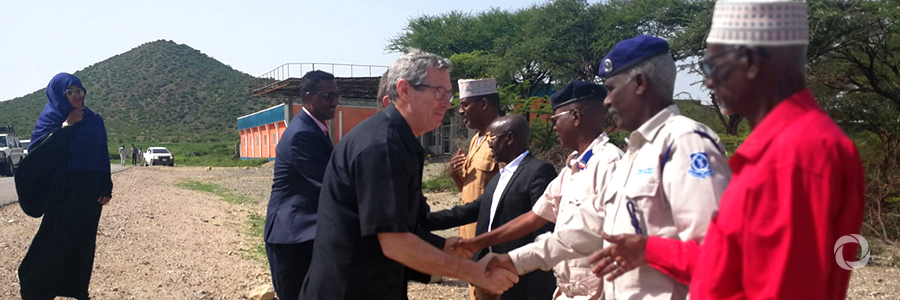
Mr. de Clercq had been in Borama to see its impact first-hand, as well as meet with local partners, including government officials, representatives of non-governmental organizations, community elders and people directly affected by the storm.
“It was an opportunity to interact with people who were immediately affected by it,” he said. “They’ve lived through this year of near-famine already, and they had to endure not only this very difficult period of drought, but then floods, immediately followed by the cyclone.”
Currently, the Humanitarian Response Plan funding stands at $390 million – less than 50 percent of the amount that was pledged at this stage in 2017.
“We really need to not just work on the relief, but on the increased resilience of the families that live in this area, the families that have to go through this kind of terrible humanitarian challenges year after year after year,” Mr. de Clercq said. “So, we should not be waiting until the next crisis hits us – we haven’t seen the last drought yet, we very well may not have seen the last cyclone here.”
Original source: UN
Published on 29 May 2018