
Add us as your preferred source on Google to see more of our content in Search.
 Add to Preferred Sources
In the face of growing health impacts from extreme weather, climate change and air pollution, the World Meteorological Organization (WMO) and World Health Organization (WHO) have agreed to step up joint action to tackle environmental health risks that cause an estimated 12.6 million premature deaths every year.
A new Collaboration Framework on Climate, Environment and Health was signed on 30 May by WMO Secretary-General Petteri Taalas and Dr. Tedros Adhanom Ghebreyesus, Director-General of WHO. It follows the launch of a global coalition between WMO, WHO and UN Environment during the World Health Assembly on 24 May.
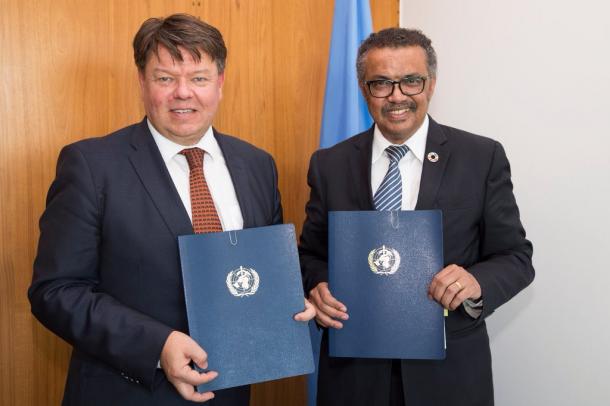
The agreement commits WMO and WHO to accelerate action to improve health outcomes through the development and use of “relevant and authoritative weather, climate, atmospheric composition and hydrological science and operational services.”
It focuses on strengthening the understanding and management of health risks associated with extreme weather and climate events and long-term climate change. This includes better access and use of weather and climate data for risk assessment, adaptation planning and development of tailored services.
It also prioritizes improved monitoring and management of environmental health risks, such as UV radiation, hazardous air quality, and water. This will facilitate closer coordination between meteorological services, which monitor and predict air quality, and health authorities, which deal with the impact of human exposure to pollutants.
An overarching aim is to promote policies and practices which are beneficial both to public health and which cut greenhouse gas emissions.
The new agreement is aligned to the international agenda on sustainable development, disaster risk reduction and climate change adaptation. It places special emphasis on reaching the most vulnerable populations in developing countries, small island developing states and urban areas.
“Every year, more than 12 million people die from the hidden risks in our environment, carried by the air we breathe, the water we drink, or unseen chemicals to which we are too often exposed. In addition, a changing climate is exposing us to more extreme weather, including storms, droughts and shifting patterns of infectious disease,” said Dr. Tedros. “That is why we are joining forces with other leading UN agencies to intensify our actions to address the root environmental causes of ill health.”
International coalition
The bilateral agreement is part of a wider international coalition which also embraces UN Environment and the Climate and Clean Air Coalition. This coalition was showcased during the annual World Health Assembly and will pool expertise and achieve greater coordination.
One of the most immediate outcomes of the coalition will be a Global Conference on Air Pollution and Health, which will take place in Geneva 30 October to 1 November 2018.
Original source: WMO
Published on 31 May 2018