
Add us as your preferred source on Google to see more of our content in Search.
 Add to Preferred Sources
Since 2011 the amount of solid waste generated by Jordan’s capital of Amman has increased by almost half, a consequence almost entirely of the arrival of a large number of Syrian refugees.
Such growth in population has made it difficult for Amman’s infrastructure to cope. The effects are felt in municipal services, schools, hospitals and other sectors.
Since 2015, the European Bank for Reconstruction and Development (EBRD), with support from the European Union (EU), the United Kingdom the EBRD’s Southern and Eastern Mediterranean Multi-Donor Account (SEMED MDA) and Taipei China, has taken several steps to upgrade Amman’s solid waste management system.
A total of JOD 87 million of EBRD loans and grants to the Greater Amman Municipality (GAM) are helping improve the city’s infrastructure.
The funding is partly being used for the construction of a Landfill Gas Recovery (LFG) system at the main landfill site in Ghabawi, serving the capital as well as Zarqa and Ruseifah.
The investment covers the installation of four generators on capped cells filled with waste and covered up to produce electricity by trapping the biogas generated by waste decay.
Currently, the system extracts 2000 square metres of biogas per hour from the first three capped cells then flares it at the site. Burning the landfill gas prevents methane from escaping into the atmosphere, which is 50 times more harmful than CO2 emissions. In addition, the system will avoid the hazardous contamination that buried garbage causes the environment.
By the beginning of 2019, the waste-to-energy system at Ghabawi will generate electricity to be distributed via the national power grid around the entire country.
Additionally, the cells are connected to pipes that help drain strong municipal wastewater from the capped cells, allowing it to evaporate instead of contaminating the ground.
The EBRD and donors are also financing the construction of a fifth cell, equipped with a leakage-proof lining which will allow the landfill to receive larger amounts of waste, extending the landfill’s lifespan.
GAM anticipates that Ghabawi will be able to contain a total of 9 cells, enough to process the city’s waste till 2027.
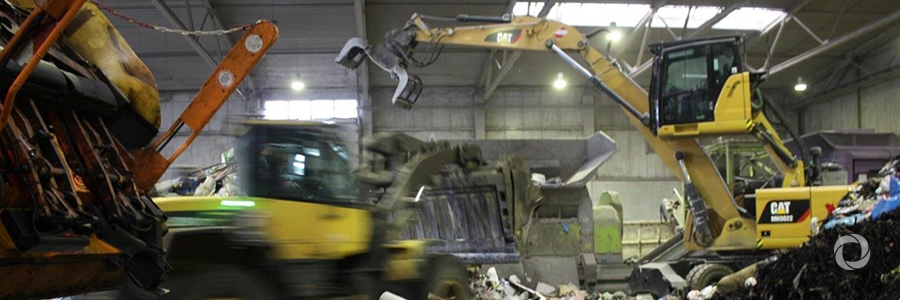
The Bank’s latest investment will be used to purchase 75 new refuse collection vehicles. The new trucks will complement and replace an old fleet that travels long distances, providing better working conditions for GAM’s drivers and reducing working hours.
The EBRD and GAM are also working to develop a Green City Action Plan to address the city’s needs for sustainable growth in different sectors such as solid waste and wastewater management, urban transport, and lighting and energy efficiency.
Original source: EBRD
Published on 11 July 2018