
Add us as your preferred source on Google to see more of our content in Search.
 Add to Preferred Sources
The IAEA and the French Institute of Radioprotection and Nuclear Safety (IRSN) will intensify their cooperation to provide radiation protection services worldwide.
Under a new agreement, signed on 13 July, the two organizations will exchange information to build upon best practices and further enhance dosimetry methods, including numerical methods for the calibration of body counters. The agreement will also help IRSN capacity to provide nuclear safety, security, and radioprotection services.
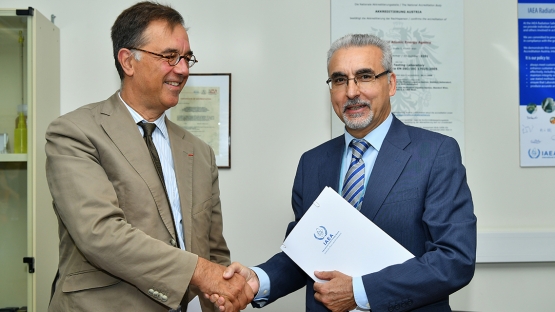
“The signing of this Practical Arrangements agreement with IRSN will allow us to mutually improve and help us establish points of reference for dosimetry for our Member States,” said Deputy Director General and Head of Nuclear Safety and Security Juan Carlos Lentijo. “We look forward to more technical visits from IRSN to our laboratory to assist them in continuing to provide top-level dosimetry and radioprotection services.”
IRSN conducts activities in a wide variety of radiation safety areas, including transport safety and occupational radiation monitoring. IRSN’s Dosimetry Laboratory, which has been in continuous operation for more than 50 years, provides occupational radiation monitoring services essentially in France and worldwide, to 24 000 customers in 39 countries.
The laboratory, which helps monitor approximately 170 000 workers, will now benefit from increased collaboration, including more frequent technical visits to the IAEA’s Radiation Safety Technical Services Laboratory, also known as the IAEA Testing Laboratory. This IAEA laboratory is responsible for the occupational exposure assessment of approximately 3 000 people including IAEA staff members, experts, fellows, participants in regional training courses and other workers who may be exposed to radiation during activities such as safeguards and verification.
Original source: IAEA
Published on 13 July 2018