
Add us as your preferred source on Google to see more of our content in Search.
 Add to Preferred Sources
Stigma and discrimination in health-care settings is a major obstacle to ending AIDS. Widespread across the world, stigma, and discrimination seriously reduces the quality of life of people who experience it and hinders their access to health and HIV services.
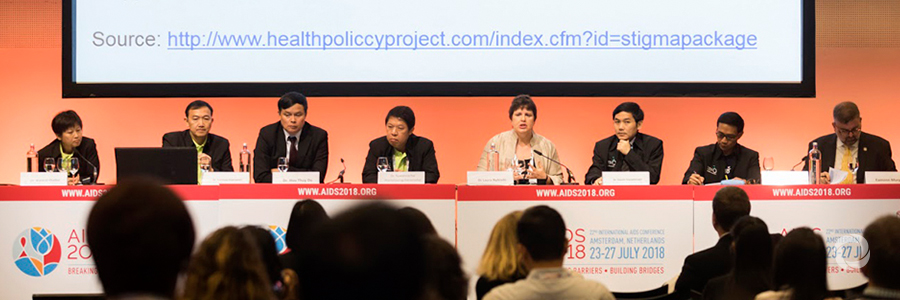
How to catalyse country initiatives and reduce stigma and discrimination in health-care facilities was the focus of a session at the International AIDS Conference on 23 July in Amsterdam, Netherlands. The session, Catalyzing Thailand and Regional Initiatives on Zero Discrimination in Healthcare Settings and Building Bridges Towards a Global Compact to Eliminate all Forms of HIV-Related Stigma and Discrimination, brought together representatives of the Governments of Thailand, Viet Nam and the Netherlands and representatives of regional civil society networks, the United States Centers for Disease Control and Prevention and UNAIDS.
Thailand is acknowledged as a pioneer in reducing stigma and discrimination in health-care settings in Asia through its innovative system-wide response. The event heard that the Thai stigma and discrimination reduction package is based on global measuring tools and contains a permanent monitoring system, evidence-informed actions at health facilities and community engagement at all levels.
Viet Nam piloted a stigma and discrimination reduction programme in Ho Chi Minh. At the session, Huu Thuy Do, Head of the Information, Education and Communication Department of the Viet Nam Administration for AIDS Control, explained how Viet Nam learned from cooperation with Thailand and how the Thai model was translated to the city level in Viet Nam.
Based on the experiences of Thailand and Viet Nam, speakers encouraged countries to foster cross-border links on stigma and discrimination reduction efforts in health-care settings in order to achieve more effective and efficient joint global action.
The participants heard that the greater engagement of communities, people living with HIV and key populations in the development and monitoring of programmes against stigma and discrimination is a core element for successful stigma and discrimination reduction programmes. Their participation not only increases access by hard-to-reach communities, but also helps ensure that a rights-based approach is used.
The event concluded with the presentation of the Global Framework for Action, an initiative led by civil society that aims to catalyse and accelerate the implementation of commitments made to end HIV-related stigma and discrimination in different settings.
Original source: UNAIDS
Published on 23 July 2018