
Regional cooperation in infrastructure is boosting economic growth in Southeast Asia: the case of Economic Corridors (part I)

Add us as your preferred source on Google to see more of our content in Search.
 Add to Preferred Sources
For decades, Asia recorded the world’s fastest economic growth while infrastructure investment has been at the heart of the region’s development strategy. Whereas some Asian countries have far better infrastructure than others, overall, the region remains below the world average in terms of both its quantity and quality.
Infrastructure plays a key role in promoting and sustaining rapid economic growth. The 1994 World Development Report, Infrastructure for Development, concluded that infrastructure investment was an important reason why the growth of East Asia was much faster than that of Sub-Saharan Africa. More recent studies have suggested that differences in infrastructure accounted for around one-third of the difference in output per worker between Latin America and East Asia. Inadequate physical infrastructure is thus not only an impediment to growth, but it is also one of the root causes of poverty.
Asia’s reemergence as an economic powerhouse in recent decades, and its recovery from the 1997-1998 financial crisis, owes much to the expansion of its international trade. This has been fostered by the development of supporting infrastructure, both hard (physical) and soft (institutional), and of efficient logistic services that make the best possible use of trade-related infrastructure. As Asian economies have liberalized their trade policies, infrastructure deficiencies have become an increasingly significant impediment to trade. In a study of eight sectors in 10 Asian countries, infrastructure quality and transport costs were found to be the leading determinants (along with tariffs) of cross-country variations in trade flows.
Regional cooperation, a solution for infrastructure gaps in Southeast Asia
According to the Asian Development Bank (ADB) and ADB Institute study, Infrastructure for a Seamless Asia, at the end of the first decade of the 21st century, Asia remained below the world average in terms of both the quantity and the quality of infrastructure. Specifically, Asian countries had very wide gaps in terms of infrastructure attainment, where the regional infrastructure inequalities between countries have widened rather than narrowed over time.
Modern theory and practical experience have proved that prospects for development are improved when markets and government action stretch beyond the confines of a single country. In other words, the larger the cross-border externalities are, the stronger the economic case for regional cooperation and coordination in infrastructure provision.
As such, regional cooperation in Asian infrastructure has come to be bolstered through regional initiatives including Pan-Asian initiatives, such as the Asian Land Transport Infrastructure Development, and sub-regional initiatives, which include the well-known Association of Southeast Asian Nations (ASEAN), Central Asia Regional Economic Cooperation (CAREC), Pacific Islands Forum (PIF) and Greater Mekong Sub-region Economic Cooperation Program (GMS) in Southeast Asia, to name but a few.
The latter initiative adopted the concept of economic corridor development, which has become one of the most important initiatives of the program since it was first considered in 1998. A cross-border economic corridor means improved transport connections between centers of economic activity which reduces the cost of moving and trading along them and promotes development around them. Economic corridors encourage trade, investment and other economic opportunities and can thus help to reduce poverty, support the development of rural and border areas, increase the earnings of low-income groups and promote tourism.
Economic corridors as drivers of economic growth in the Greater Mekong Sub-region
The Greater Mekong Sub-region is very diverse. It includes the landlocked Lao PDR as well as Vietnam, which has over 3,400 km of coastline. Population density ranges from 25 people per square kilometer in the Lao PDR to more than 270 in Vietnam. The GMS is home to some of Asia’s poorest people (for example, in Cambodia and the Lao PDR) as well as a relatively prosperous country (Thailand). The diversity of the GMS is both a challenge and an opportunity for regional cooperation.
In its early stages, the concept of economic corridors in the GMS gained support from international agencies, in the hope that they would greatly improve the prospects for the region. As such, the vision developed into three main economic corridors: the North-South Economic Corridor, the Southern Economic Corridor and the East-West Economic Corridor. The North-South Economic Corridor involves three routes along the north to south axis of the GMS. The Southern Economic Corridor runs along the south of the sub-region and links Cambodia with six provinces in Thailand, including Bangkok, four regions in Vietnam including Ho Chi Minh City and six provinces in Lao People’s Democratic Republic. It also reaches to Dawei in Myanmar. The East-West Corridor runs from Da Nang Port in Vietnam, through Lao PDR, Thailand and to Myanmar. It intersects the North-South Economic Corridor in the provinces of Tak and Phitsanulok in Thailand.
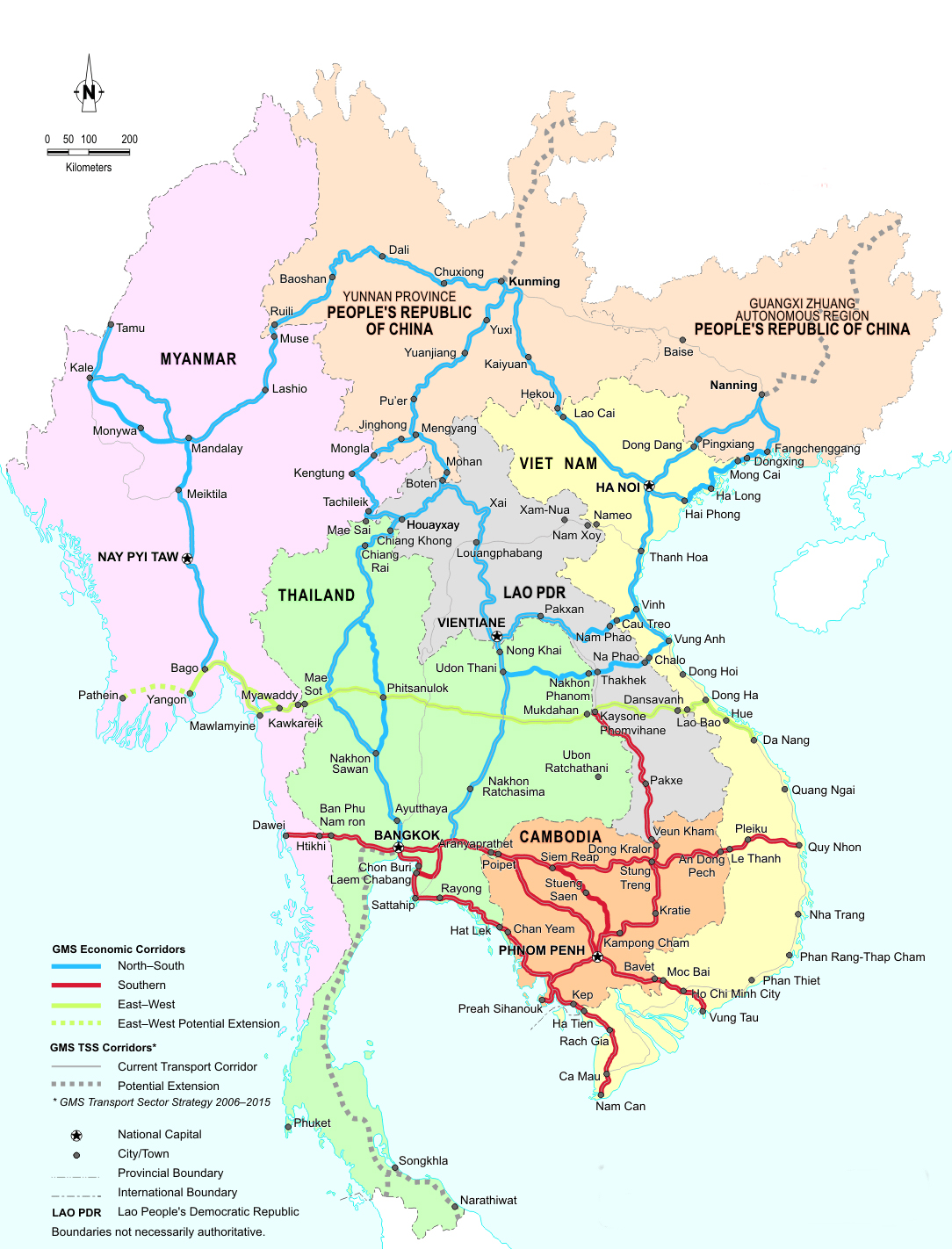
Once established, the corridors induced investments in new economic activities in the region, leading to the development of new industrial districts such as Trang Bang Industrial Park on the Vietnamese side of the border along the Southern Economic Corridor, generating jobs for the local population.
The benefits of the improved cross-border transport infrastructure were shown in the Mekong Institute Research Working Paper, Social and Economic Impacts of GMS Southern Economic Corridor on Cambodia, where it was found that around 46% of households in the area around the Champasak road improvement projects increased their agricultural output to be sold at local markets, significantly increasing incomes. In addition to this, more than 70% of field survey respondents in the Southern Economic Corridor stated that their living standards had improved as a result of the project.
By increasing their mobility, infrastructure also increases impoverished people’s employment opportunities. For example, many workers from the Saravan Province of the Lao PDR, which is not even on the direct East-West Corridor route, work in Cambodia and Thailand. There is also evidence that such mobility ensures decent labor standards. Cross-border workers in the GMS reported improved working conditions in 2001-2005, as border crossings eased and wage levels improved, according to the report, Reviewing the Poverty Impact of Regional Economic Integration in the Greater Mekong Sub-region.
In December 2011, at the 4th GMS Summit, the leaders of the six countries adopted the GMS Strategic Framework for 2012-2022, which expanded the program from conventional infrastructure to multi-sector investments designed to foster economic corridor development involving stronger cross-sectoral linkages, better consideration of the spatial aspects of regional economic development, more local stakeholder involvement and more effective monitoring and evaluation.
This article is part of a series dedicated to the Greater Mekong Sub-region with a specific focus on its past and current infrastructure projects. The series aims to bring the region under the spotlight as a preamble to the Economic Infrastructure Development Forum (EIDF Vietnam) which will take place in Hanoi, Vietnam, in September 2018.
Author: DevelopmentAid News Team