

Add us as your preferred source on Google to see more of our content in Search.
 Add to Preferred Sources
With nearly one million refugees expected to have crossed the border from South Sudan to Uganda by the end of this month, Save the Children is calling for education to be put at the centre of a make-or-break summit.
Almost three quarters of a million refugees – more than half of them children – have arrived in Uganda since fighting escalated. The organisation warns that many children – some as young as 11 – are making the journey alone, having fled from their homes or villages due to insecurity and violence. Bidi Bidi, now reportedly the largest refugee camp in the world, houses approximately 270,000 people, most of whom are living in tarpaulin homes and relying on help provided by the Ugandan government and aid organisations to survive.
The summit – organised by the Government of Uganda, and attended by the UN Secretary General, development ministers, and NGOs – aims to raise critical funds for the response so it can continue providing nearly 1.3 million refugees with basic services, including education. The response is currently only 17% funded.
“Uganda is experiencing the fastest-growing refugee crisis in the world and is now the top refugee hosting country in Africa. While it has one of the most generous refugee policies of any country, it simply can’t provide for them without support from the international community. In 2015, the world made a promise that all children would have a right to survive, learn and be protected. But for millions of refugee children this is not the case. Nearly 60 per cent of refugees in Uganda are children, and as many as 300,000 aren’t in school. Education gives these children hope for a better future, and world leaders must commit this week to getting them back to school,” Helle Thorning-Schmidt, CEO of Save the Children International.
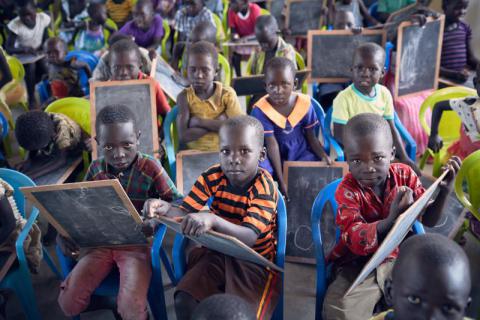
“As a mother myself, it breaks my heart that children are forced to flee from their homes in South Sudan to Uganda. Some are alone, desperately scared for their future. Some report witnessing terrible atrocities, the scars of which will last a lifetime. Many have missed school, further stunting their future and life chances. I am humbled that Uganda is offering some help at such scale, and we will continue to do so – but we need the support of those who are willing to do a part,” First Lady and Minister of Education and Sports, Honourable Janet Museveni.
In advance of the summit, Save the Children shared a plan of action. It challenges donors to step up to pay $464 million over three and half years – an average of $152 per child, per year – helping to cover costs for:
- The construction of 304 new early childhood and primary school sites using semi-permanent classrooms constructed to a standard conducive to learning
- The construction of 110 new secondary schools
Reading materials, text books and school supplies for all schools - The employment of 5,307 primary and secondary school teachers
- The training, recruitment and accreditation of 750 primary school teachers from South Sudan.
Save the Children is providing emergency schooling to refugees across Uganda, offering early schooling for young children, top up classes for those who have fallen behind, and providing safe spaces for children to play, learn and to recover from their trauma.
Source: Save the Children. Read full article here.
20 June, 2017