
Add us as your preferred source on Google to see more of our content in Search.
 Add to Preferred Sources
Years back, nuclear energy was a fancy option limited to the industrialized world. In due course, nuclear could be an energy source for much of Africa, where only South Africa currently has a nuclear power plant.
Governments across the continent are devising development policies to become middle-income countries in the medium term. Socioeconomic growth comes with a rise in energy demand—and a need for a reliable and sustainable energy supply.
“Africa is hungry for energy, and nuclear power could be part of the answer for an increasing number of countries,” says Mikhail Chudakov, deputy director general and head of the Department of Nuclear Energy at the International Atomic Energy Agency (IAEA), an international organisation that promotes the peaceful use of nuclear technology.
A third of the almost 30 countries currently considering nuclear power are in Africa. Egypt, Ghana, Kenya, Morocco, Niger, Nigeria and Sudan have already engaged with the IAEA to assess their readiness to embark on a nuclear programme. Algeria, Tunisia, Uganda and Zambia are also mulling the possibility of nuclear power.
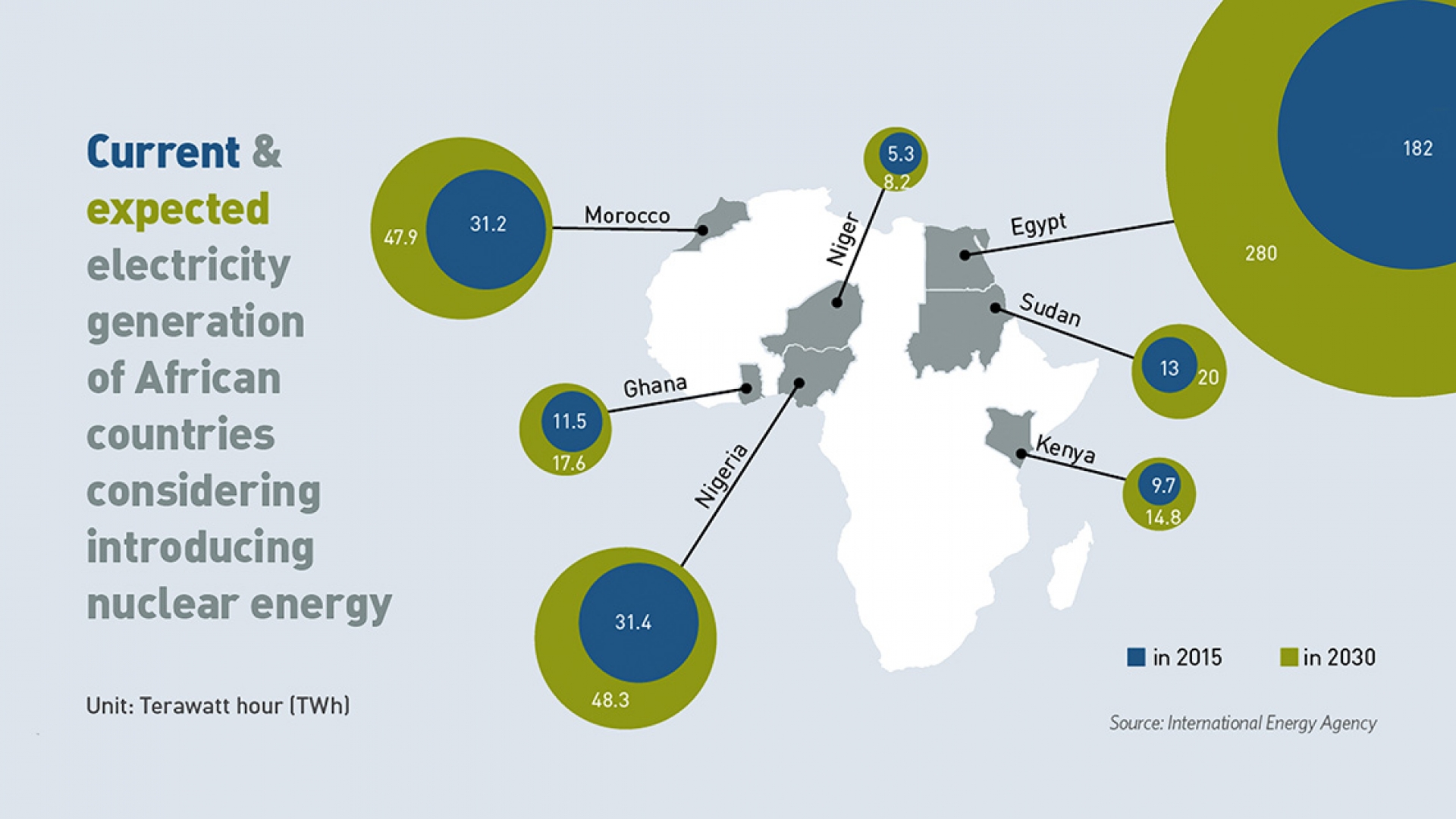
African governments are working to make electricity more widely accessible. Roughly 57% of the population of sub-Saharan Africa does not have access to electricity. For many, the electricity supply is characterised by frequent power outages, according to the International Energy Agency, an organisation of 30 mostly industrialised countries that have met a set of energy security criteria.
Kenya is considering nuclear to meet the demand generated by hooking up households nationwide, which is expected to contribute significantly to the 30% increase in electricity demand predicted for the country by 2030.
“Going nuclear is not something that happens from one day to the next. From the moment a country initiates a nuclear power programme until the first unit becomes operative, years could pass,” says Milko Kovachev, head of the IAEA’s Nuclear Infrastructure Development Section, which works with countries new to nuclear power.
“Creating the necessary nuclear infrastructure and building the first nuclear power plant will take at least 10 to 15 years.”
Without proper financing, nuclear is not an option.
“Most countries in Africa will find it difficult to invest this amount of money in a nuclear power project,” Mr. Kovachev stresses. “But there are financing mechanisms like, for instance, from export agencies of vendor countries. Tapping into a reliable, carbon-free supply of energy when vendors are offering to fund it can make sense for several countries in Africa.”
IAEA assistance
While the IAEA does not influence a country’s decision about whether to add nuclear power to its energy mix, the organisation provides technical expertise and other pertinent information about safe, secure and sustainable use to countries that opt for nuclear energy.
Safety and security are key considerations in the IAEA Milestones Approach, a phased method created to assist countries that are assessing their readiness to embark on a nuclear power programme. The approach helps them consider aspects such as the legal framework, nuclear safety, security, radiation protection, environmental protection and radioactive waste management.
“Many, many people ask the question: Why nuclear?” Mr. Allotey says. “To me, it’s not about nuclear being an option. It is about energy being an option. Do you, as a country, need energy? And the simple answer is yes. So if you need energy, you need to find cost-effective electricity that is clean and reliable.”
“With a rapidly expanding population and plans to grow our economies, we need to work within these constraints,” he adds. “We are a continent that is in dire need of energy.”
Original source: IAEA
Published on 3 September 2018