
Add us as your preferred source on Google to see more of our content in Search.
 Add to Preferred Sources
The Asian Development Bank (ADB) and the Government of Nauru signed grant and project agreements to help transform the Aiwo boat harbor in Nauru into the country’s first fully functioning international port. The signing ceremony marked the start of the construction phase of the port project.
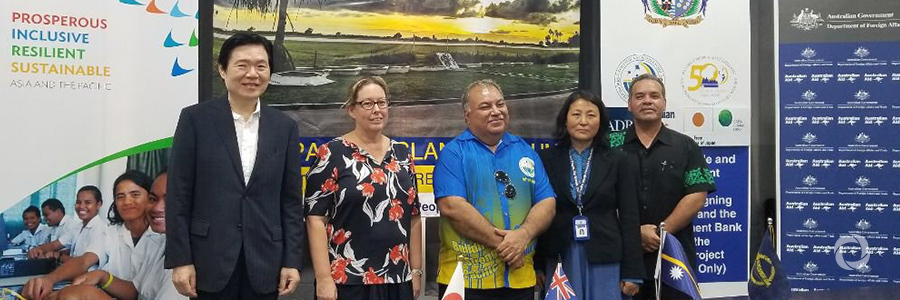
ADB’s Pacific Liaison and Coordination Office Regional Director Ms. Emma Fan and Minister of Finance and ADB Governor Mr. David Adeang signed the agreements on the sidelines of the Pacific Islands Forum Leaders Meeting in Aiwo. Australia’s High Commissioner to Nauru Ms. Angela Tierney and the Ambassador of Japan to Nauru Mr. Masahiro Omura witnessed the signing.
“The Government of Nauru, on behalf of all its people, would like to express their sincere gratitude to all the contributors to the project,” said Mr. Adeang. “This project, which is our highest priority and an achievement for the Waqa government, will provide many long-term economic benefits and support Nauru’s commitment to climate change. These benefits will be for all of our people on an intergenerational basis.”
The Nauru Sustainable and Climate Resilient Connectivity Project, approved in January 2018, will transform the largely inoperable boat harbor into an efficient, reliable, and climate-resilient port through structural improvements and capacity building. This will help improve the quality of life of all people in Nauru and boost the country’s economic performance through increased trade.
ADB is providing a $21.3 million grant for the project. The Green Climate Fund (GCF) and the Government of Australia will contribute $26.91 million and $14.08 million, respectively, while the Government of Nauru will provide $17.3 million. The Government of Japan has pledged to supply port operation equipment under a separate bilateral agreement between the two governments.
“The project will help to strengthen the resilience of Nauru to extreme weather caused by climate change,” said GCF Deputy Executive Director Mr. Javier Manzanares. “This initiative will help to better prepare Nauru for the sudden impact of disasters as well as the slow-moving threat of sea level rise. This project is part of our strong support for climate action in the Pacific—with nine approved GCF projects in the region to date, amounting to nearly $300 million.”
ADB has been supporting Nauru since 1991 and has committed a loan of $5 million, grants totaling $20.33 million, and technical assistance projects totaling $6.96 million.
Original source: ADB
Published on 6 September 2018