
Add us as your preferred source on Google to see more of our content in Search.
 Add to Preferred Sources
As the battle officially began his week to retake the last few neighbourhoods of West Mosul’s old city from ISIL, about 50 kilometres away people have started returning to the increasingly bustling riverside town of Gwer.
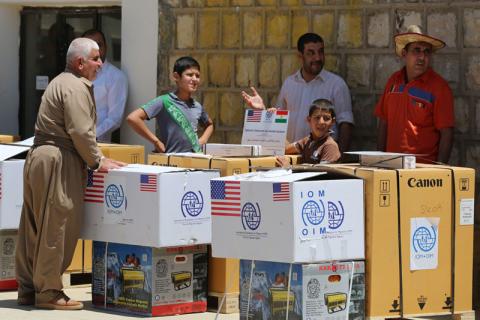
About 11,200 of Gwer’s population of 65,000 initially fled after ISIL briefly took control of the town in 2014. Gwer was retaken by the Peshmerga forces a few days later, but the city remained a volatile frontline with ISIL. Only when the militant group was pushed back, in the lead up to Mosul’s liberation in July 2016, did displaced families feel safe enough to return. Nearly a third of those displaced have now returned.
Last week, the city of Gwer hosted a ceremony attended by the Governor of Erbil, dignitaries from Gwer and beneficiaries from the community to celebrate the opening of the primary health care centre which was rehabilitated and refurnished by IOM with financial support from Canada and the UK Department for International Development (DFID).
The care centre aims to provide primary and emergency health services for about 7,000 people inside Gwer and 50,000 individuals in 30 surrounding villages.
Much of Gwer’s infrastructure and its primary health care centre was damaged and looted when ISIL first took and entrenched itself there during the summer of 2014. Although the building itself was not massively damaged, doors and windows were broken, toilets, wash basins and generators destroyed, and electricity cables, health equipment and furniture stolen.
In August 2016, IOM joined the Erbil Governorate’s Refugee Council for an initial assessment in Gwer, which identified the priority needs for rebuilding the city. After careful consultations with key community stakeholders, IOM decided to rehabilitate critical community infrastructure.
Source: IOM. Read full article here.
20 June, 2017