
Add us as your preferred source on Google to see more of our content in Search.
 Add to Preferred Sources
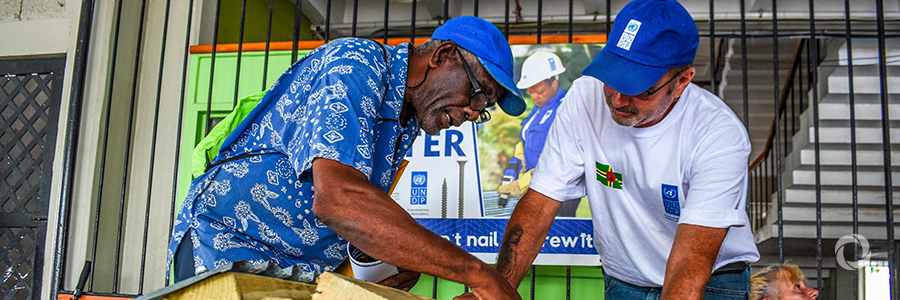
China and UNDP joined hands to support the Governments in Antigua and Barbuda and the Commonwealth of Dominica to rebuild homes with urgently needed material aid. In addition, technical support on “Build Back Better” approaches was provided, introducing concrete steps for the affected areas to strengthen resilience through an upgrade of standards and building techniques.
The Sustainable Development Goals (SDGs) carry a hefty price tag of $2-3 trillion per year to accelerate the 2030 Agenda for Sustainable Development. New and innovative forms of finance and cooperation are needed. Various forms of private and public financings such as grant aid, concessional and non-concessional, investments, bonds and impact financing that build on national public financing, lay the foundation for development and innovation.
Since the 1950’s, China has been expanding its international cooperation under the framework of South-South cooperation. In February 2018, its first agency for international cooperation – China International Development Cooperation Agency (CIDCA) – was established. CIDCA’s task is to provide policy coherence and guidance for China’s international cooperation, particularly bridging foreign assistance, foreign policy and the Belt & Road Initiative.
Accelerating SDG achievement goes way beyond financial assistance. Training, experience sharing, capacity building and demonstration of approaches to development are integral aspects of China’s support where partner countries draw on China’s unique experiences in poverty reduction. China has, after all, lifted 800 million people out of poverty in the last 40 years of Economic Reform and Opening Up. The country’s domestic experiences are significantly shaping the areas that characterize China’s international cooperation in terms of knowledge and technology exchange.
With the intent of distilling specific experiences from China’s support to agriculture development and identify areas where impact and approach can be strengthened, China and UNDP have jointly assessed China’s partnership with Guinea-Bissau and Mozambique on agricultural development. The two case studies represent two different approaches of China’s agricultural assistance. In Mozambique, the Agricultural Technology Demonstration Center has introduced a market-based approach to sustain long-term operations, using aid as a lever and entry point for private investment into agricultural production. In Guinea-Bissau, the Agricultural Technical Cooperation Project has focused mainly on the technical capacity building of local communities through a participatory approach. There is also a need, however, to strengthen communication and outreach work with local stakeholders and international partners, and continue experimenting with financing and sustainability models that ensure financial viability while maintaining a focus on development impact.
China’s expanding global cooperation – including its Belt and Road Initiative – has the potential to significantly close the financing gap of the 2030 Agenda and help to lift people out of poverty provided that social, environmental and economic standards are firmly anchored on local needs, building capacity, and nurturing local content and involvement.
Original source: UNDP
Published on 29 October 2018