
Add us as your preferred source on Google to see more of our content in Search.
 Add to Preferred Sources
The global energy landscape is witnessing a rapid and disruptive change driven by an unprecedented growth in renewables. Last year alone, a record-breaking 168 GW of renewable energy capacity were added globally – the sixth consecutive year in which additions from renewables have exceeded those from conventional sources. Today, a quarter of the world’s electricity comes from renewables.
But, the recent IPCC report has sent a clear signal and called for a scaling up of renewables both in the power and in end-use sectors such as transport and buildings. This echoes IRENA’s own analysis which estimates that avoiding the worst effects of global warming will require to source 85% of global power and two-thirds of total energy supply from renewables by 2050. Around 60% of electricity would come from so-called variable renewable energy (VRE) like solar and wind.
Experiences from frontrunner countries show that flexibility in the power system can help integrating solar and wind into the market.
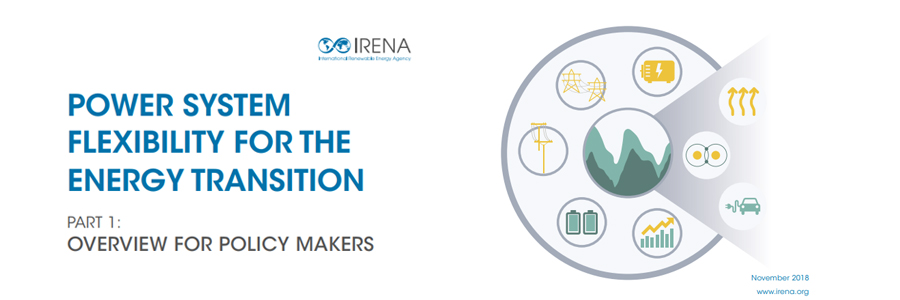
With today’s report on Power system flexibility for the energy transition and a new tool to assess the flexibility of the power system – the FlexTool – IRENA opens a new work stream that supports its members in finding the most cost-effective mix of flexibility solutions. The tool has been applied jointly with IRENA members Colombia, Panama, Uruguay, and Thailand to assess the flexibility of their power system based on the latest national plans.
Demand has a significant potential to contribute to the flexibility of the power system – from quickly responding to supply shortages to following price signals in order to consume energy when it is cheaper, and the grid does not face congestion. A central element of flexibility is sector-coupling, the coupling of energy demand for heat, fuels, and mobility by using power to heat (e.g. heat pumps), power to gas (e.g. hydrogen from renewable electricity) and power to mobility. Electric vehicles, for example, can act as battery storage devices if regulations and technologies are aligned and provide short-term storage and grid services.
Read and download full report “Power System Flexibility for the Energy Transition”
Original source: IRENA
Published on 13 November 2018