
Add us as your preferred source on Google to see more of our content in Search.
 Add to Preferred Sources
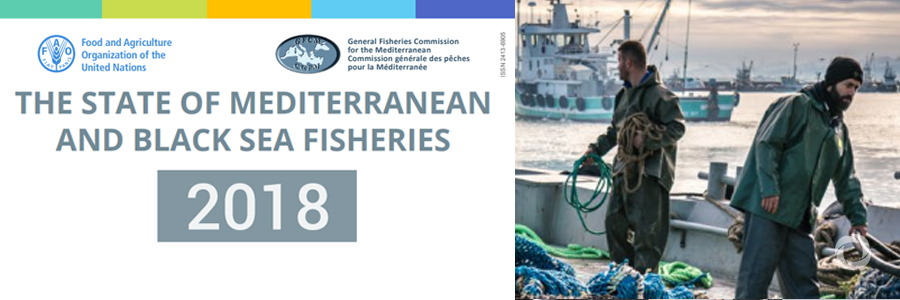
Although the main commercial fish species in the Mediterranean and Black Sea are still over-fished, pressure has reduced over the past years, raising hopes – for the first time – for the recovery of fish stocks, according to new FAO-GFCM report.
The percentage of overexploited fish stocks decreased by 10 percent – from 88 percent in 2014 to 78 percent in 2016. More efforts are needed, however, to ensure long-term fish stock sustainability, warns The State of Mediterranean and Black Sea Fisheries.
This means more support for the small-scale fishing sector, which employs most fishers and causes least environmental damage; reducing bycatch and discards, and introducing more drastic measures such as significantly reducing fishing or establishing fisheries restricted areas (areas where fishing activities are regulated).
The latter is particularly needed to safeguard the most heavily fished species, such as European hake, which is fished nearly six times beyond its sustainable level.
“Fisheries provide the region with an important socio-economic balance and are essential to ending hunger and poverty,” said Abdellah Srour, GFCM Executive Secretary.
“Sustainability may be expensive in the short term, but there is nothing more expensive than running out of fish,” said Miguel Bernal, FAO Fishery Officer and one of the report’s coordinators.
Mediterranean and Black Sea fisheries are under threat in the long run because of the effects of increased pollution from human activities, habitat degradation, the introduction of non-indigenous species, overfishing and the impacts of climate-driven changes.
Catch levels – latest trends
Overall, fish catch levels have been stable for the last few years, but are significantly down from the record years of the 1980s – 1.2 million tonnes in 2016 versus 2 million tonnes in 1982.
The 1.2 million of tonnes comprise of 830 000 tonnes of fish caught in the Mediterranean and 390 000 tonnes of fish from the Black Sea.
Across, the region, the ranking of capture fisheries production in 2014-2016 continues to be dominated by Turkey, followed by Italy, Algeria, and Greece.
According to the report, incidental catches of vulnerable species are relatively rare events but are important because the species caught are of conservation concern. Among the vulnerable species most affected by incidental catches, are sea turtles (which appear in 8 out 10 of reports on incidental catches) followed by sharks, rays, and skates (appearing in 2 out of 10 reports on incidental catches each). Seabirds and marine mammals represent the lowest number of incidental catches, and are only occasionally included on incidental catches reports.
Read and download the report The State of Mediterranean and Black Sea Fisheries.
Original source: FAO
Published on 11 December 2018