
Add us as your preferred source on Google to see more of our content in Search.
 Add to Preferred Sources
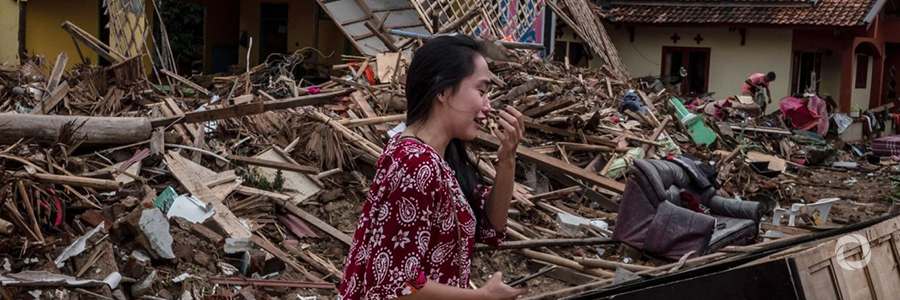
Government-led relief efforts are being stepped up at the tip of Indonesia’s two main islands of Sumatra and Java after a tsunami slammed into densely-populated coastal areas along the Sunda Strait on the night of December 22.
The UN humanitarian coordination office, OCHA, is reporting that as of December 26, according to the Indonesian National Disaster Management Agency (BNPB), 430 people are dead, 1,495 injured, and 159 are missing.
An estimated 22,000 people are displaced due to shelter damage and the latest tsunami alert. Damages include some 924 houses, 73 hotels and villas, 60 shops, 434 boats and 65 vehicles.
Indonesia’s Meteorology, Climatology, and Geophysics Agency warned that a new tsunami could affect the area surrounding the Anak Krakatau volcano in the Sunda Strait. Authorities are alerting people to stay up to one kilometer away from the coastal area.
The deadly tsunami is believed to have been triggered by an underwater landslide following a volcanic eruption on December 22.
Wednesday marked the anniversary of 2004’s deadly 26 December Indian Ocean quake and tsunami which killed more than 226,000 people in 13 countries, with Indonesia bearing the highest number of fatalities.
More than 400 Red Cross staff and volunteers are reportedly delivering medical services and supplies to tsunami-ravaged villages. “Our teams are seeing many broken bones and broken homes, and people who are very shaken,” says Arifin M. Hadi, Head of Disaster Management at the Indonesian Red Cross. “Indonesians have withstood a string of disasters this year and with them, so much loss and misery.”
Meanwhile, Jan Gelfand, head of UN partner agency, the International Federation of Red Cross and Red Crescent Societies (IFRC), support office in Jakarta, pointed out that previous disaster responses illustrated the value of providing rapid treatment for the injured, “not only to save lives but also to prevent long-term health complications.”
“The Indonesian Red Cross’s mobile medical teams are reaching remote and hard-to-reach areas to treat people who haven’t had help since Saturday,” he explained.
On December 25, IFRC announced that it was releasing more than $333,583 from its Disaster Relief Emergency Fund to replenish relief items and enable the Indonesian Red Cross to ramp up medical care, psychosocial support, sanitation services and the distribution of clean water for an estimated 7,000 people in affected areas.
Original source: UN News
Published on 26 December 2018