
Add us as your preferred source on Google to see more of our content in Search.
 Add to Preferred Sources
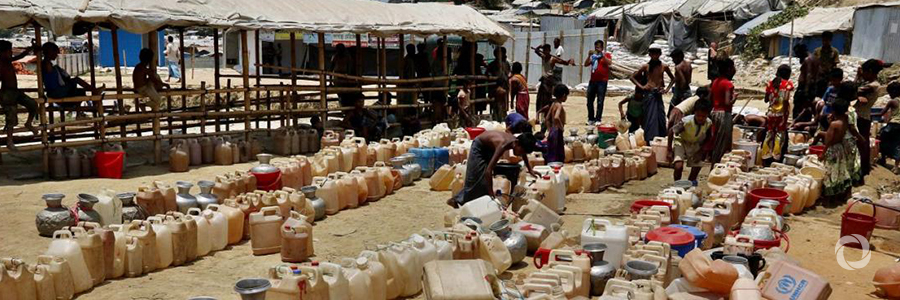
More than 900,000 Rohingya refugees live across 36 different locations in Cox’s Bazar area, in south-eastern Bangladesh. Water is scarce in most locations. It is challenging to secure adequate water sources for the whole refugee population – most of whom fled to Bangladesh in late 2017.
This is why UNHCR, the UN Refugee Agency and partners have stepped up their efforts throughout 2018 to address the massive water and sanitation needs.
At the start of the refugee influx, due to the urgency to react and provide essential services, there was insufficient planning between the many organisations working to help the Rohingya. Many tube wells were installed, but often too close to each other. This meant they could be easily contaminated by latrines nearby or from other contaminated sources.
Also, with water being pumped from 20,000 tube wells at the same time, there was a dramatic drop in water levels of the first, ground-level aquifer.
To overcome this issue and to avoid future water conflicts, a prompt decision was taken at the start of 2018 by agencies working in the water, sanitation and hygiene sector to start decommissioning shallow tube wells and start installing only deep tube wells.
The deep tube wells pump enough water for the population, was made a decision to install overhead water tanks drawing water with the help of a pump and providing water through a pipe network using multiple tap stands.
In order to run the pump, was used solar energy as the most efficient and environmentally friendly option, as well as the most cost-effective.
“At the beginning of the influx, working closely with the government, our partners and other UN agencies, we were able to provide safe drinking water to the refugees despite the large arrival numbers. If it had not been the case, we could have seen a massive outbreak of diseases in the camps. It did not happen. We continue to do so, using more efficient methods and ensuring water quality. This is our greatest achievement and it makes us proud,” said Minhaj Uddin Ahmed, Minhaj Uddin Ahmed, UNHCR assistant water, sanitation and hygiene officer in Cox’s Bazar, Bangladesh.
Original source: UNHCR
Published on 04 January 2019