
Add us as your preferred source on Google to see more of our content in Search.
 Add to Preferred Sources
Over the past decade, Haiti has been left devastated by a series of extreme weather events and natural disasters. In 2008, the country was hit by four hurricanes, killing 800 people and destroying agricultural land. Then, less than two years later, a 7.0 magnitude earthquake rocked the country’s capital. More than 220,000 people lost their lives and 1.5 million people were rendered homeless.
A combination of poor infrastructure, densely populated urban areas, and a lack of disaster preparedness has left Haiti’s 11 million-some population extremely vulnerable to the effects of natural disasters. Given the frequency of natural disasters, planning for and building resilient infrastructure is crucial for creating safer living environments and a more sustainable future for Haiti’s people.
With partners, UNOPS has been working with communities across the country to do just that, by helping to rebuild and rehabilitate key infrastructure that can better withstand the kinds of brute forces of nature that have ravaged the Small Island Developing State.
Better education
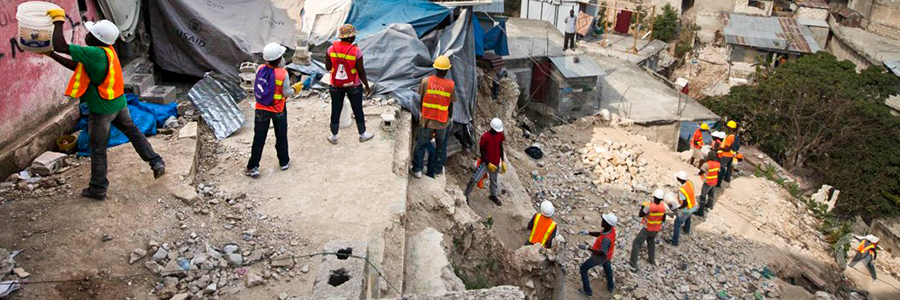
UNOPS is currently rebuilding a school and dispensary that used to be located in the heart of one of Port-au-Prince’s poorest neighborhoods, Fort National. The school, which was once attended by more than 700 students, was completely destroyed in the 2010 earthquake. While a replacement school was rebuilt nearby in another location, the old site was left empty and had become a dumping ground for rubbish, causing a range of health and social challenges for the neighboring community.
“We are working in one of the most challenging parts of the world to build infrastructure that will help empower women and give them better access to education, as well as give families access to better healthcare,” says UNOPS Project Manager, Pierre-Yves Jousseaume.
Better access
In the Departments of Grand’Anse and Sud, UNOPS recently completed a project to build and rehabilitate a series of roads damaged by Hurricane Matthew in 2016, and make them accessible during heavy rains. Funded by the International Bank of Reconstruction and Development, the project included the construction of several new roads and bridges that will improve access in places where people were forced to cross rivers to reach their homes. The works ensure surrounding communities can access important public services, such as hospitals and schools, but will also enable safer evacuations for people – if and when a natural disaster happens.
Better health
Back in Haiti’s capital Port-au-Prince, UNOPS has built three community hospitals to ease pressure on the city’s main hospital. The facilities are located in densely populated areas around the city and are built using sustainable materials designed to withstand shocks from earthquakes and hurricanes. The new hospitals already have a big impact, handling 8,000 consultations, 150 cesarean-sections and 400 hospitalizations each month.
In addition, UNOPS has procured 40 ambulances and constructed an ambulance repair garage, to help strengthen local capacity and ensure the vehicles are well-maintained. Local mechanics were provided with training. A rehabilitation centre offering physiotherapy as well as visual, auditory and speech rehabilitation was also built – the first of its kind in Haiti.
Original source: UNOPS
Published on 13 January 2019