
Add us as your preferred source on Google to see more of our content in Search.
 Add to Preferred Sources
IFAD is piloting the use of household methodologies (HHMs) for gender equality and climate change adaptation as a way to accelerate progress towards the economic empowerment of rural women in Rwanda.
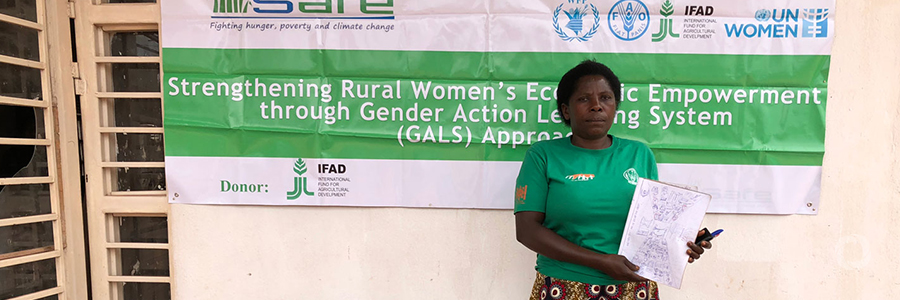
The Gender Action Learning System (GALS) is being piloted in five districts and provides a unique opportunity to improve gender equality while promoting climate-smart activities.
Men and women have diverse ways of coping and adapting to the adverse impacts of climate change. These are shaped to a high degree by gender inequalities in the country, in particular by women’s unequal access to social and economic resources. To address this climate challenges and solutions are identified that are specific to men and women, as well as solutions that they can take together.
One approach is through household methodologies (HHMs) that encourage change at the household level by challenging underlying social norms, attitudes and behaviors. In Rwanda, IFAD has been piloting the use of the Gender Action Learning System which is a specific household methodology. It uses visual materials and diagram tools to encourage people taking part to think about their current life situations and to start planning and visualising their future.
Typically, GALS is used for generating gender transformative changes and improved intra-household gender relations. As a new approach, IFAD is also piloting GALS to strengthen the mitigation measures and adaptive capacities of households and communities to climate change. It includes using traditional GALS tools with an integrated climate component. Through this method, it is possible to engage both women and men in identifying the specific climate-related challenges they face and to discover possible solutions.
The GALS pilot is part of a wider IFAD intervention under the Joint Programme Accelerating Progress towards the Economic Empowerment of Rural Women. It is a joint initiative by FAO, IFAD, WFP and UN Women with the overarching goal of securing rural women’s livelihoods and rights in order to achieve sustainable development in Ethiopia, Guatemala, Kyrgyzstan, Liberia, Nepal, Niger, and Rwanda. The programme builds on the best practices and comparative strengths of the agencies to improve the status of women in rural areas.
Original source: IFAD
Published on 10 January 2019