

Add us as your preferred source on Google to see more of our content in Search.
 Add to Preferred Sources
Global e-waste production is on track to reach 120 million tonnes per year by 2050 if current trends continue, according to a report from the Platform for Accelerating the Circular Economy (PACE) and the UN E-Waste Coalition released at Davos.
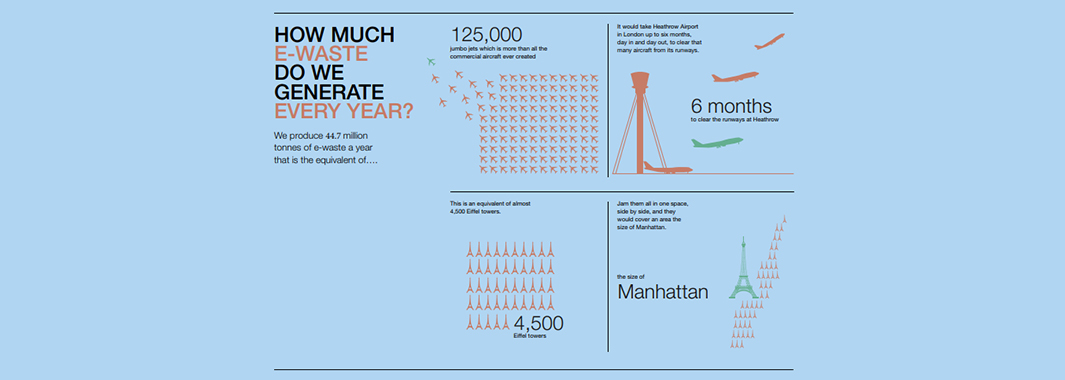
The report reveals the annual value of global e-waste as over $62.5 billion, more than the GDP of most countries. More than 44 million tonnes of electronic and electrical waste was produced globally in 2017 – over six kilograms for every person on the planet. This is equivalent in weight to all the commercial aircraft ever built.

Less than 20% of e-waste is formally recycled, with 80% either ending up in the landfill or being informally recycled – much of it by hand in developing countries, exposing workers to hazardous and carcinogenic substances such as mercury, lead and cadmium. E-waste in landfill contaminates soil and groundwater, putting food supply systems and water sources at risk.
According to the report, in addition to health and pollution impacts, improper management of e-waste is resulting in a significant loss of scarce and valuable raw materials, such as gold, platinum, cobalt and rare earth elements. As much as 7% of the world’s gold may currently be contained in e-waste, with 100 times more gold in a tonne of e-waste than in a tonne of gold ore.
In the report, members of PACE and the UN E-Waste Coalition, including UN Environment, the Global Environment Facility, the World Economic Forum and the World Business Council for Sustainable Development call for an overhaul of the current electronics system, emphasising the need for a circular economy in which resources are not extracted, used and discarded, but valued and reused in ways that minimise environmental impacts and create decent, sustainable jobs.
Solutions include durable product design, buy-back and return systems for used electronics, ‘urban mining’ to extract metals and minerals from e-waste, and the ‘dematerialisation’ of electronics by replacing outright device ownership with rental and leasing models in order to maximise product reuse and recycling opportunities.
“A circular economy brings with it tremendous environmental and economic benefits for us all,” UN Environment Acting Executive Director Joyce Msuya said.
Read and download A New Circular Vision for Global Electronics’ report.
Original source: UN Environment
Published on 24 January 2019