
Guterres in Davos: ‘Dysfunctional’ response to common problems, shows need for effective multilateralism
Add us as your preferred source on Google to see more of our content in Search.
 Add to Preferred Sources
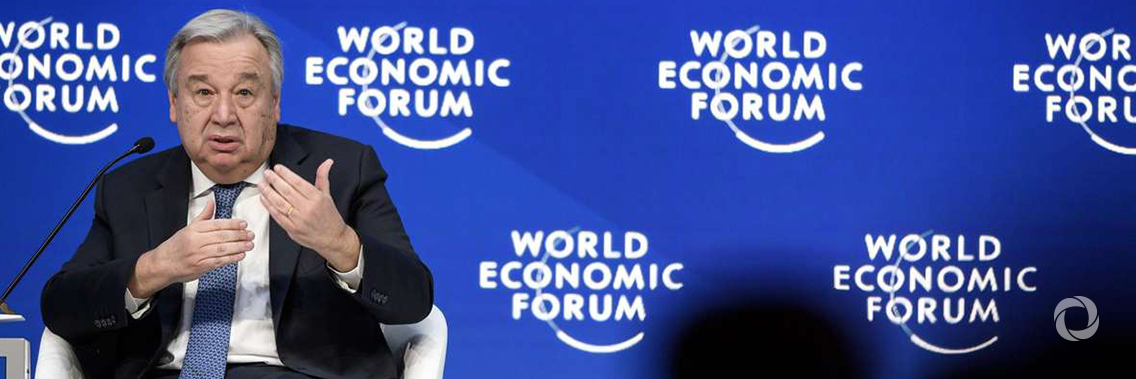
The world’s problems are “more and more integrated” but the response to them is increasingly “fragmented” and “dysfunctional”, UN Secretary-General António Guterres said in an appeal for governments and other partners to respond to people’s grievances and recommit to international cooperation.
In his “State of the World” address, delivered at the World Economic Forum (WEF) in Davos, Switzerland, Mr. Guterres gave a comprehensive assessment of current global risks and challenges, while also noting “a wind of hope” for potential conflict resolution in the Central African Republic, South Sudan, Yemen and Syria.
Much greater solidarity is needed to counter the many challenges facing the world, he insisted, highlighting the “paralysis” of the UN Security Council on certain issues, and the fact that relations between the world’s three superpowers – China, Russia and the United States – had “never been as dysfunctional” as they are today.
In light of this “multipolar” situation, and the involvement of other States such as Iran, Turkey and Saudi Arabia in the Syrian conflict, Mr. Guterres called for greater involvement in multilateral organizations, suggesting that it was an absence of these mechanisms that had led to the First World War.
“If one looks at global politics and geopolitical tensions, the global economy and megatrends including climate change, the movement of people and digitalization, the truth is that they are more and more interlinked… but the responses are fragmented,” he said, warning that “if these are not reversed, it’s a recipe for disaster”.
Climate change ‘running faster than we are’
Focusing on climate change as one of the key challenges facing the world, the UN chief insisted that “we are losing the race” to manage it.
“Climate change is running faster than we are,” he said, highlighting that even though the reality was “proving to be worse than what science has foreseen” as the world experiences ever-warmer temperatures, political will to do something about it was “slowing down”.
Economic dark clouds
Turning to the world’s economy, the UN chief noted that although global growth was “acceptable”, there were nonetheless “dark clouds on the horizon.”
These were being encouraged by trade disputes – which were “essentially a political problem”, he maintained – along with higher levels of debt than before the 2008-9 financial crisis.
Key to show ‘added value’ of UN in surge for diplomacy
Among his other priorities, the UN Secretary-General underlined his wish to show the “added value” of the United Nations.
Original source: UN News
Published on 24 January 2019