
Add us as your preferred source on Google to see more of our content in Search.
 Add to Preferred Sources
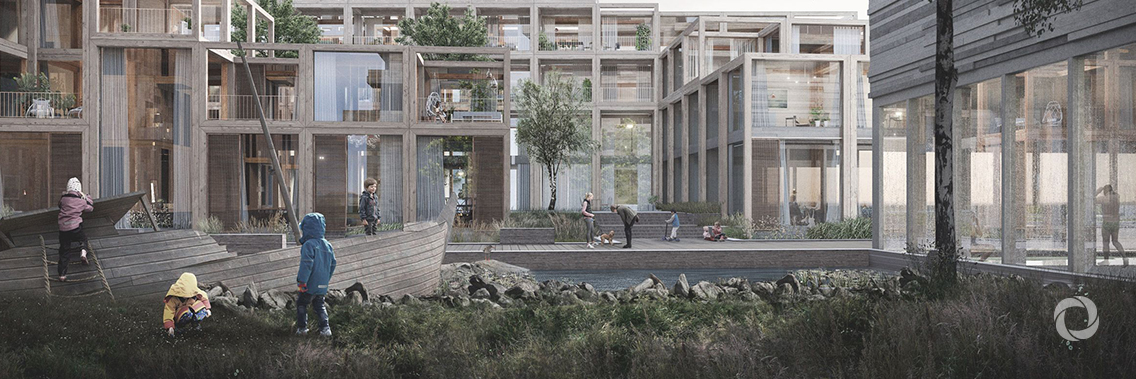
It’s a building project with towering ambitions—to use all 17 of the UN’s Global Goals as a sustainability blueprint for a 35,000-square-metre eco-village being built on the southern outskirts of Copenhagen.
Amid dire warnings about the need to rapidly rein in carbon dioxide emissions, Danish architects Lendager Group, and project partners Årstiderne Arkitekter, want their 400-home development in Ørestad South to set a new standard for sustainable construction.
“We see the Sustainable Development Goals as a global tool with a holistic approach to the world’s sustainability challenges. A tool and a language that can be understood across sectors and countries,” Lendager says in its project description for the UN17 Village development.
UN17 Village will house 830 people, including around 175 children and 100 older residents. Five housing blocks will be built using recycled concrete, wood and glass. Some of the construction materials will be sourced from Lendager UP, the branch of Lendager that provides upcycled building materials, and the company will also use various subcontractors.
Construction is due to begin at the end of 2019, or early 2020, depending on the weather, and the work is scheduled to be completed in 2023.
It seems fitting that this innovative project is going ahead in Copenhagen. The Danish capital was the 2014 European Green Capital and aims to become carbon neutral by 2025.
As well as addressing poverty, hunger, inequality and environmental degradation, the Sustainable Development Goals include specific targets to make cities and settlements “inclusive, safe, resilient and sustainable”. Lendager and its partners took this challenge to heart and their designs came out on top in a competition to select architects for the UN17 Village project.
The development will include rainwater collection facilities capable of recycling 1.5 million litres of water each year. The water will be treated and recirculated and used in the wash-house and in the bath house. Water heating will be based on geothermic energy, while solar panels will also be used. Each building will also have a rooftop garden.
There will be around 3,000 square-metres of communal spaces for residents.
“The innovations we are introducing provide solutions for a new, more inclusive and less harmful way of doing things,” Lendager says. “Sixty percent of the housing needed by 2030 globally has not yet been built. The UN17 Village shows how we can support growing populations without compromising on sustainability.”
Original source: UN Environment
Published on 05 February 2019