

Add us as your preferred source on Google to see more of our content in Search.
 Add to Preferred Sources
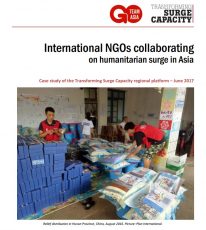
This case study traces the collaboration of seven international humanitarian NGOs in Asia as part of the DEPP’s Transforming Surge Capacity project. It identifies the enabling factors that have allowed the involved organisations to collaborate and produce an innovative inter-agency roster for Asia. It also captures what partners have learned from collaborating at a regional level.
While the frequency and complexity of humanitarian disasters have increased over the last years, funding for adequate response has not kept up, leaving humanitarian organisations competing for limited financial resources.
A 2015 report on the state of surge capacity, as well as on the Nepal earthquake, both highlighted instances of duplication and “competing for space,” a failure to maximise resources that humanitarian actors can ill afford to lose. The Transforming Surge Capacity (TSC) project was set up to improve collaboration among eleven international NGOs1 and test out more collaborative and localised approaches to surge response in humanitarian crises. The project is part of the Disasters and Emergencies Preparedness Programme (DEPP), which the Start Network has been implementing over the past three years. As such, the project fits into discussions held during the World Humanitarian Summit in May 2016, stressing the need to move away from competition between organisations towards an ecosystem of actors that complement each other.
The Transforming Surge Capacity (TSC) project was set up to improve collaboration among eleven international NGOs1 and test out more collaborative and localised approaches to surge response in humanitarian crises. The project is part of the Disasters and Emergencies Preparedness Programme (DEPP), which the Start Network has been implementing over the past three years. As such, the project fits into discussions held during the World Humanitarian Summit in May 2016, stressing the need to move away from competition between organisations towards an ecosystem of actors that complement each other.
The Transforming Surge Capacity project operates in Pakistan and the Philippines, with a regional hub led from Bangkok by Plan International, and an international platform in the UK. Its Asia Regional Platform is carrying out collaborative activities among 7 agencies, including setting up and using a regional shared roster, which allows those organisations to share a pool of qualified, deployable staff to respond to disasters. The platform also organises joint surge trainings, as well as simulations, to build the capacity of staff enrolled in the shared roster, and promotes sharing of good practice and joint learning between humanitarian organisations.
This case study outlines the journey of the regional Surge platform, how the group has managed to produce its innovative collaborative outputs, and how participating organisations benefitted from it.
Source: Relief web.
Published 12 July, 2017